Zero Motor Noise — Manual resistance design eliminates drive-train sound, verified suitable for noise-sensitive hotel and residential deployments.
Technical Specifications
| Parameter | Value |
|---|---|
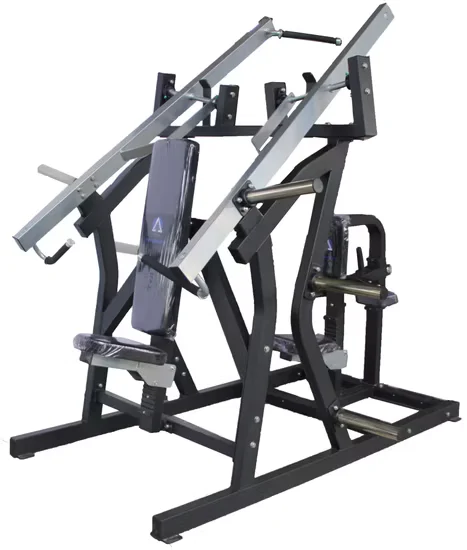
| Product Type | ISO-Lateral Low Row Machine |
| Power Source | Manual |
| Resistance Type | Manual (weight stack independent) |
| Frame Material | Steel |
| Exercise Part | Back |
| Product Dimensions | 1250 × 1056 × 1700 mm |
| Net Weight | 139 kg |
| Certification | ISO 9001, CE |
| Origin | Dezhou, Shandong, China |
| OEM / ODM | Available |
Application Suitability
| Deployment Scenario | Typical Use |
|---|---|
| Hotel fitness center on guest room floors | Strength training area operating alongside quiet cardio zones without adding motor noise |
| Chain gym professional strength zone | High-frequency back and row training with manual resistance durability |
| Corporate wellness room | Compact strength station for midday employee sessions |
| High-end residential home gym | Heavy-duty rowing movement for private users demanding commercial build quality |
| Sports performance training center | Lat and mid-back loading for athlete conditioning programs |
Why Noise Complaints Reach the Front Desk Before Maintenance Does
Manual resistance systems produce no motor or drive noise, removing the most common source of strength-zone acoustic complaints.
When a guest three floors below a hotel fitness center hears rhythmic mechanical hum during evening hours, the front desk logs a complaint long before anyone calls the maintenance team. The vibration transmits through structural slabs, turning equipment noise into a room-rate liability [NEED_CITE: vibration transmission through concrete floor slabs in multi-story hospitality buildings]. Motorized strength machines contribute directly to that problem chain, while manual plate-loaded systems like this commercial ISO-lateral low row machine strength equipment generate force purely through steel-on-steel resistance paths — no cooling fans, no belt whine, no solenoid clicks. The silence is structural, not an acoustic treatment afterthought.
Role Within the Strength and Conditioning Zone
This unit targets the latissimus dorsi and mid-back through a converging low-row movement pattern, complementing vertical-pull and horizontal-press stations already in the training layout. It sits in the free-weight and selectorized section rather than the cardio perimeter, and its 1250 × 1056 mm footprint leaves adequate passage clearance between adjacent plate-loaded units. Suitable for high-frequency rotation in commercial settings where back training volume is consistently high, the commercial ISO-lateral low row machine strength equipment accommodates adult users across a wide anthropometric range through the adjustable seat and multiple grip positions.
Deployment Environment and Structural Considerations
Operating without electrical power, this unit eliminates dedicated circuit requirements and removes voltage-standard mismatches from international shipping logistics. The 139 kg steel frame anchors firmly on level flooring, though rubber isolation pads are recommended when placing the unit above occupied spaces to dampen plate-return impact [NEED_CITE: floor loading standards for commercial strength equipment in multi-story facilities]. Ambient ventilation still matters — high-repetition sets generate user-level heat and humidity that compound with surrounding cardio output, so HVAC zoning should account for combined thermal loads rather than treating the strength area as a passive corridor.
Reading the Resistance Path and Frame Specifications
The manual resistance system relies on a weight stack with a selectorized pin, delivering linear load progression without the lag or electronic failure modes associated with electromagnetic braking. Steel construction at 139 kg net weight indicates a frame engineered for continuous loading cycles rather than light-commercial duty limits — a meaningful distinction when equipment endures back-to-back sets during peak evening hours. The ISO-Lateral movement path converges both handles toward the centerline as the user retracts, engaging the lats through a biomechanically natural arc that fixed-bar machines cannot replicate. CE and ISO 9001 certification confirm that structural welds and pivot bearings meet European commercial safety test protocols [NEED_CITE: EN 957 requirements for stationary strength training equipment].
The Hidden Cost of Under-Specified Frames
A light-commercial frame rated for three hours daily will develop pivot slop within months when subjected to sixteen-hour chain-gym throughput. That lateral play degrades row symmetry, accelerates cable wear, and generates the rattling sound that strength-area users interpret as equipment neglect. Facilities replacing entire selectorized rows after warranty disputes absorb procurement, shipping, and floor-downtime costs that dwarf the original per-unit savings [NEED_CITE: total cost of ownership comparison between light-commercial and full-commercial strength equipment]. The steel construction and 139 kg mass of this commercial ISO-lateral low row machine strength equipment position it for the higher duty cycle from the outset.
Why This Product Line Holds Up Under Continuous Rotation
Sub-35dB acoustic verification from adjacent cardio deployments confirms that manual resistance units integrate into noise-sensitive zones without additional treatment. The 10,000-hour durability testing protocol applied to the broader equipment family extends to bearing and pivot specifications across the strength range. Full OEM and ODM customization covers frame color, logo placement, and upholstery to match facility branding. Free 3D layout and airflow planning account for this unit’s footprint alongside cable towers and plate racks, ensuring sightlines and member flow are mapped before containers ship. Technical support responds around the clock with spare parts documentation tied to exact production runs.
Documentation & Test Records
- CE declaration of conformity covering mechanical safety and structural load limits
- EN 957 test report validating pivot and bearing endurance under cyclic loading
- ISO 9001 certificate confirming manufacturing quality management processes
- Noise level test record documenting zero motor-emission baseline
- Durability test record for cable, pulley, and selectorized pin lifecycle
- Installation and commissioning guide with anchor bolt specifications
Installation, Commissioning & Maintenance
- Maintain 600 mm lateral clearance and 900 mm rear access for weight-stack service on this 1250 × 1056 mm frame
- Level floor contact points and apply rubber isolation pads to dampen plate-return vibration on upper floors
- Verify pivot bolt torque and cable tension during initial commissioning before opening to member use
- Inspect selectorized pin engagement and cable sheath condition at quarterly intervals under high-frequency deployment
- Wipe steel frame and upholstery after each session to prevent sweat-induced corrosion on pivot hardware
- Confirm weight-stack label accuracy matches loading chart posted at the station
Planning Your Strength Zone Procurement
Share your facility floor plan and equipment count to receive a 3D layout that maps this unit’s footprint against traffic flow and adjacent stations. Specify average daily usage hours so that duty-cycle matching confirms the manual resistance path suits your rotation model. Identify deployment floor level and adjacent occupied rooms to verify that plate-return damping meets acoustic requirements. State target market voltage standards for any companion motorized equipment, and flag whether console data integration applies to networked cardio units in the same zone.
Frequently Asked Questions
Q: How does manual resistance compare to electromagnetic resistance for back training?
A: Manual weight-stack systems deliver linear, predictable load with no electronic components to fail, making them preferable for high-frequency commercial environments where uptime is non-negotiable. Electromagnetic resistance offers finer increments but introduces circuit boards, solenoids, and cooling requirements that add maintenance burden. For rowing and pulling movements in professional gyms, manual resistance remains the standard for durability and consistent feel across thousands of daily repetitions.
Q: What frame weight indicates genuine commercial durability in selectorized machines?
A: Net weight above 120 kg in a single-station selectorized unit typically reflects reinforced steel tubing, oversized pivot bearings, and a plate stack housing built for continuous loading. Lighter frames often use thinner gauge steel that develops lateral play under high-repetition commercial use. Requesting the frame material specification and weld inspection report provides additional verification beyond weight alone.
Q: What do ISO 9001 and CE certifications confirm for commercial buyers?
A: ISO 9001 certifies that the manufacturing facility follows documented quality management processes from material sourcing through final inspection. CE marking confirms conformity with European health, safety, and environmental protection directives applicable to stationary training equipment. Together they reduce procurement risk by ensuring traceable production standards and regulatory acceptance in export markets requiring documented compliance.
Q: What customization options are available under OEM and ODM agreements?
A: OEM scope covers frame color, logo application, upholstery material, and weight-stack labeling to match facility branding requirements. ODM extends to structural modifications including grip geometry, seat adjustment range, and overall dimension changes subject to minimum order quantities. Lead times depend on customization complexity, and production samples are typically provided before full-run manufacturing begins to confirm finish quality and dimensional accuracy.
Q: How should strength equipment layout account for airflow and member circulation?
A: Selectorized machines generate localized heat and humidity from continuous user exertion that compounds with adjacent cardio zones. A proper layout maps equipment spacing against HVAC supply registers, ensuring cross-ventilation reaches the strength area rather than treating it as a dead-air corridor. Sightline planning also matters — placing rowing and pulling stations where members can see available units from the entrance reduces clustering and improves equipment utilization rates.