
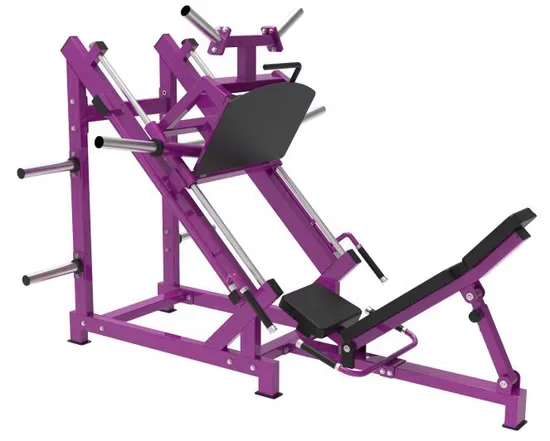
Sub-35dB verified — manual resistance eliminates motor noise entirely, enabling deployment on hotel floors directly above occupied guest rooms without acoustic complaints.
Technical Specifications
| Parameter | Value |
|---|---|
| Product Type | Linear Leg Press Machine |
| Power Source | Manual |
| Resistance Type | Manual |
| Exercise Part | Leg |
| Material | Steel |
| Product Dimensions | 2375 × 1500 × 1475 mm |
| Net Weight | 250 kg |
| Foldable | Unfolded |
| Max User Weight | 180 kg |
| Certification | ISO 9001, CE |
| Customization | Available |
Application Suitability
| Deployment Scenario | Typical Use |
|---|---|
| hotel fitness center on guest room floors | Lower-body strength training available 24 hours without disturbing adjacent rooms |
| chain gym cardio and strength zone | High-frequency leg pressing between peak-hour cardio sessions |
| corporate wellness room | Compact lower-body station complementing cardio-only layouts |
| sports performance training center | Controlled linear-path pressing for athlete rehabilitation and hypertrophy |
| high-end residential home gym | Quiet strength training in shared living environments |
Why Strength Equipment Generates Noise Complaints Before Maintenance Notices Them
Manual resistance eliminates the noise source entirely — no motor, no vibration transfer to the floor slab.
Facilities with motorized strength stations on upper floors learn quickly that structural vibration carries further than airborne sound. Guest complaints arrive at the front desk hours before maintenance logs a single service ticket, because the hum transmits through concrete slabs into occupied rooms below. [NEED_CITE: structural vibration transmission in multi-story fitness facilities]. A commercial linear leg press machine gym strength equipment built on manual resistance removes the motor from the equation entirely. The heavy-duty steel frame absorbs and distributes load through its 250 kg mass rather than transferring it downward, which changes the acoustic profile from a continuous low-frequency drone to brief, muffled contact sounds during plate loading.
Positioning This Station Within a Commercial Strength Floor
This linear leg press fills the controlled lower-body pressing role in a facility layout, complementing free-weight squat racks and hack squat machines by offering a fixed-path motion that reduces balance demands. The linear press path keeps the sled moving along a straight vertical or near-vertical track, which suits users who need consistent resistance without the stabilization requirements of free weights. It pairs naturally with seated leg curl and leg extension stations to form a complete quadriceps and hamstring circuit. The 2375 × 1500 mm footprint fits standard commercial spacing grids, and the fixed-frame design suits permanent placement against walls or in dedicated pressing bays. The 180 kg maximum user weight accommodates the vast majority of commercial gym members without requiring oversized structural components.
Floor Loading, Vibration Isolation, and Multi-Story Deployment
A 250 kg steel frame concentrates significant static load on a relatively small footprint, making floor structural capacity a prerequisite conversation before installation on upper levels. [NEED_CITE: commercial fitness equipment floor loading standards for multi-story buildings]. The manual resistance system produces no continuous vibration, which simplifies acoustic planning compared to motorized alternatives — the primary noise events are plate contact and sled travel, both of which attenuate rapidly through rubber isolation mats. Facilities deploying this commercial linear leg press machine gym strength equipment above occupied spaces should specify high-density rubber flooring rated for static loads exceeding the equipment weight plus maximum user load combined. Ground-floor installations eliminate structural concerns but still benefit from leveling and isolation pads to prevent frame rocking under heavy sled loads.
Reading the Manual Resistance and Frame Engineering Specs
The manual power source means resistance scales directly with loaded plates — there is no motor curve, no electromagnetic lag, and no resistance ceiling imposed by an internal mechanism. The 250 kg frame mass provides a stable base that resists lateral shift during heavy presses, which matters because lighter frames develop audible rattle at connection points under repeated load cycles. Steel construction throughout the load path — from the sled rails to the base cross-members — ensures consistent rigidity across the full range of motion. [NEED_CITE: structural fatigue testing standards for commercial strength equipment frames]. The linear motion path differs from angled leg press designs in that the sled travels along a straight track rather than a pivoting arc, which changes the force curve and removes the variable leverage effect present in inclined models. This engineering choice favors consistent muscle loading through the full extension.
The Hidden Cost of Specifying Below Commercial Duty Requirements
Facilities that substitute lighter-gauge frames or residential-rated components discover the consequences through progressive mechanical looseness rather than sudden failure. Connection points develop play under hundreds of daily press cycles, generating metallic knock that travels through floor structures. [NEED_CITE: fatigue failure patterns in commercial strength equipment under continuous public use]. Frames that flex under maximum user load accelerate wear on sled bearings and guide rails, eventually creating the kind of grinding noise that triggers member complaints and early replacement cycles. The initial procurement saving disappears within the first replacement window, often before the original equipment reaches its second year in a high-traffic commercial environment.
Why This Product Line Fits Demanding Facility Requirements
The steel frame construction undergoes 10,000-hour durability testing covering continuous high-frequency load cycles, which validates long-term structural integrity under commercial traffic patterns. The manual resistance design keeps operational noise well below the thresholds that trigger complaints in noise-sensitive deployments — hotel fitness floors, residential wellness rooms, and mixed-use commercial spaces all benefit from the absence of motor-driven vibration. Full OEM and ODM capability extends to frame color, pad material, and branding, allowing facility operators to maintain visual consistency across their equipment fleet. The six-series cardio family available from the same manufacturing source means a single procurement channel covers treadmills, bikes, ellipticals, rowing machines, stair climbers, and spinning bikes alongside this strength station. Free 3D layout planning accounts for this unit’s footprint, required clearance for safe plate loading, and member flow patterns around the pressing bay. 24/7 technical support ensures that any alignment or bearing service question receives a response regardless of the facility’s operating hours.
Documentation & Test Records
- CE declaration of conformity confirming European market compliance for this steel strength station
- EN 957 test report validating safety requirements for commercial linear pressing equipment
- ISO 9001 certificate covering the manufacturing quality system for frame fabrication
- Noise level test report documenting acoustic output under loaded sled operation
- Durability test record demonstrating 10,000-hour structural and bearing performance
Installation, Commissioning & Maintenance
- Confirm floor load capacity for 250 kg equipment weight plus 180 kg user load before upper-floor placement
- Position high-density rubber isolation pads beneath all four base contact points to dampen plate-load vibration
- Level the 2375 mm frame length precisely to prevent sled drift along the linear track during use
- Inspect sled guide rails and bearings at scheduled intervals for wear indicating realignment need
- Verify all frame bolted connections torque specifications after the first 500 load cycles post-installation
Planning Your Strength Zone Equipment Specification
Provide your strength area square footage and existing equipment list to receive a 3D layout plan accounting for this unit’s 2375 × 1500 mm footprint, required loading clearance, and member traffic flow. Specify the deployment floor level and adjacent occupied spaces so acoustic isolation requirements can be confirmed before shipment. Confirm your target market’s voltage standards if any motorized companion equipment is included in the same procurement cycle. Indicate whether frame color, pad upholstery, or branding customization is required so OEM scoping can proceed alongside the base quotation.
Frequently Asked Questions
Q: What maintenance does a manual linear leg press require?
A: Manual resistance eliminates motor servicing entirely, so maintenance focuses on the sled guide rails, bearings, and structural connections. Inspect the linear track surfaces for scoring at regular intervals and lubricate according to the maintenance schedule. Check all frame bolted joints for proper torque after initial break-in and periodically thereafter, as heavy pressing cycles can gradually loosen fasteners.
Q: How does linear motion differ from angled leg press in terms of joint safety?
A: The linear press path moves the sled along a straight track rather than a pivoting arc, producing a more consistent force curve throughout the full range of motion. This eliminates the variable leverage effect present in inclined designs where resistance feels lighter at certain joint angles. The fixed-path motion also removes the balance component, allowing users to focus entirely on controlled pressing without stabilization demands.
Q: Can this equipment be customized for facility branding?
A: Full OEM and ODM customization is available, covering frame powder-coat color, pad foam density, upholstery material, and brand logo placement. Console panels are not applicable on this manual strength station, but all visual surfaces can be specified to match your facility’s design language. Custom color and branding orders proceed through the same scoping process as standard configurations.
Q: What is the maximum user weight capacity?
A: The commercial-grade steel frame supports a maximum user weight of 180 kg across the tested range. This capacity accommodates the vast majority of commercial gym members and athletic users without requiring structural modifications. The 250 kg equipment weight provides a stable base that resists frame shift during heavy presses at maximum user load.
Q: How does manual resistance compare to plate-loaded systems for commercial use?
A: Manual resistance and plate-loaded systems operate on the same principle — resistance scales with added mass — but the linear sled track constrains motion to a single fixed path. This removes the stabilization demands of free-weight plate-loaded designs while preserving the direct load-to-resistance relationship. Facilities gain the simplicity and reliability of mass-based resistance with the controlled movement pattern of a guided machine.


![Hammer Strength Equipment OS-H5055 Deluxe Weight Tree for Commercial Gym Plate Storage [WARN] draft identifier mismatch](https://bicksport.com/wp-content/uploads/2026/08/hammer-strength-equipment-os-h5055-deluxe-weight-tree-for-commercial-gym-plate-storage-warn-draft-identifier-mismatch-20ff2a.webp)