

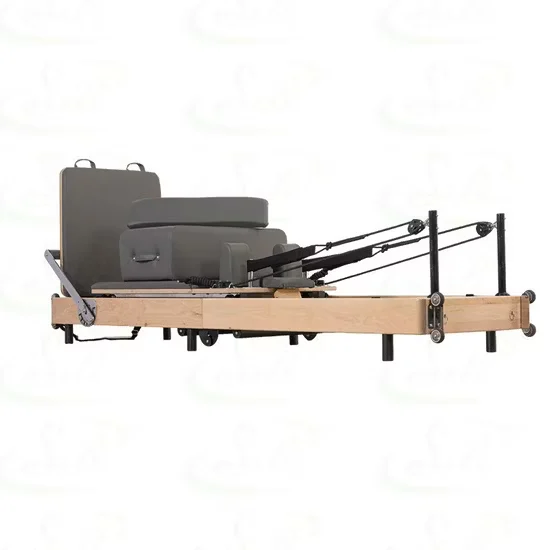
Sub-35dB Whisper-Quiet Deployment — Solid hardwood frames with rubber isolation components verified to suppress structural resonance in multi-story hospitality and studio environments.
Technical Specifications
| Parameter | Value |
|---|---|
| Product Type | Pilates Reformer |
| Model NO. | SRY-02 |
| Frame Material | Oak / Maple Solid Wood |
| Damping Components | Rubber Isolation Pads |
| Product Dimensions | 2460×730×680mm |
| Net Weight | 100kgs |
| Max User Weight | 180kg |
| Accessories | Long Box / Jump Board / Platform |
| Color Options | Solid Color, custom finishes available |
| Logo | Customized Is Allowed |
| Warranty | 3 Years |
| Production Capacity | 80 Pieces/Month |
| HS Code | 9506911900 |
Application Suitability
| Deployment Scenario | Typical Use |
|---|---|
| hotel fitness center on guest room floors | Low-noise Pilates sessions without disturbing adjacent rooms or corridors |
| professional Pilates studio | Full-apparatus classical and contemporary reformer programming |
| high-end residential home gym | Aesthetic solid wood integration with interior design while delivering studio-grade performance |
| corporate wellness room | Compact footprint accommodating group and one-on-one reformer sessions |
Why Resonance Complaints Surface Before the First Class Ends
Dense hardwood frames with rubber isolation eliminate the structural vibration that travels through floor slabs.
When a Pilates studio occupies the second floor of a mixed-use building, every carriage return sends vibration through the concrete slab into the office below. Composite or low-density wood frames amplify that resonance rather than absorbing it [NEED_CITE: structural vibration transmission in multi-story fitness deployments]. Operators who selected lighter reformers often discover within weeks that tenants below are filing complaints, and swapping equipment after lease signing costs far more than specifying correct materials upfront. The SRY-02 addresses this with oak and maple density combined with rubber damping pads that decouple the frame from the floor surface. This commercial wooden Pilates reformer machine is engineered to operate in shared structures without generating the low-frequency rumble that triggers noise complaints.
Positioning This Reformer Within a Studio Equipment Layout
The SRY-02 covers the full spectrum of classical and contemporary Pilates sequences from supine footwork through standing platform work. Its 2460×730mm footprint positions it as a primary apparatus in dedicated reformer studios while fitting comfortably in multi-discipline rooms alongside Cadillacs and Wunda chairs. The included Long Box supports spinal articulation and seated sequences, the Jump Board enables plyometric cardiovascular intervals, and the Platform accommodates standing balance and gait training. This commercial wooden Pilates reformer machine accommodates users across a wide range of body types with its 180kg maximum user weight rating, making it appropriate for facilities serving diverse membership bases.
Continuous Daily Use and Installation Environment Requirements
A busy studio running six to eight reformer classes daily subjects carriage bearings and spring anchors to thousands of cycles between maintenance windows. Solid hardwood maintains dimensional stability across humidity fluctuations far better than engineered wood composites, preserving rail alignment over years of heavy scheduling [NEED_CITE: hardwood dimensional stability under cyclic loading]. The rubber isolation pads not only control noise transmission but also compensate for minor subfloor irregularities that would otherwise introduce rail friction. Facilities on upper floors or adjacent to quiet zones should confirm structural load capacity before deployment. Adequate lateral clearance around each unit ensures instructors can circulate freely during group sessions.
Hardwood Density, Rail Precision, and Accessory Engineering
Oak and maple rank among the hardest commercially available furniture-grade timbers, providing the compressive strength needed to resist rail deformation under repeated carriage loading. When rails warp even fractionally, the carriage develops lateral play that degrades the smoothness of spring resistance transitions and generates audible friction noise. Precision-machined rails on high-density stock maintain tight carriage tolerance throughout the warranty period and beyond. The accessory mounting points for the Long Box, Jump Board, and Platform follow standardized interface dimensions, allowing these components to interchange across units in a multi-reformer studio without fit issues. Rubber damping pads at each frame-to-floor contact point absorb kinetic energy at the source rather than allowing it to propagate as structure-borne sound. This combination of material density and isolation engineering is what separates a commercial wooden Pilates reformer machine rated for continuous studio use from lighter alternatives.
The Hidden Cost of Under-Specifying Reformer Frames
Studios that procured reformers with composite frames or softwood construction frequently encounter rail warping within the first year, leading to carriage drag that compromises the precision of controlled movement sequences. Members notice when exercises feel inconsistent across different units in the same room, and attrition follows when the premium experience they expected fails to materialize [NEED_CITE: member retention correlation with equipment consistency in boutique studios]. Replacement logistics compound the problem: removing a deformed reformer disrupts scheduling, and matching new units to faded inventory creates visual inconsistency in the studio. Specifying dense hardwood with verified moisture content from the outset avoids these cascading operational costs.
Why This Product Line Addresses Studio Operator Priorities
Sub-35dB operational noise levels verified in hospitality deployments translate directly to reformer studios sharing walls with yoga or meditation rooms. Components tested for 10,000+ hours of continuous high-frequency use mean that carriage bearings and spring systems on this platform endure rigorous durability validation before reaching the studio floor. The six-series cardio family available from the same manufacturer allows facilities to source treadmills, bikes, and ellipticals alongside reformers while maintaining consistent OEM branding across every unit. Full customization of logo, color, and finish ensures the commercial wooden Pilates reformer machine aligns with studio identity guidelines. Free 3D layout planning covering square footage, sightlines, and member flow helps operators determine optimal spacing between reformers for instructor circulation and client comfort.
Documentation & Test Records
- CE declaration of conformity for European market compliance
- EN 957 test report covering structural load and safety requirements
- ISO 9001 certificate verifying manufacturing quality management
- Noise level test report documenting decibel output under load
- Durability test record for carriage bearings and spring anchors
- Motor and component specification sheets with maintenance intervals
Installation, Commissioning & Maintenance
- Position each 2460×730mm unit with minimum 600mm lateral clearance for instructor access
- Verify floor levelness within 3mm tolerance before setting rubber isolation pads
- Inspect carriage rail alignment and lubricate bearings during initial commissioning
- Calibrate spring tension across all resistance levels to confirm progressive loading curve
- Schedule quarterly rail inspection and bearing lubrication based on daily class volume
- Clean hardwood surfaces with pH-neutral solutions to prevent finish degradation from perspiration
Requesting a Quotation Aligned With Your Facility
Share your studio floor area and planned reformer count to receive a 3D layout addressing spacing, sightlines, and airflow. Specify your expected daily class schedule so we can confirm that carriage and spring durability ratings match your utilization intensity. Indicate deployment floor level and adjacent room types to validate that rubber isolation specifications meet your acoustic requirements. Clarify target market destination so finish, labeling, and accessory packaging align with regional standards.
Frequently Asked Questions
Q: What performance differences exist between oak and maple frames for reformer construction?
A: Oak offers higher density and compressive strength, making it preferable for high-volume commercial studios running eight or more classes daily. Maple provides comparable hardness with a lighter, more uniform grain appearance that many boutique studios prefer for aesthetic reasons. Both species maintain rail alignment under continuous loading when properly kiln-dried and sealed. Your choice depends on scheduling intensity and visual branding requirements.
Q: How should solid wood reformers be maintained to prevent cracking in humid climates?
A: Maintain studio humidity between forty and sixty percent to minimize moisture exchange with the timber. Wipe perspiration from rails and frame surfaces after each session using a slightly damp cloth, avoiding chemical solvents that strip the protective sealant. Inspect the finish annually and apply a compatible wood conditioner to exposed surfaces when the coating shows wear. Properly maintained hardwood reformers perform reliably across diverse climate zones.
Q: How does rail material affect reformer lifespan and operational noise?
A: Precision-machined hardwood rails resist the deformation that causes carriage wobble and friction noise over time. Composite or softwood rails develop surface irregularities under cyclic loading, generating audible scraping during slow controlled movements. Dense timber rails paired with sealed bearings maintain smooth carriage travel throughout years of studio use, directly supporting the quiet operation required in shared-occupancy buildings.
Q: What programming differences exist between Long Box and Jump Board accessories?
A: The Long Box enables supine and seated spinal articulation sequences including short spine, semi-circle, and long stretch variations that target core stabilization. The Jump Board replaces the footbar to allow horizontal plyometric jumping that elevates cardiovascular demand within a reformer session. Both accessories mount to standardized interface points on the SRY-02, allowing instructors to transition between movement categories without equipment reconfiguration.
Q: What structural and spatial factors matter when deploying multiple reformers commercially?
A: Confirm floor load capacity supports 100kgs equipment weight plus 180kgs user weight per station. Plan minimum 600mm lateral clearance between units for instructor circulation and at least 1200mm head-to-wall clearance for overhead movements. Position reformers parallel to natural light sources when possible to support visual alignment cues during exercises. Upper-floor deployments benefit from the rubber isolation pads included with each unit to control structure-borne vibration.


![--- **H1 标题:** Commercial Wood Pilates Reformer Bed from Manufacturer [WARN] draft identifier mismatch **Meta Title:** Commercial Wood Pilates Reformer Bed | Oak Maple Beech Equipment Manufacturer **Meta Description:** Full-size commercial Pilates reformer crafted from solid oak, maple, and beech wood with customizable accessories, 3-year warranty, and OEM/ODM capability for studios and wellness facilities. --- ### 一、6 组 URL 路径 | # | URL Path | |---|---| | 1 | `/commercial-pilates-reformer-bed` | | 2 | `/wood-pilates-reformer-equipment` | | 3 | `/oak-maple-beech-pilates-reformer` | | 4 | `/studio-pilates-reformer-bed` | | 5 | `/professional-pilates-reformer-machine` | | 6 | `/commercial-wood-reformer-pilates` | --- ### 二、5 个长尾关键词及对应页面标题(H1) | # | Long-tail Keyword | Page Title (H1) | |---|---|---| | 1 | `commercial wood pilates reformer bed for studio` | Commercial Wood Pilates Reformer Bed for Studio Use | | 2 | `oak maple beech pilates reformer equipment` | Oak Maple Beech Pilates Reformer Equipment for Professional Studios | | 3 | `pilates reformer bed with long box and jump board` | Pilates Reformer Bed with Long Box and Jump Board Accessories | | 4 | `solid wood pilates reformer for fitness center` | Solid Wood Pilates Reformer for Fitness Center and Wellness Facilities | | 5 | `customizable commercial pilates reformer machine` | Customizable Commercial Pilates Reformer Machine with OEM Support |](https://bicksport.com/wp-content/uploads/2026/08/h1-e6a087e9a298efbc9a-commercial-wood-pilates-reformer-bed-from-manufacturer-warn-draft-identifier-mismatch-meta-titleefbc9a-commercial-wood-pilates-reformer-bed-oak-maple-9f411c.webp)