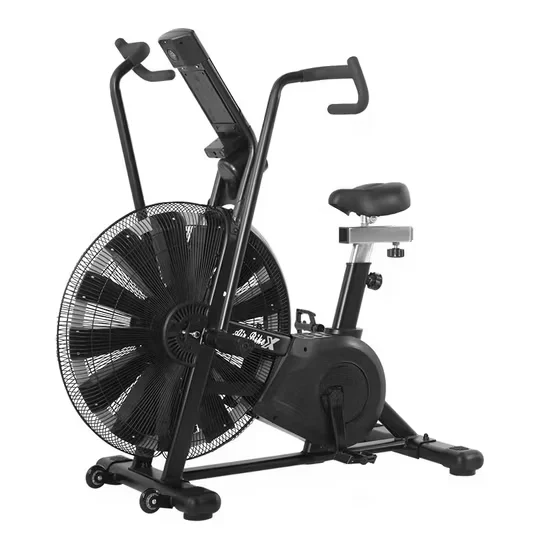
Infinite Duty Cycles — Air resistance eliminates motor thermal limits, enabling continuous high-intensity operation across commercial deployments without shutdown risk.
Technical Specifications
| Parameter | Value |
|---|---|
| Product Type | Air Bike |
| Resistance Type | Power-Style Resistance Adjustment (air) |
| Fan Size | 27-Inch Steel Fan Blades |
| Max User Weight | 150kg |
| Console Type | High-Definition Screen |
| Product Dimensions | 1300380880mm |
| Net Weight | 58kg |
| Foldable | No (Unfolded) |
| Certification | CE, GS, RoHS, FCC |
| Age Group | Adult |
| Condition | New |
Application Suitability
| Deployment Scenario | Typical Use |
|---|---|
| hotel fitness center on guest room floors | 24-hour self-service cardio with noise-sensitive environment requirements |
| chain gym cardio zone | High-frequency HIIT programming with member app data integration |
| corporate wellness room | Shared low-maintenance cardio for diverse fitness levels across employee groups |
| high-end residential home gym | Durable full-body conditioning for private use without motor burnout concerns |
| sports performance training center | Athlete-grade interval conditioning with biometric data capture |
Why Fan Noise Complaints Reach the Front Desk Before Maintenance Does
Air resistance removes the motor entirely, eliminating the primary source of continuous noise and thermal failure in commercial cardio zones.
Facility managers deploying HIIT zones in hotels or residential towers face a difficult trade-off. Belt-driven and magnetic systems handle steady-state work quietly, yet under repeated sprint intervals, their motors heat up and eventually fail mid-cycle. Air bikes generate substantial fan noise at peak RPM, which travels through floor slabs and partition walls into adjacent guest rooms [NEED_CITE: acoustic transmission standards for fitness equipment on suspended floors]. Choosing the right commercial air bike fan bike gym equipment means verifying noise behavior across the full RPM range, not just at idle. I have seen hotel deployments where entire cardio fleets were replaced after repeated guest complaints during late-night interval sessions.
Full-Body Interval Work and Cardio Zone Positioning
This unit delivers simultaneous upper and lower body engagement through linked arm levers and pedal cranks, producing a total-body metabolic demand that complements steady-state treadmills and ellipticals in a mixed cardio zone. The air resistance curve scales linearly with user effort, meaning a beginner and an advanced athlete can share the same commercial air bike fan bike gym equipment without manual adjustments. It occupies a compact footprint suited to corridor-style cardio rows or open HIIT bays, and accommodates users across a broad weight and height range up to 150kg. The HD console captures wattage, cadence, heart rate, and elapsed distance for session-level analytics.
Thermal Load and Deployment Environment Compatibility
Air-driven resistance produces no motor heat, which shifts the thermal management burden entirely to room ventilation and ambient airflow rather than internal cooling systems. In hotel fitness centers on upper floors, the fan itself provides localized air circulation for the rider, though at higher RPM the acoustic output requires assessment against adjacent occupied spaces [NEED_CITE: noise propagation testing for cardio equipment in mixed-use hospitality buildings]. The unfolded steel frame requires a level, rigid floor surface with vibration-dampening pads beneath the stabilizer feet to prevent resonance transfer to the structure below. Facilities should verify that the dedicated electrical circuit matches local voltage and plug standards before the unit is positioned, as voltage mismatch discovered after installation forces costly rewiring or transformer additions.
Air Drive Mechanics and Resistance Curve Behavior
The 27-inch steel fan blade assembly generates resistance proportional to pedal cadence, meaning the harder a rider pushes, the greater the opposing force becomes — a self-regulating intensity curve that eliminates the need for manual resistance adjustments or magnetic calibration. Unlike magnetic systems where resistance steps can feel abrupt during rapid transitions, air resistance delivers a continuous progressive load that smooths out interval shifts. The sealed bearings supporting the fan axle are rated for sustained high-frequency rotation, reducing maintenance intervals compared to open-bearing assemblies found in lighter-duty equipment. The HD console connects via IoT protocols to facility management dashboards, allowing operators to track usage patterns, peak RPM sessions, and equipment utilization rates without relying on manual logbooks. Heart rate data streams through the integrated sensor, providing real-time feedback for interval programming.
The Hidden Cost of Underspecified Commercial Cardio
Selecting light-commercial equipment for high-frequency facilities creates a cascade of operational failures. Motors rated for intermittent duty shut down during peak afternoon HIIT classes, leaving members mid-workout and generating negative reviews. Fan assemblies with unbalanced blades develop harmonic resonance that transmits through floor structures, triggering noise complaints from neighboring tenants [NEED_CITE: vibration transfer thresholds for commercial cardio on suspended floor assemblies]. Consoles lacking data integration capabilities strand usage metrics in isolated displays, preventing operators from tracking equipment utilization or planning preventive maintenance schedules. I recall a deployment where an entire batch of underspecified units required replacement within the first year because their drive systems could not sustain the duty cycles demanded by a 24-hour gym environment.
Why This Air Resistance Lineup Fits Commercial Deployments
Air resistance eliminates motor thermal limits entirely, which aligns with our 10,000-hour continuous operation testing protocol across motors, frames, and bearing assemblies. The HD IoT console integrates with facility management systems, ensuring usage data flows directly to operator dashboards rather than remaining trapped on isolated screens. For hotels requiring noise-sensitive deployments, we provide acoustic test documentation covering the full RPM spectrum so buyers can verify compatibility with their specific floor and partition configurations. Our 3D cardio zone layout service maps this unit’s footprint and spacing requirements alongside complementary cardio machines, optimizing member flow and sightlines. Full OEM customization extends to console UI branding, and 24/7 technical support covers post-commissioning troubleshooting across time zones.
Documentation & Test Records
- CE declaration of conformity covering air bike mechanical and electrical safety requirements
- EN 957 test report validating structural integrity under cyclic loading
- ISO 9001 certificate documenting quality management across production stages
- Noise level test report measuring acoustic output across RPM ranges
- Durability test record covering 10,000-hour bearing and frame fatigue cycles
- HD console technical documentation with API specifications for data integration
Installation, Commissioning & Maintenance
- Position with minimum clearance on all sides based on 1300380880mm dimensions and arm lever sweep arc
- Level stabilizer feet on rigid flooring with vibration-dampening pads to isolate fan resonance from structure
- Verify dedicated circuit voltage and plug standard match local supply before powering the HD console
- Calibrate console sensors and confirm IoT connectivity to facility management platform during initial commissioning
- Inspect sealed bearing assemblies and fan blade balance at scheduled intervals per maintenance documentation
- Wipe steel fan blades and frame surfaces with non-corrosive cleaner to prevent sweat-induced oxidation
Planning Your Cardio Zone Deployment
Share your facility floor plan and target equipment count to receive a 3D cardio zone layout covering spacing, airflow pathways, and member traffic flow. Specify daily operating hours and expected session intensity so we can confirm the air resistance system matches your duty cycle requirements. Identify deployment floor level and adjacent occupied spaces to align acoustic expectations with test report data. Confirm target market voltage and plug standards to prevent compatibility issues at delivery, and indicate whether console data integration with your existing management platform is required.
Frequently Asked Questions
Q: How does air resistance compare to magnetic systems in high-frequency commercial environments?
A: Air resistance scales with user effort and produces no motor heat, making it suitable for repeated sprint intervals without thermal shutdown. Magnetic systems offer quieter operation at steady state but can struggle with rapid resistance transitions during HIIT programming. The choice depends on your facility’s session mix and noise tolerance thresholds for adjacent spaces.
Q: What data does the HD console capture and can it integrate with our management system?
A: The console records wattage, cadence, heart rate, distance, and elapsed time during each session. IoT connectivity enables data export to facility dashboards and member apps. Before ordering, request the console API documentation to verify compatibility with your specific gym management platform and data reporting requirements.
Q: How do we confirm noise levels will not disturb hotel guests or residential neighbors?
A: Request the noise level test report covering acoustic output across the full RPM spectrum, not just idle operation. Compare measured values against your building’s acoustic partition ratings and floor construction. For deployments above occupied rooms, vibration-dampening pads beneath the frame reduce structural resonance transfer significantly.
Q: What maintenance do the steel fan blades and sealed bearings require over extended operation?
A: Sealed bearings are designed for prolonged high-frequency rotation with minimal intervention. Fan blades should be inspected periodically for dust accumulation and balance integrity. Cleaning with non-corrosive solutions prevents oxidation from sweat exposure. Detailed service intervals are documented in the commissioning guide provided with each unit.