

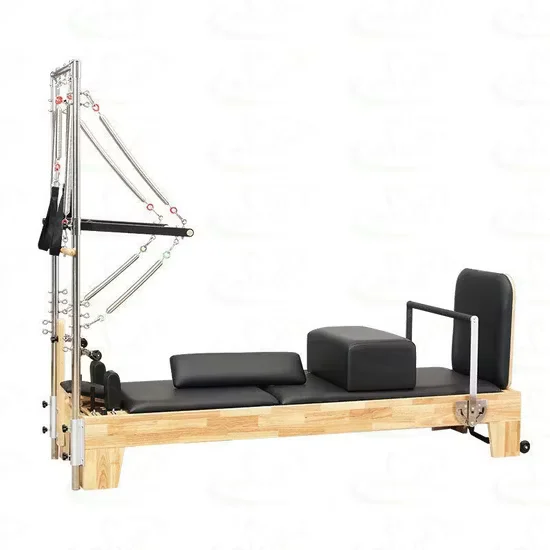
Acoustic Precision & Structural Integrity — Solid white maple frame engineered to maintain silent glide performance under continuous studio deployment, eliminating the vibration resonance common in composite wood alternatives.
Technical Specifications
| Parameter | Value |
|---|---|
| Product Type | Pilates Reformer |
| Model NO. | SRY-02 |
| Frame Material | White Maple Wood |
| Dimensions | 2460730680mm |
| Net Weight | 100kgs |
| Included Accessories | Long Box / Jump Board / Platform |
| Color Options | Solid Color (Customization Available) |
| Logo | Customized Is Allowed |
| Target Demographic | Adult / Unisex |
| Warranty | 3 Years |
| Production Capacity | 80 Pieces/Month |
Application Suitability
| Deployment Scenario | Typical Use |
|---|---|
| Pilates studio | Group and private reformer classes requiring consistent carriage resistance and silent operation |
| Boutique fitness center | High-frequency circuit training with rapid equipment turnover between sessions |
| Rehabilitation center | Controlled resistance exercises for post-injury recovery and joint mobilization protocols |
| Home gym | Dedicated personal training space demanding furniture-grade aesthetics and floor protection |
Why Studio Operators Discover Carriage Noise After the First Month of Classes
The carriage decibel level during transitions defines whether instructors must raise their voices over equipment friction.
When white maple wood reformer pilates equipment commercial studios deploy sees hundreds of carriage cycles daily, the interaction between wheels and rails determines whether the environment remains focused or becomes a source of member distraction. [NEED_CITE: acoustic standards for group fitness environments]. Instructors teaching back-to-back classes notice which reformers develop rhythmic squeaks or lateral wobble first, and those units get relegated to the back corner. The frame material and rail machining tolerances determine whether a reformer maintains its acoustic profile through thousands of spring changes and carriage transitions, or whether maintenance tickets accumulate faster than the schedule allows.
Positioning the Reformer Within a Mixed-Modality Studio Layout
This unit occupies the core training position in dedicated reformer studios where class capacity depends on uniform equipment spacing and consistent resistance feel across all stations. The 2460mm length accommodates the full range of supine, prone, and standing exercises while maintaining adequate clearance between adjacent units for instructor circulation. For facilities combining reformer work with mat-based apparatus, this model pairs with tower attachments or chair units to create progressive programming without requiring members to transition between rooms. The 100kg net weight provides sufficient mass to prevent drift during dynamic jump board sequences, though floor anchoring remains advisable in high-traffic zones. Users ranging from rehabilitation clients to advanced athletes access the same frame, relying on spring tension adjustments rather than structural modifications.
Daily Utilization Cycles and Environmental Considerations for Deployment
Studios running four to six group classes daily place distinct demands on carriage wheels and spring anchors that home-use equipment never encounters. [NEED_CITE: commercial equipment duty cycle classification for fitness studios]. The solid maple frame responds to ambient humidity shifts, requiring climate-controlled environments to prevent wood expansion that could affect rail alignment over seasons. Facilities on upper floors must consider vibration transmission to spaces below, particularly during jump board protocols where repetitive impact loads transfer through the frame to the subfloor. Rubber isolation pads beneath the feet address both acoustic transfer and surface protection without compromising stability. Adequate spacing for instructor sightlines demands the full 2460mm footprint plus clearance on all sides for safe spotting during standing exercises.
Decoding the Frame Material and Accessory Configuration Choices
White maple delivers density and grain consistency that composite woods cannot replicate under repeated load cycles, maintaining dimensional stability where particle board would delaminate at fastener points. The long box attachment extends the carriage surface for supine exercises requiring full torso support, while the jump board converts the foot bar end into a plyometric training station. Platform extensions provide the standing surface needed for upright balance work that traditional reformer configurations lack. Each accessory interfaces with the base frame through standardized mounting points, meaning replacements or additions do not require custom fabrication. The 100kg frame weight reflects solid timber construction rather than hollow-core assembly, translating to reduced resonance during dynamic movements and extended service life under continuous booking schedules.
The Operational Cost When Equipment Specifications Are Compromised
Studios that source reformers based on initial purchase price rather than frame density frequently encounter carriage misalignment within the first year of commercial operation. [NEED_CITE: common failure modes in commercial Pilates equipment]. Wheels that lack precision bearings develop flat spots, creating rhythmic thumping that instructors and members both notice during quiet concentration phases. Spring anchors that work loose from low-density frame materials require weekly tightening protocols that consume staff hours and interrupt class schedules. When the carriage develops lateral play, advanced exercises requiring unilateral stability become unsafe, forcing instructors to modify programming and limiting the class offerings the studio can market. Facilities that cycle through multiple equipment suppliers before finding durable construction lose member confidence alongside capital expenditure.
Why This Production Line Serves Commercial Studio Requirements
The 80-unit monthly production capacity supports facility build-outs where multiple reformers must arrive with matching specifications and finish quality, preventing the visual inconsistency that occurs when units are sourced from different batches. The three-year warranty reflects confidence in frame integrity and component durability under continuous booking loads, reducing the operator’s risk of premature replacement costs. OEM customization for branding allows studio chains to maintain visual identity across locations without sacrificing structural specification. The solid color finish options coordinate with interior design schemes while the maple substrate provides the load-bearing performance that veneered alternatives cannot sustain. Documentation packages include assembly guidance that accounts for commercial installation scenarios rather than assuming single-unit home delivery.
Documentation & Test Records
- Frame load testing verification for commercial user weight ranges
- Carriage cycle durability records demonstrating performance under repeated use
- Material certification confirming solid maple construction standards
- Accessory compatibility testing for long box and jump board attachments
- Assembly and calibration documentation for studio installation teams
- Warranty terms covering frame integrity and component service life
Installation, Commissioning & Maintenance
- Position on level subfloor with adequate clearance for full carriage travel and instructor access
- Install vibration isolation pads beneath all contact points in upper-floor studio deployments
- Verify carriage wheel alignment and rail lubrication before first class scheduling
- Calibrate spring tension anchors to manufacturer specifications for consistent resistance feel
- Inspect wheel bearings and rail surfaces quarterly under high-frequency class schedules
- Clean maple frame with wood-appropriate products that protect against sweat and humidity exposure
Equipment Selection Process for Studio Build-Outs
Facility operators planning reformer rooms should provide studio dimensions and target class capacity to receive spacing recommendations that account for instructor circulation and emergency access requirements. Specifying the expected daily class frequency helps determine whether the standard production lead time accommodates the deployment schedule or whether advance ordering is necessary. Confirming the target market’s electrical requirements for any adjacent electronic equipment ensures compatibility with the manual resistance system this platform provides. Facilities requiring custom branding or specific finish colors should initiate those conversations during the layout planning phase to coordinate production timelines with build-out completion.
Frequently Asked Questions
Q: What distinguishes solid white maple from other wood options for commercial reformer frames?
A: White maple provides the density and grain uniformity necessary for maintaining rail alignment under thousands of carriage cycles. Unlike composite materials that delaminate at fastener points, solid maple allows hardware to be retightened without stripping the substrate. The acoustic properties also differ, with solid wood dampening vibration rather than amplifying it through hollow construction.
Q: How does this equipment perform under high-frequency commercial scheduling?
A: The frame and carriage system are engineered for studio environments running multiple classes daily without requiring rest periods between sessions. Production capacity of 80 units monthly indicates manufacturing processes designed for volume consistency. The three-year warranty covers the frame integrity through sustained commercial use patterns.
Q: What role do the included accessories play in expanding training variety?
A: The long box extends the carriage for full-torso exercises, the jump board enables plyometric protocols, and the platform provides standing exercise capability. These attachments integrate with the base frame through standardized mounting systems, allowing instructors to modify class programming without requiring additional equipment purchases or floor space allocation.
Q: What is involved in customizing logo placement and color options?
A: Customization requests are processed during the order confirmation stage, allowing coordination with studio branding guidelines before production begins. The customization process accommodates facility chains requiring visual consistency across multiple locations while maintaining the structural specifications of the base platform. Lead times should be confirmed during layout planning.
Q: What maintenance protocols preserve performance in studio environments?
A: Regular inspection of carriage wheels and rail surfaces prevents debris accumulation that affects glide performance. Spring anchors should be checked for secure fastening according to the maintenance schedule provided with documentation. Frame cleaning protocols must account for both sweat exposure and ambient humidity to preserve the maple finish and dimensional stability over time.
![Custom Hot Sale EVA Foam Yoga Block with Soft Non-Slip Surface for Studio Use [WARN] draft identifier mismatch](https://bicksport.com/wp-content/uploads/2026/08/custom-hot-sale-eva-foam-yoga-block-with-soft-non-slip-surface-for-studio-use-warn-draft-identifier-mismatch-0542c9.webp)
![Sry-22 Yoga Sports Home Pilates Wood Portable Folding Yoga Chair Bench for Studio [WARN] draft identifier mismatch](https://bicksport.com/wp-content/uploads/2026/08/sry-22-yoga-sports-home-pilates-wood-portable-folding-yoga-chair-bench-for-studio-warn-draft-identifier-mismatch-fefab1.webp)
