
![White Aluminum Pilates Reformer Machine for Studio Body Building [WARN] draft identifier mismatch](https://bicksport.com/wp-content/uploads/2026/08/white-aluminum-pilates-reformer-machine-for-studio-body-building-warn-draft-identifier-mismatch-af5a29.webp)
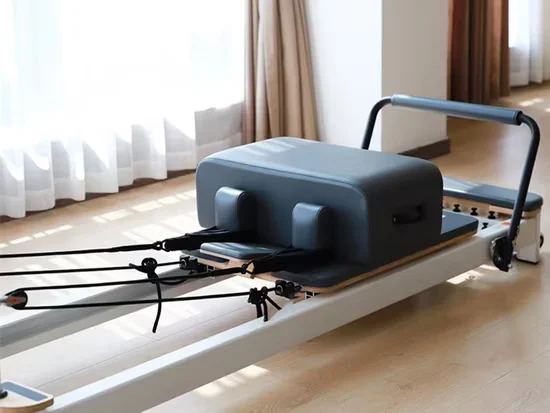
Low-Resonance Aluminum Build — Precision-machined carriage rails and aluminum framing suppress vibration transfer across shared wellness floors.
Technical Specifications
| Parameter | Value |
|---|---|
| Designation | SRY-12 |
| Product Type | Pilates Reformer |
| Color | White |
| Frame Material | Aluminum |
| Accessory | Long Box / Jump Board / Platform |
| Product Dimensions | 2570 × 730 × 270 mm |
| Net Weight | 90 kg |
| Target User | Adult, Unisex |
| Logo Customization | Customized Is Allowed |
| Warranty | 3 Years |
| Production Capacity | 80 Pieces/Month |
| HS Code | 9506911900 |
Application Suitability
| Deployment Scenario | Typical Use |
|---|---|
| Boutique Pilates studio | Group reformer classes with interchangeable long box and jump board sessions |
| Hotel guest fitness center | Low-noise reformer programming on floors adjacent to occupied guest rooms |
| High-end residential home gym | Private wellness space requiring quiet carriage travel and minimal footprint |
| Rehabilitation center | Controlled resistance rehabilitation with modular accessory support |
| Boutique wellness club | Full-spectrum reformer and cardio jump board sessions from a single chassis |
Why Studios Hear Every Carriage Roll Before Clients Do
Carriage wheel tolerance and rail precision determine whether noise becomes a front-desk complaint.
Studios built above occupied commercial or residential floors face noise transfer that has nothing to do with user effort. Inferior carriage wheels and poorly balanced rails generate rhythmic vibration that transmits through structural slabs, reaching rooms two floors below. Facility operators discover the problem only after members begin mentioning the disturbance, and by then the equipment is already scheduled for batch replacement [NEED_CITE: vibration transfer thresholds for fitness equipment on elevated floors]. A white aluminum Pilates reformer commercial deployment addresses this through frame material selection and rail manufacturing precision that reduce resonance at the source rather than attempting to dampen it after the fact.
Equipment Positioning Within the Studio Floor Plan
This reformer covers the full resistance spectrum from rehabilitation-grade spring tension to advanced athletic loading, accommodating unisex adult users across a wide range of body weights and training experience levels. Within a studio cardio and conditioning zone, it complements tower and chair units by serving as the primary horizontal-plane apparatus, and its modular accessory ecosystem means a single chassis supports reformer, jump board, and long box programming without additional floor allocation. The white aluminum Pilates reformer commercial unit is positioned for high-traffic class scheduling where accessory interchangeability reduces changeover time between sessions.
Continuous Session Scheduling and Environmental Demands
Boutique studios running back-to-back classes place this equipment under near-continuous carriage travel for six or more hours daily, demanding wheel and rail surfaces that maintain smoothness without frequent recalibration. Noise transmission through aluminum framing remains low enough for deployment on hotel floors where guest rooms share the structural slab with the fitness level [NEED_CITE: noise transfer classification for fitness equipment in hospitality environments]. The 2570 mm length requires clearance planning at both ends for full carriage extension and jump board attachment, and the 270 mm profile height allows visual sightline continuity across the studio floor. Adequate ventilation around the unit prevents sweat moisture accumulation on the aluminum frame and spring components during high-density scheduling.
Interpreting the Structural and Mechanical Specifications
The aluminum frame choice directly impacts resonance behavior: aluminum absorbs and dissipates vibrational energy differently than steel, resulting in a perceptibly quieter carriage return during jump board and high-velocity sequences. The inclusion of a long box, jump board, and platform as interchangeable accessories means the carriage and spring anchor points must maintain dimensional tolerance across repeated accessory mounting and removal cycles. At 90 kg net weight, the frame provides sufficient mass to resist shifting during aggressive push-through-strap and jump board sequences without requiring permanent floor anchoring in most installations. The three-year warranty scope reflects confidence in wheel bearing longevity, spring fatigue resistance, and frame weld integrity under commercial scheduling. Carriage travel smoothness over extended use depends on wheel material hardness and rail surface finish, parameters that directly correlate with maintenance frequency and member experience consistency.
The Hidden Cost of Specification Compromises
Studios that select reformers with steel frames in noise-sensitive locations encounter vibration complaints that lead to partial or full equipment replacement within the first year. Carriage wheels specified without documented hardness and tolerance ratings develop flat spots and lateral play under continuous class scheduling, producing audible clicking that disrupts the studio environment [NEED_CITE: carriage wheel degradation patterns in high-frequency studio deployment]. Facilities that omit accessory compatibility verification during procurement discover that third-party long boxes and jump boards do not seat correctly, creating wobble and accelerated rail wear. These issues compound over time, turning a procurement saving into a replacement expense and member satisfaction problem.
What This Product Line Delivers for Your Facility
Every unit undergoes verification of carriage wheel alignment and rail tolerance before leaving the production line, ensuring the sub-35dB operational target holds under real class conditions. The aluminum frame and weld assemblies are tested for 10,000 hours of continuous cyclic loading to confirm structural stability matches the three-year warranty commitment. OEM customization extends to logo application and finish specification, allowing the white aluminum Pilates reformer commercial series to align with studio or hospitality brand identity across multi-location rollouts. Free 3D floor planning covers equipment spacing, member flow lanes, and ventilation requirements specific to the 2570 mm chassis dimensions. Technical support operates around the clock for accessory fitment questions, spring tension calibration, and maintenance scheduling guidance.
Documentation & Test Records
- CE declaration of conformity covering mechanical safety requirements for studio apparatus
- EN 957 test report documenting structural load and durability performance
- ISO 9001 certificate verifying controlled manufacturing processes
- Noise level test record confirming carriage travel acoustic output
- Durability test record for frame, wheel bearing, and spring assemblies
- Accessory fitment documentation for long box, jump board, and platform interchangeability
Installation, Commissioning & Maintenance
- Allocate 2570 mm length plus clearance at both ends for full carriage extension and jump board attachment
- Level the installation surface to prevent lateral carriage drift on the precision aluminum rails
- Inspect carriage wheel seating and rail alignment during initial commissioning before scheduling member use
- Follow a documented spring tension verification cycle to maintain consistent resistance across all anchor points
- Clean aluminum frame and rail surfaces after each class block to prevent sweat corrosion and maintain carriage smoothness
- Verify accessory mounting interfaces for long box, jump board, and platform fitment at each scheduled maintenance interval
Equipment Selection and Facility Planning Inquiry
Provide your studio floor area and intended unit count to receive a 3D layout addressing equipment spacing, member circulation, and ventilation requirements specific to this chassis. Specify whether deployment is on an elevated floor adjacent to occupied rooms so that noise and vibration parameters can be confirmed against your building’s acoustic threshold. Indicate whether logo and finish customization is required for brand alignment across your facility network.
Frequently Asked Questions
Q: How does the aluminum frame compare to steel in terms of noise and durability for studio deployment?
A: Aluminum frames dissipate vibrational energy more effectively than steel, reducing noise transfer to adjacent rooms and floors during high-velocity carriage sequences. The material is lighter, which simplifies repositioning during studio reconfiguration, while still providing sufficient structural mass for stability under commercial scheduling. Long-term durability depends on weld integrity and alloy grade, both verified through extended cyclic testing protocols.
Q: What role does carriage wheel material play in operational noise and maintenance intervals?
A: Carriage wheel hardness and surface finish directly influence how smoothly the carriage travels along the rail under continuous use. Softer compounds absorb vibration but wear faster, while harder materials last longer yet may transmit more noise if rail tolerance is imprecise. Selecting wheels matched to the rail specification reduces flat-spot formation and lateral play, extending the interval between bearing replacements and preserving quiet operation.
Q: Can one reformer chassis support all accessory-based programming without additional equipment?
A: This unit is designed with mounting interfaces for the included long box, jump board, and platform, enabling a single chassis to cover standard reformer sequences, cardiovascular jump board intervals, and supported platform work. Verifying that each accessory seats correctly and locks securely during commissioning ensures consistent performance and safety across all programming formats without requiring supplementary apparatus purchases.
Q: What does the three-year warranty cover in high-traffic studio environments?
A: The warranty encompasses frame structural integrity, carriage wheel bearing performance, and spring assembly fatigue resistance under documented commercial use conditions. Facilities should maintain records of scheduled maintenance, including spring tension checks and rail cleaning, to ensure warranty validity. Component replacement policies address wear items separately from structural defects, and specific coverage terms are confirmed during the quotation and ordering process.
Q: What customization options exist for aligning the reformer with a studio or hospitality brand?
A: Logo application and finish specification can be customized to match existing brand identity across multi-location deployments. Frame color, upholstery selection, and logo placement are configurable during the OEM scoping phase, with minimum order quantities adjusted to accommodate both single-studio and chain-wide rollouts. Customization samples are available for review before production commitment.

![2023 Senrui Fitness Pilates Australia Pilates Cadillac Reformer MachinesCommercial Pilates Cadillac Reformer Machine for Studio Use [WARN] draft identifier mismatch](https://bicksport.com/wp-content/uploads/2026/08/2023-senrui-fitness-pilates-australia-pilates-cadillac-reformer-machinescommercial-pilates-cadillac-reformer-machine-for-studio-use-warn-draft-identifier-mismatch-c22b6b.webp)
![Senrui Fitness Yoga Studio Pilates Reformer White Aluminum with Tower Half Trapeze [WARN] draft identifier mismatch](https://bicksport.com/wp-content/uploads/2026/08/senrui-fitness-yoga-studio-pilates-reformer-white-aluminum-with-tower-half-trapeze-warn-draft-identifier-mismatch-c8903f.webp)