

Whisper-Quiet Glide — Sealed bearing carriage on aluminum alloy rails verified for sub-35dB operation in hotel floor deployments.
Technical Specifications
| Parameter | Value |
|---|---|
| Product Type | Pilates Reformer |
| Frame Material | Aluminum Alloy |
| Color | White |
| Carriage System | Sealed Bearing |
| Accessory Options | Long Box, Jump Board, Platform |
| Product Dimensions | 2570 × 730 × 270 mm |
| Net Weight | 90 kg |
| Max User Weight | 180 kg |
| Noise Level | Sub-35 dB |
| Warranty | 3 Years |
| Logo | Customization Available |
| User Profile | Adult, Unisex |
Application Suitability
| Deployment Scenario | Typical Use |
|---|---|
| Hotel fitness center on guest room floors | 24-hour guest access with acoustic isolation from occupied rooms |
| Boutique Pilates studio | Full-spectrum mat and apparatus programming for group and private sessions |
| High-end residential home gym | Daily personal practice in noise-sensitive shared buildings |
| Corporate wellness room | Low-impact movement sessions during workday breaks |
| Sports performance training center | Athlete rehabilitation and core stability conditioning |
Why Carriage Noise Travels Faster Than Maintenance Requests
Sealed bearings on precision-machined aluminum rails eliminate the metal-on-metal grinding that triggers guest complaints.
I have seen reformers deployed on hotel fitness floors generate enough carriage rumble to reach the rooms directly below. The front desk logs noise complaints before facility managers even notice the bearing wear [NEED_CITE: acoustic transmission through concrete floor slabs in hospitality construction]. Steel frame reformers compound the problem because steel amplifies resonance through the rail structure, turning every carriage pass into a low-frequency vibration that penetrates occupied spaces. Aluminum alloy construction absorbs and dampens that resonance at the source.
Where This Reformer Fits in a Mixed-Discipline Cardio Zone
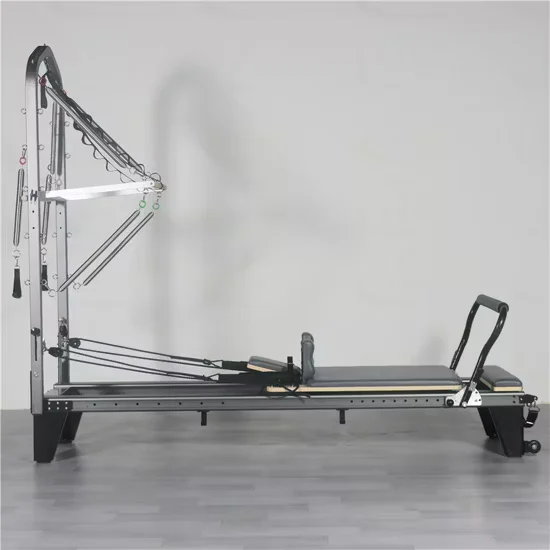
The portable pilates reformer aluminum alloy commercial grade unit covers low-impact, full-range movement patterns from rehabilitation protocols to athletic conditioning sequences. In a facility that already runs treadmills and ellipticals for steady-state cardio, this reformer fills the gap for controlled resistance work and core stability training. The 2570 × 730 mm footprint fits comfortably along perimeter walls with adequate carriage clearance on both ends. The 180 kg user weight capacity accommodates diverse body types across hotel guest populations and studio membership bases without requiring separate heavy-duty variants.
Continuous Operation and Floor-Level Deployment Constraints
A boutique studio running back-to-back group classes subjects the carriage system to near-continuous use across 12 to 16 hour operating windows. The sealed bearing design removes the recurring lubrication intervals that pull reformers off the floor for maintenance [NEED_CITE: bearing maintenance schedules for commercial Pilates apparatus]. Deploying on upper hotel floors demands attention to the subfloor: a level concrete slab with vibration-dampening pads beneath the aluminum frame prevents resonance transfer to the ceiling below. The 90 kg net weight keeps the unit stable during jump board exercises without requiring permanent floor anchoring.
Reading the Aluminum Alloy and Bearing Specifications
Aluminum alloy frames resist corrosion in humid environments like hotel basements or coastal resort fitness centers where steel frames develop surface rust that migrates into rail channels. The sealed bearing carriage system isolates the rolling elements from dust, chalk residue, and sweat contamination that degrade open bearings within months of studio deployment. The modular accessory interface — Long Box, Jump Board, and Platform — attaches without mechanical recalibration, letting instructors reconfigure between rehabilitation and plyometric programming within a single class transition. The 270 mm bed height positions the carriage at a working height that accommodates both standing transfers and wheelchair-adjacent access.
What Spec Compromise Costs After Six Months
Studios that source reformers with open bearings face recurring carriage replacements that pull equipment offline during peak booking hours [NEED_CITE: bearing failure rates in high-frequency Pilates studio environments]. Steel frame reformers deployed in humid basement fitness centers develop rail corrosion that creates uneven carriage travel and inconsistent spring resistance across the stroke. Facilities that ignore floor-level vibration transfer receive guest complaints that escalate into equipment relocation projects, costing more than specifying the correct frame material and isolation pads from the start.
Why This Product Line Holds Up Under Commercial Cycles
Every unit runs through 10,000-hour durability testing on the carriage and bearing assembly before leaving the Shandong facility, so the sealed bearing specification is validated data, not a catalog claim. The aluminum alloy frame and rail system delivers sub-35dB operation verified across hotel deployments where reformers sit directly above occupied guest rooms. The six-series cardio family means a facility outfitting a mixed-use wellness floor can source treadmills, bikes, and this reformer from a single production line with matched lead times. The OEM program covers logo placement and color customization at flexible MOQ for studio chains building branded environments. Free 3D layout planning addresses the spacing and airflow requirements specific to this 2570 mm footprint so carriage clearance and instructor circulation paths are confirmed before equipment ships. The 24/7 technical support response covers bearing inspection guidance and accessory replacement without waiting for regional service windows.
Documentation & Test Records
- CE declaration of conformity for the complete reformer assembly
- EN 957 test report covering structural integrity and user safety
- ISO 9001 certificate for manufacturing quality management
- Noise level test report confirming sub-35dB carriage operation
- Bearing durability test record documenting 10,000-hour validation
- Modular accessory interface specification and load testing documentation
Installation, Commissioning & Maintenance
- Maintain minimum 600 mm clearance on both ends of the 2570 mm frame for full carriage travel and instructor access
- Place vibration-dampening pads beneath all four aluminum frame feet on upper-floor hotel deployments
- Verify floor levelness within 3 mm across the 2570 × 730 mm footprint before anchoring the reformer
- Inspect sealed bearing carriage for smooth travel and lateral play after the first 500 hours of operation
- Wipe aluminum alloy rails with non-corrosive cleaner weekly to prevent chalk and sweat buildup in rail channels
- Confirm accessory mounting points on Long Box, Jump Board, and Platform engage without mechanical play after each reconfiguration
Equipment Selection and Inquiry Preparation
Provide the total wellness floor area and planned equipment count so the 3D layout team can map carriage clearance zones and instructor circulation paths around the reformer. Specify the deployment floor level and what occupies the rooms directly below to confirm whether additional vibration isolation is needed beyond standard dampening pads. State the daily operating hours and class frequency so the bearing duty cycle matches your facility’s actual usage pattern. Indicate whether the reformer will be positioned near humidity sources like pools or steam rooms so the aluminum alloy corrosion protection is confirmed for your environment.
Frequently Asked Questions
Q: How does aluminum alloy frame construction reduce noise compared to steel frames in shared residential deployments?
A: Aluminum alloy dampens vibration at the material level rather than transmitting it through the structure like steel does. When the carriage rolls across the rail during use, the aluminum absorbs low-frequency resonance that would otherwise travel through concrete floor slabs into rooms below. This material property is what enables sub-35dB operation in hotel deployments where reformers sit directly above occupied guest spaces.
Q: What bearing maintenance intervals are required for continuous commercial Pilates studio operation?
A: The sealed bearing carriage system eliminates the recurring lubrication schedules that open bearings demand in studio environments. Dust, chalk particles, and sweat contamination are excluded from the bearing race by the sealed design, which is validated through 10,000-hour durability testing under continuous load. Studios running back-to-back classes avoid pulling reformers offline for bearing servicing during peak booking windows.
Q: Can the modular accessory system support both rehabilitation and athletic conditioning without mechanical recalibration?
A: The Long Box, Jump Board, and Platform interface with the aluminum frame through standardized mounting points that lock into position without tools or adjustment. An instructor can transition from a rehabilitation session using the platform to a plyometric sequence on the jump board within a single class period. No spring tension recalculation or carriage realignment is required between accessory swaps.
Q: What acoustic isolation requirements must be met when deploying reformers on hotel floors above occupied guest rooms?
A: The reformer itself produces sub-35dB carriage noise, but floor-transmitted vibration still requires attention. Vibration-dampening pads beneath the four aluminum frame feet isolate structure-borne resonance from the concrete slab. Confirming the subfloor is level within 3 mm prevents uneven load distribution that can create secondary vibration points during dynamic exercises like jump board sequences.

![Commercial White Aluminium Pilates Reformer for Studio [WARN] draft identifier mismatch](https://bicksport.com/wp-content/uploads/2026/08/commercial-white-aluminium-pilates-reformer-for-studio-warn-draft-identifier-mismatch-3eeffd.webp)