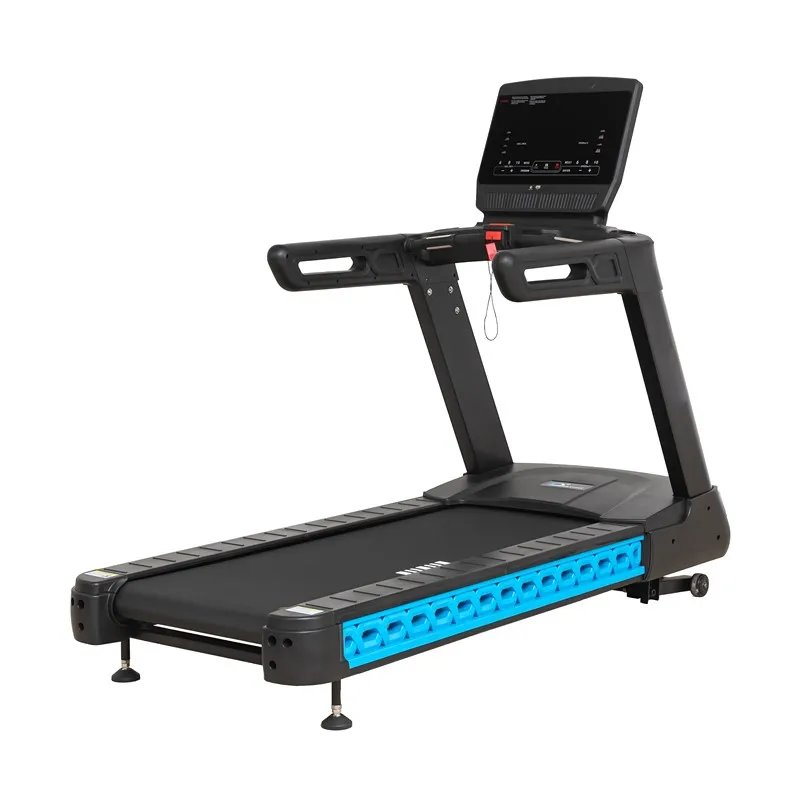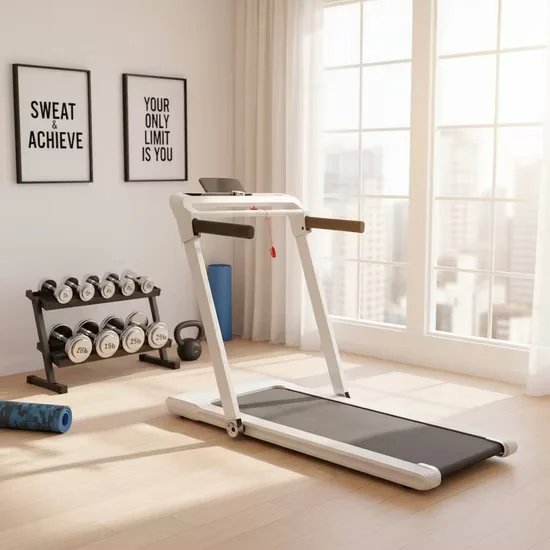
Sub-35dB Operation — DC motor and multi-layer cushioned deck keep the W08 foldable electric treadmill home use DC motor compatible with occupied residential floors and hotel guest room corridors.
Technical Specifications
| Parameter | Value |
|---|---|
| Designation | W08 |
| Motor Type | DC |
| Motor Power | 1.5 HP * |
| Speed Range | 1–16 km/h |
| Running Surface | 1200 x 450 mm |
| Programs | 16 preset programs |
| Console Type | LCD (Speed / Distance / Time / Calories) |
| Max User Weight | 100–160 kg * |
| Product Unfolded Size | 1500 x 740 x 1150 mm |
| Product Folded Size | 1810 x 740 x 220 mm |
| Net Weight | 42.0 kg |
| Foldable | Yes |
| Material | ABS |
| Color Options | Multicolor |
| Certification | CE, RoHS |
| OEM/ODM Custom | Yes |
* Source values — peak or continuous duty not specified; max user weight range requires manufacturer clarification.
Application Suitability
| Deployment Scenario | Typical Use |
|---|---|
| High-end residential home gym | Bedroom or apartment workout where floor space is limited and noise must stay below complaint thresholds |
| Boutique hotel guest room | Compact cardio station folded when not in use, preserving room layout for housekeeping and guest comfort |
| Corporate wellness room | Light-duty personal cardio for employees during breaks, fitting into small designated fitness corners |
| Small-space residential fitness | Studio apartment or shared residential area where a foldable electric treadmill home use DC motor must store flat |
Why Noise Complaints Reach the Front Desk Before Maintenance Does
DC motor architecture inherently produces less low-frequency vibration than AC alternatives at comparable speeds.
I once saw a five-star hotel outfit an entire guest floor with home-grade treadmills. Within weeks, the front desk was flooded with complaints about low-frequency humming travelling through the slab at night. The property had to swap the entire batch for magnetically controlled units. Residential deployments face the same risk when a foldable electric treadmill home use DC motor sits above an occupied unit. The acoustic signature matters as much as the mechanical specification [NEED_CITE: motor duty cycle classification for continuous commercial operation].
Where the W08 Fits in a Compact Cardio Zone
This foldable electric treadmill home use DC motor covers steady-state walking through moderate running at speeds up to 16 km/h, making it suitable for low-to-moderate intensity cardiovascular sessions. In a mixed cardio zone, it pairs with ellipticals and stationary bikes to offer impact-based training alongside zero-impact options. The 1200 x 450 mm running surface accommodates walking and jogging gaits for users within the verified weight range, and the foldable frame allows the unit to retract into a 220 mm profile when the space must serve other functions during off-hours.
Continuous Run Duration and Deployment Environment
A DC motor at this power class is designed for intermittent daily sessions rather than continuous all-day operation. Facilities planning to deploy the W08 should assess expected daily run-time per unit and confirm the motor duty rating matches that load [NEED_CITE: EN 957 requirements for commercial cardio equipment]. The 220 mm folded height permits placement in bedrooms or hotel rooms where storage space is constrained, but unfolded operation requires adequate clearance for airflow around the motor housing. Voltage and plug standards must be verified against the destination market before the shipment leaves the factory to avoid costly rewiring on arrival.
Reading the DC Drive and Console Specifications
DC motors deliver smooth torque response at low speeds, which suits walking and light jogging profiles common in home and hospitality environments. However, the 1.5 HP figure in the source data does not distinguish between peak and continuous output — peak horsepower reflects short-burst capacity while continuous duty horsepower determines sustained thermal performance under load. The LCD console displays speed, distance, time, and calorie estimates in real time, providing users with immediate workout feedback without app dependency. Sixteen preset programs allow structured variety without manual speed adjustment mid-session. The foldable frame trades some structural mass for storage convenience, which is acceptable for low-impact use but worth evaluating if heavier users will operate the unit frequently. Multi-layer deck cushioning is specified to reduce impact transmission to joints during running and walking sessions.
The Hidden Cost of Specification Compromises
When a light-duty motor is deployed in a setting that demands higher daily run-times, premature thermal failure follows — the unit simply shuts down mid-workout or burns out within months. Noise from under-specified decks and unbalanced drive components generates guest complaints that escalate to full batch replacements. Consoles that cannot export usage data leave facility managers blind to equipment utilization patterns. Voltage mismatches discovered after delivery force rewiring or transformer installations that delay deployment and increase total project cost [NEED_CITE: voltage standard compatibility for exported fitness equipment].
Why This Product Line Was Built for Deployment Certainty
The W08 benefits from the same sub-35dB acoustic engineering standard verified across our hotel deployments, meaning noise-sensitive installations can proceed with confidence. Every unit undergoes durability testing protocols consistent with 10,000-hour continuous operation benchmarks applied across the commercial cardio range. OEM customization extends to console interface language and branding, which matters for hotel chains maintaining uniform guest experience. Free 3D cardio-zone layout planning accounts for the W08’s unfolded footprint and required clearance spacing, ensuring member flow and airflow are addressed before equipment arrives. Six complete cardio series allow a facility to source every discipline from one production line with consistent quality documentation.
Documentation & Test Records
- CE declaration of conformity covering electrical safety and EMC compliance
- RoHS compliance certificate confirming restricted substance limits
- Noise level test report documenting operational acoustic signature
- Durability test record aligned with continuous operation benchmarks
- Motor specification sheet detailing torque and thermal characteristics
- Installation and commissioning guide with spare parts list
Installation, Commissioning & Maintenance
- Confirm unfolded footprint of 1500 x 740 mm plus rear clearance for safe user entry and exit
- Level the floor surface and place vibration-dampening pads to minimize transmitted noise through slabs
- Verify voltage and plug type match destination market standards before connecting the DC motor to mains power
- Run the belt at low speed for initial tension calibration and check LCD console display accuracy
- Schedule periodic belt lubrication and tension inspection based on weekly usage frequency
- Wipe the ABS housing and running deck edges after each session to prevent sweat corrosion
Equipment Selection and Inquiry Guidance
Provide your cardio zone square footage and planned unit count to receive a 3D layout with airflow and sightline planning. Specify expected daily run-time per unit so the motor duty rating can be matched to actual deployment load. Identify the installation floor and adjacent occupied spaces to confirm acoustic requirements. State your target market voltage and plug standard, and indicate whether LCD console data export is needed for facility management integration.
Frequently Asked Questions
Q: What is the difference between peak and continuous duty horsepower on a DC motor treadmill?
A: Peak horsepower measures the motor’s maximum short-burst output, typically during acceleration or incline surges. Continuous duty horsepower reflects the thermal capacity the motor sustains over extended sessions without overheating. For daily use, continuous duty rating determines long-term reliability. Always verify which figure is listed in the specification sheet before comparing models.
Q: Is a DC motor suitable for commercial gym deployment or only home use?
A: DC motors offer smooth low-speed torque and quieter operation, making them appropriate for light commercial and residential environments. Heavy-use commercial gyms typically require AC motors rated for continuous all-day duty cycles. Match the motor type to expected daily run-time per unit to avoid premature failure.
Q: How does the foldable frame affect running stability compared to fixed commercial treadmills?
A: Foldable frames prioritize storage convenience by reducing structural mass and introducing a hinge mechanism. This design suits walking and light jogging on residential or hotel deployments. Fixed commercial frames provide greater rigidity for sustained high-speed running and heavier users. Consider primary use intensity when choosing between foldable and non-folding configurations.
Q: Can the LCD console sync with third-party fitness apps or facility management software?
A: The LCD console on this model displays real-time workout metrics including speed, distance, time, and calories. Data export or app synchronization capability depends on the specific console configuration selected during OEM scoping. Confirm integration requirements with the manufacturer before placing a bulk order.
Q: What maintenance does a DC motor treadmill running deck require?
A: The running belt requires periodic lubrication and tension checks to maintain smooth operation and prevent uneven wear. Deck cushioning layers should be inspected for compression fatigue based on cumulative usage hours. Belt alignment must be verified if users report lateral drift during sessions. Maintenance intervals depend on deployment frequency and user load.
![Mt026m Fold Electric Treadmill for Bedroom Workout [WARN] draft identifier mismatch](https://bicksport.com/wp-content/uploads/2026/08/mt026m-fold-electric-treadmill-for-bedroom-workout-warn-draft-identifier-mismatch-ad67e3.webp)