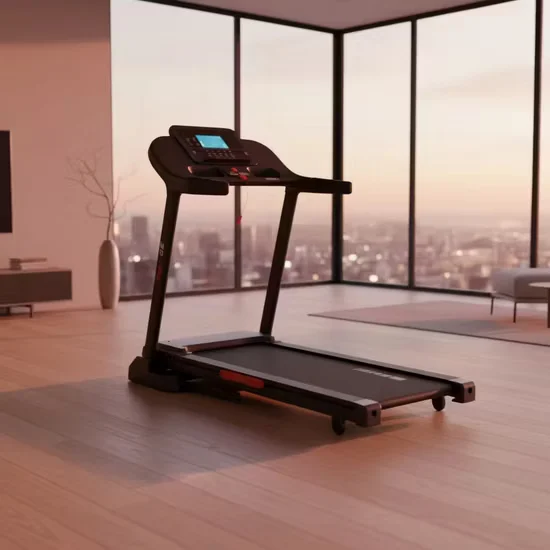
![W08 Electric Folding Walking Treadmill with DC Motor for Training Space-Saving Design [WARN] draft identifier mismatch](https://bicksport.com/wp-content/uploads/2026/08/w08-electric-folding-walking-treadmill-with-dc-motor-for-training-space-saving-design-warn-draft-identifier-mismatch-51d39c.webp)
Whisper-Quiet DC Drive — engineered for shared residential floors where motor noise and neighbor complaints dictate equipment survival.
Technical Specifications
| Parameter | Value |
|---|---|
| Designation | W08 |
| Product Type | Foldable Treadmill |
| Motor Type | DC |
| Motor Power | 1.5HP* |
| Speed Range | 1-16 km/h |
| Running Surface | 1200 x 450 mm |
| Console Type | LCD (Speed / Distance / Time / Calories) |
| Programs | 16 |
| Product Unfold Size | 1500 x 740 x 1150 mm |
| Product Folded Size | 1810 x 740 x 220 mm |
| Net Weight | 42.0 kg |
| Material | ABS |
| Foldable | Yes |
| OEM / ODM Custom | Available |
| Certification | CE, RoHS |
*Peak or continuous duty rating not specified in source documentation; confirm with engineering team for daily usage matching.
Application Suitability
| Deployment Scenario | Typical Use |
|---|---|
| High-end residential home gym | Daily walking and light jogging in compact apartment fitness corners |
| Compact apartment training | Space-restricted living areas requiring fold-and-store after each session |
| Personal wellness space | Recovery cardio and low-intensity steady-state walking routines |
| Corporate wellness room | Employee walking breaks with minimal acoustic disruption to adjacent offices |
Why Motor Duty Cycle Matters More Than Horsepower on Paper
A foldable walking treadmill DC motor home use setup lives or dies by how the motor handles repeated starts, heat accumulation, and extended low-speed operation. Confirming whether the 1.5HP rating is peak or continuous determines whether this unit survives daily hour-long sessions or degrades within months.
I have pulled burned-out motors from hotel guest floor units that were specced by horsepower alone. The maintenance team never saw it coming because the plate said 2HP. What the plate did not say was that the motor was rated for thirty-minute intervals with cool-down periods. Run it for back-to-back guest sessions and the windings cook from the inside [NEED_CITE: motor duty cycle classification for continuous commercial operation]. The DC motor in the W08 operates at lower heat output than comparable AC alternatives, which matters when the unit sits against a shared wall or in an enclosed apartment corner with limited cross-ventilation.
Role in a Compact Cardio Configuration
The W08 occupies the walking and light jogging zone in a home fitness layout. Its 1-16 km/h range covers everything from recovery-paced walking to moderate jogging cadence. In a multi-equipment residential setup, it pairs with resistance training stations or free-weight zones where floor space is shared. The 1200 x 450 mm running surface accommodates walking strides and shorter jogging gaits comfortably, while the foldable frame reclaims floor area for other activities when not in use. The LCD console delivers speed, distance, time, and calorie readouts across 16 preset programs, giving users structured variety without app dependency.
Continuous Operation and Deployment Environment
For residential and apartment deployments, the primary constraint is thermal management rather than mechanical wear. A DC motor running at walking speeds generates less airflow across its housing than at full sprint, so enclosed alcove placements need at least moderate clearance for heat dissipation. The 220 mm folded profile allows under-bed or closet storage, but the unfolded 1500 mm length requires clear fore-and-aft space for safe mounting and dismounting. Shared-wall installations should account for low-frequency vibration transmission through floor joists — a rubber isolation mat beneath the unit addresses both acoustic coupling and minor floor unevenness [NEED_CITE: vibration transmission standards for residential fitness equipment deployment].
Drive Train and Specification Breakdown
The DC motor architecture delivers quieter low-speed operation compared to AC induction motors, which tend to produce audible electromagnetic hum at reduced RPMs. This matters for walking-heavy usage patterns where the motor spends most of its runtime below 8 km/h. The 1.5HP output is suitable for walking and light jogging duty cycles; however, buyers must verify whether this figure represents peak burst capacity or sustained continuous output, as the two ratings describe fundamentally different thermal tolerances. The LCD console provides essential workout telemetry — speed, distance, elapsed time, and estimated calorie expenditure — with 16 preset programs enabling interval and progressive intensity structures. The foldable hinge mechanism reduces the unit to a 220 mm profile, a dimension that dictates storage compatibility with standard bed-frame clearances and wardrobe depths. At 42.0 kg net weight, the frame is portable enough for single-person repositioning yet requires stable floor contact during use. The ABS material housing keeps overall mass manageable while maintaining structural rigidity at walking and jogging impact loads.
What Specification Gaps Cost Downstream
A foldable walking treadmill DC motor home use unit purchased without duty-cycle verification often surfaces its first problem at month six. The motor runs hotter than expected during consecutive sessions, insulation degrades, and the unit trips thermal protection or fails outright. Noise complaints follow a similar pattern: a machine that measures acceptable in a showroom can transmit low-frequency vibration through residential floor structures, prompting neighbor complaints that escalate to strata or building management [NEED_CITE: acoustic transmission criteria for multi-unit residential fitness equipment]. Skipping the voltage and plug standard confirmation means discovering mismatches after the shipment arrives — a problem that costs more in rework than in the initial verification call.
Why This Product Line
The W08 sits within a six-series cardio family, meaning a facility sourcing treadmills can match ellipticals, bikes, rowers, and climbers from the same engineering platform. Each unit undergoes 10,000-hour durability testing on motors and bearings, providing a documented baseline for duty-cycle planning. The sub-35dB whisper-quiet operation verified in hotel deployments translates directly to residential installations where shared walls amplify every mechanical sound. OEM customization extends to console UI, color, and logo, so residential developers or corporate wellness programs can align the equipment with interior branding. The 3D cardio-zone layout service accounts for the W08’s unfolded footprint and storage envelope, ensuring the allocated space supports both active use and folded clearance. Technical support responds around the clock for commissioning questions and spare parts requests.
Documentation & Test Records
- CE declaration of conformity covering electrical safety and EMC requirements
- EN 957 test report validating mechanical safety and structural performance
- ISO 9001 certificate for manufacturing quality management systems
- RoHS compliance documentation for hazardous substance restrictions
- Noise level test record for motor and belt operation at representative speeds
- Motor specification sheet detailing power rating and thermal characteristics
Installation, Commissioning & Maintenance
- Verify unfolded clearance of 1500 x 740 mm plus safety margin fore and aft
- Place rubber isolation mat beneath frame to decouple vibration from floor structure
- Confirm voltage and plug type match local supply before first power-on
- Calibrate belt tracking and tension during initial commissioning cycle
- Inspect foldable hinge mechanism and safety lock after the first month of use
- Clean LCD console surface and ventilation openings weekly to prevent dust buildup
Planning Your Equipment Selection
Provide the room dimensions and intended unit count to receive a 3D layout with airflow and sightline analysis. Specify the expected daily usage duration per unit so the motor duty cycle can be matched to the application. Confirm the deployment floor level and adjacent room types to validate acoustic requirements. State the target market voltage and plug standard to prevent post-shipment rework. Indicate whether console data export or facility management system integration is required.
Frequently Asked Questions
Q: What is the difference between peak and continuous motor power, and why does it matter?
A: Peak power describes the maximum output a motor can sustain for short bursts, while continuous power reflects what it can deliver indefinitely without overheating. A treadmill rated at 1.5HP peak may only sustain a lower continuous output. For daily walking or jogging sessions exceeding thirty minutes, continuous rating determines long-term reliability and thermal stability of the drive system.
Q: How does a DC motor compare to AC in noise output for home environments?
A: DC motors typically produce less electromagnetic hum at low and variable speeds, making them quieter during walking-pace operation. AC motors can generate noticeable vibration tones at reduced RPMs. For apartments and shared-wall residences where low-speed walking dominates usage patterns, DC architecture provides a noticeably quieter acoustic profile during typical sessions.
Q: What should buyers verify about folding mechanisms for long-term reliability?
A: Inspect the hinge design for metal-on-metal pivot points rather than plastic bushings, and confirm the safety lock engages positively when folded and unfolded. Request durability cycle data showing repeated fold-unfold operations without loosening. A mechanism that develops play over time creates both a safety hazard and increasing noise during use.
Q: How does the 1200 x 450 mm running surface affect comfort for walking versus jogging?
A: This surface length accommodates natural walking strides with margin for pace variation, while the width provides stable foot placement during steady-state use. For jogging, shorter-stride users will find adequate room, but taller users with longer gaits may notice the boundary at higher speeds. The dimensions balance stride comfort with the space-saving intent of a foldable residential unit.