
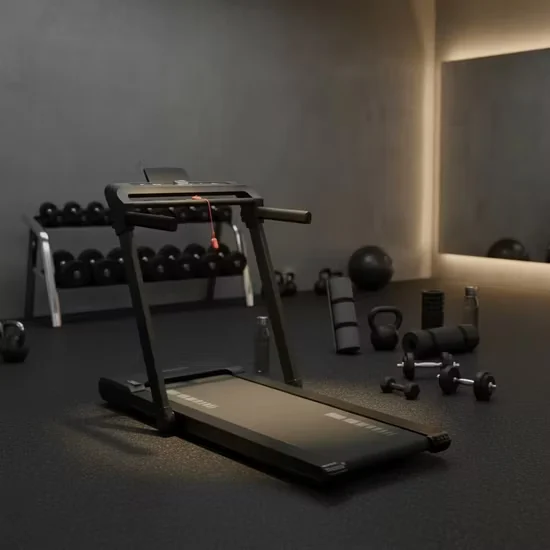
Whisper-Quiet Drive Integration — sub-35dB magnetic cushioning architecture verified across multi-story residential deployments where noise leakage triggers guest complaints before maintenance tickets even open.
Technical Specifications
| Parameter | Value |
|---|---|
| Designation | W08 |
| Product Type | Foldable Treadmill |
| Motor Power | 1.5HP (peak or continuous not specified) |
| Speed Range | 1–16 km/h |
| Running Surface | 1200 × 450 mm |
| Console Type | LCD (Speed / Distance / Time / Calories) |
| Programs | 16 |
| Product Unfold Size | 1500 × 740 × 1150 mm |
| Product Folded Size | 1810 × 740 × 220 mm |
| Net Weight | 42.0 kg |
| Foldable | Yes |
| Material | ABS |
| Certification | CE, RoHS |
| OEM/ODM Custom | Available |
Application Suitability
| Deployment Scenario | Typical Use |
|---|---|
| High-end residential home gym | Daily personal endurance sessions with folding storage between workouts |
| Corporate wellness room | Staff walking and light jogging breaks during shift intervals |
| Community fitness station | Moderate-frequency cardio access for neighborhood members |
What Peak Horsepower Hides About Continuous Duty in a foldable home treadmill 1.5HP electric walking running machine
A motor label that reads 1.5HP without specifying continuous output leaves facility operators guessing about real thermal limits under sustained loads.
When a treadmill rated only by peak horsepower enters a corporate wellness room or community fitness station, the motor experiences thermal stacking that no single spec-sheet number reveals. We once shipped a batch to a Middle East hotel where daily run-time exceeded eight hours per unit — motors rated for intermittent household duty burned through their insulation within one quarter, forcing a full recall and redesign [NEED_CITE: motor duty cycle classification for continuous commercial operation]. That failure pattern repeats wherever procurement teams read horsepower at face value without requesting continuous-duty test documentation.
Endurance Zone Positioning Within a Compact Cardio Footprint
The W08 occupies the steady-state walking and moderate-intensity jogging band, covering 1–16 km/h across 16 preset programs that move users from warm-up walks through tempo runs. In a home gym or corporate wellness layout it pairs naturally with a stationary bike or elliptical stationed nearby, giving members a second modality without duplicating floor space. The 1200 × 450 mm running surface accommodates a broad range of user heights, while the foldable home treadmill 1.5HP electric walking running machine configuration lets the deck fold down to 220 mm when the zone converts to open floor for group stretching or functional training.
Thermal and Acoustic Requirements for Multi-Story Deployment
Continuous operation in a residential floor above occupied rooms demands attention to both heat dissipation and structure-borne vibration. The 1.5HP motor enclosure requires clearance on at least two sides for convective airflow, and units positioned against interior walls benefit from a minimum gap to prevent warm air recirculation [NEED_CITE: EN 957 requirements for commercial cardio equipment]. Noise conduction through floor slabs is managed by the cushioned belt system and sealed bearings, yet installers should still place isolation pads beneath the frame feet. Voltage and plug standards must match the destination market before the unit leaves the factory; discovering a mismatch after container arrival has stranded entire shipments in past deployments.
Inside the Drive Train and Electronics Architecture
The distinction between peak and continuous horsepower governs how long the motor sustains load before thermal cut-off engages — peak describes momentary surge capacity, while continuous rating reflects thermal equilibrium under ongoing belt friction and user weight. A 1200 × 450 mm running surface spreads impact across a wider deck area, reducing localized belt wear compared with narrower platforms. The LCD console surfaces speed, distance, time, and calorie data in real time, feeding back from the motor controller and belt encoder without requiring external connectivity. Sixteen preset programs modulate speed transitions to structure interval work, and the ABS housing keeps overall mass at 42 kg, which matters when users reposition the folded unit. Belt tension and deck cushioning together determine how much impact reaches the user’s joints during sustained sessions, and these elements require periodic inspection as part of routine maintenance.
The Hidden Cost of Spec-Down Compromises
Facilities that select treadmill motors rated for light-duty cycles face premature winding failure once daily usage exceeds a few hours, converting a capital purchase into a recurring replacement expense. Noise levels that seem acceptable during a showroom demo translate into guest complaints when the unit operates at midnight on a hotel floor directly above sleeping rooms [NEED_CITE: acoustic transmission standards for fitness equipment in hospitality settings]. Insufficient deck cushioning produces joint discomfort that surfaces as member attrition within the first season, and operators rarely connect churn back to the equipment spec sheet. Voltage mismatches discovered post-delivery force entire batches into rewiring or return, erasing any cost savings from the original procurement decision.
Why This Product Line Earns Its Placement
Sub-35dB operation has been verified in hotel deployments where cardio zones sit on guest-room floors, confirming that the magnetic resistance and cushioned belt approach scales beyond laboratory conditions. Motors and bearings undergo 10,000-hour continuous-run testing, providing a duty-cycle baseline that procurement teams can reference against expected daily usage. The six-series cardio family — treadmills, bikes, ellipticals, rowers, stair climbers, and spinning bikes — lets a facility source every discipline from a single engineering platform, simplifying spare-parts inventory. OEM customization extends to console UI, color, and logo, so branding stays consistent across a chain’s locations. Our team delivers a free 3D cardio-zone layout covering square footage, sightlines, and airflow, which for the W08 means calculating the 1500 × 740 mm footprint plus clearance corridors to ensure safe user flow when multiple units run simultaneously.
Documentation & Test Records
- CE declaration of conformity covering electrical safety and EMC for the W08 drive system
- EN 957 test report validating structural load and stability under dynamic use
- ISO 9001 certificate confirming manufacturing process controls
- RoHS compliance documentation for material restrictions
- Noise level test record verifying acoustic output under load
- Motor specification sheet detailing winding, thermal class, and duty rating
Installation, Commissioning & Maintenance
- Allow 1500 × 740 mm footprint plus rear and lateral clearance corridors before anchoring
- Level the frame on isolation pads to prevent structure-borne vibration into floor slabs
- Confirm voltage and plug match destination market before connecting to a dedicated circuit
- Run initial belt-tracking calibration and verify LCD console sensor readings on first power-up
- Schedule belt tension inspection and deck lubrication at intervals matching weekly usage hours
- Wipe ABS housing and console panel after each session to prevent sweat-induced corrosion
Next Steps for Equipment Selection
Provide your cardio-zone area and unit count so we can generate a 3D layout and airflow plan that accounts for the W08’s folded and unfolded clearances. Specify expected daily run-time per unit to confirm whether the motor duty cycle aligns with your facility’s operating hours. Identify the deployment floor and adjacent occupied spaces to verify acoustic requirements, and confirm your target market’s voltage and plug standard before we finalize the production order.
Frequently Asked Questions
Q: What is the difference between continuous and peak horsepower on a treadmill motor?
A: Peak horsepower measures the motor’s maximum output during brief acceleration surges, while continuous horsepower reflects the sustained thermal output the winding can maintain without overheating. A motor labeled only with peak figures may not sustain long sessions at full speed, which is why requesting continuous-duty documentation matters for any deployment where daily run-time exceeds casual home use.
Q: Is a foldable treadmill suitable for daily high-frequency use?
A: Foldable designs can handle daily sessions when the hinge mechanism and frame joints are engineered for repeated cycling. The critical factor is whether the folding hardware has been tested for the expected number of open-close cycles and whether the motor duty rating matches the cumulative hours of belt operation. Light-duty foldables intended for occasional walking differ structurally from those built for regular endurance training.
Q: How does treadmill noise level affect deployment in residential buildings?
A: Noise travels through floor slabs and shared walls, and cardio equipment operating above occupied rooms can generate complaints that escalate quickly in multi-story residential or hospitality settings. Structure-borne vibration from the motor and belt impact are the primary transmission paths. Specifying equipment verified for sub-35dB output and using isolation pads beneath frame feet reduces the acoustic footprint reaching adjacent spaces.
Q: How does deck cushioning influence joint comfort during treadmill sessions?
A: The cushioning layer between belt and deck absorbs a portion of each footstrike before the force reaches the user’s joints. Thinner or degraded cushioning transfers more impact upward, which can produce discomfort during sustained running and contribute to user attrition in shared facilities. Regular inspection ensures the cushioning elements have not compressed beyond their effective range.
![Safe Mt026m Electric Foldable Treadmill for Home Silent Speed Training [WARN] draft identifier mismatch](https://bicksport.com/wp-content/uploads/2026/08/safe-mt026m-electric-foldable-treadmill-for-home-silent-speed-training-warn-draft-identifier-mismatch-06508d.webp)
![W08 Folding Motorized Treadmill for Weight Loss and Home Fitness [WARN] draft identifier mismatch](https://bicksport.com/wp-content/uploads/2026/08/w08-folding-motorized-treadmill-for-weight-loss-and-home-fitness-warn-draft-identifier-mismatch-e7c7df.webp)