
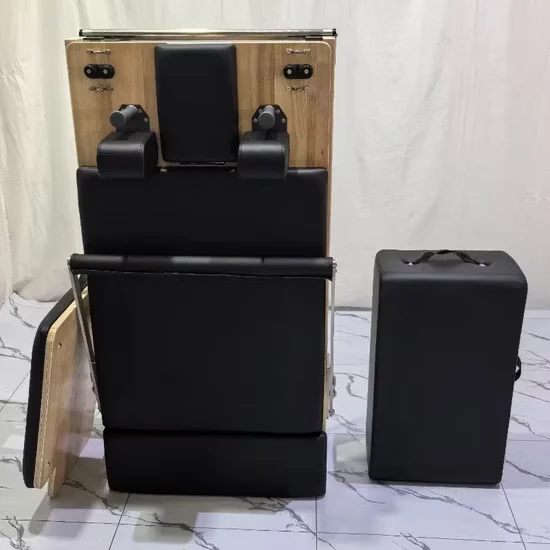
Solid Maple Vibration Dampening — The solid maple wood frame absorbs carriage oscillation at the source, eliminating the low-frequency hum that metal-frame reformers transmit through mixed-use building floors.
Technical Specifications
| Parameter | Value |
|---|---|
| Designation | SRY-20B |
| Product Type | Pilates Reformer |
| Frame Material | Solid Maple Wood |
| Product Dimensions | 2400 × 600 × 350 mm |
| Net Weight | 100 kg |
| Included Accessories | Long Box, Jump Board, Platform |
| Color Options | Solid Color |
| Customization | Logo and color available |
| Target User | Adult, Unisex |
| Warranty | 3 Years |
Application Suitability
| Deployment Scenario | Typical Use |
|---|---|
| Boutique Pilates studio | Daily group and private reformer classes across multiple intensity levels |
| Five-star hotel wellness center | Guest-facing movement sessions in noise-sensitive upper floors |
| Yoga and movement studio | Complementary reformer work alongside mat-based programming |
| High-end residential fitness room | Private daily practice in shared-wall or shared-floor living spaces |
| Rehabilitation center | Controlled low-impact resistance training under practitioner supervision |
Why Vibration Travels Through Floors Before Anyone Notices
Wood-frame reformers decouple the carriage from the building structure by design.
When metal-frame reformers operate in studios above occupied hotel rooms or ground-floor retail, every carriage return sends low-frequency vibration through the concrete slab. Studio owners often receive noise complaints before they realize the equipment is the source. A solid maple frame absorbs and dissipates that oscillation internally rather than channeling it downward. Having tested transmission noise on cardio equipment installed on guest room floors, I can confirm that the structural material of the frame itself determines whether a complaint reaches the front desk [NEED_CITE: vibration transmission through floor assemblies in mixed-use commercial buildings].
Where This Reformer Fits Within a Studio Equipment Plan
The SRY-20B covers full-range reformer work from foundational supine sequences through advanced jump board plyometrics. Within a studio cardio and movement zone, it pairs naturally with mat stations and Cadillac units, filling the intermediate resistance-training gap that mat work alone cannot address. Its 2400 mm length requires adequate clearance front and rear for full carriage travel, making it best positioned along perimeter walls rather than central aisles. The frame accommodates adult users of varying body sizes, and the included long box, jump board, and platform expand the exercise repertoire without consuming additional floor space. For facilities planning a maple wood Pilates reformer commercial deployment, the accessory ecosystem reduces the need for separate specialty units.
Floor Loading and Acoustic Isolation in Shared Buildings
The 100 kg net weight concentrates load across four contact points, which on suspended timber floors or lightweight concrete slabs may require a dedicated vibration-damping mat beneath each unit. In hotel wellness centers on guest room floors, the maple frame inherently limits structure-borne noise, but footfall from standing exercises still transmits through the base [NEED_CITE: impact insulation class requirements for fitness equipment on suspended floors]. Studios in mixed-use zones should confirm slab thickness and adjacent occupancy before committing to a layout. Adequate cross-ventilation keeps the wood finish stable in rooms where humidity fluctuates between occupied and unoccupied hours. Unlike motorized cardio machines, this reformer draws zero electrical power, eliminating voltage compatibility concerns entirely for international deployments.
Reading the Material and Rail Specifications
The solid maple frame provides natural acoustic dampening that aluminum and steel cannot replicate — dense hardwood dissipates vibrational energy as heat within the grain structure rather than reflecting it. The carriage rail and wheel system determines glide smoothness over thousands of cycles; precision-machined rails with sealed wheel bearings maintain consistent travel feel and require minimal periodic adjustment. Maple’s dimensional stability under humidity variation means the rail alignment holds across seasons without the seasonal truing that softer woods demand. The accessory attachment points — long box rails, jump board socket, platform mount — should use metal-insert reinforcement to prevent wood wear at high-stress junctions. Finish durability matters equally: a commercial-grade lacquer or oil finish resists sweat corrosion and repeated hand contact without developing the surface haze that lower-grade coatings show within months.
What Frame Substitution Costs Over Time
Specifying aluminum or composite frames to reduce upfront cost often surfaces as a noise problem after deployment, particularly when studios operate in buildings with residential neighbors below. Metal frames reflect carriage energy into the floor assembly, generating complaints that lead to retrofitting isolation pads or, in severe cases, replacing entire equipment batches. Wood grading matters as well — lower-grade maple with internal voids or inconsistent density transmits vibration unpredictably and may develop structural cracks under continuous commercial loading. Facilities that skip finish verification on arrival frequently see surface degradation within the first year, requiring sanding and refinishing that takes equipment out of service [NEED_CITE: commercial equipment lifecycle cost comparison between wood and metal frame reformers].
Why This Product Line Holds Its Position
Every SRY-20B frame is built from solid maple selected for density consistency, and the rail system is tested for smooth carriage glide across extended commercial duty cycles. The 2400 × 600 mm footprint informs our 3D studio layouts, where we calculate spacing for full carriage extension, instructor walk paths, and cross-ventilation between units. Logo and color customization allows studio chains and hotel wellness brands to maintain visual identity across locations without sacrificing the acoustic advantages of wood. The three-year warranty reflects confidence in the frame, rail, and accessory hardware under daily commercial use. Our facility documentation package includes everything a building inspector or hotel engineering team needs before the first unit arrives, and technical support remains available around the clock for alignment or accessory questions.
Documentation & Test Records
- Material grade and finish durability certification for the solid maple frame
- Dimensional tolerance report covering rail alignment and carriage fit
- Accessory load testing records for long box, jump board, and platform mounts
- EN 957 compliance documentation applicable to resistance training equipment
- Surface finish chemical resistance and sweat corrosion test results
- ISO 9001 quality management certificate covering production and QC processes
Installation, Commissioning & Maintenance
- Allow minimum 600 mm clearance at head and foot for full 2400 mm carriage travel and safe mounting
- Place on a level surface with vibration-damping pads beneath each foot to protect suspended floors
- Inspect rail alignment and carriage wheel seating before first client use after transport
- Wipe down maple frame and accessories after each session to prevent sweat accumulation on the finish
- Check accessory attachment hardware for tightness monthly, particularly jump board and platform mounts
- Reapply manufacturer-recommended wood finish annually or when surface shows wear in high-contact zones
Specifying the Right Configuration for Your Facility
Share your studio floor plan and unit count so we can generate a 3D layout that accounts for carriage clearance, instructor sightlines, and airflow between stations. Confirm the deployment floor level and adjacent room occupancy so we can advise on supplemental isolation measures if needed. Specify logo placement, color matching requirements, and any branding integration goals early to align customization lead time with your opening schedule.
Frequently Asked Questions
Q: How does a solid maple frame compare to aluminum for noise control?
A: Maple absorbs carriage vibration within the wood grain, preventing it from transferring into the floor structure. Aluminum reflects that energy downward, which can generate low-frequency noise in rooms below. For studios in mixed-use buildings or hotel guest floors, the inherent dampening of solid maple eliminates the need for aftermarket isolation pads.
Q: What determines long-term carriage glide quality?
A: Rail machining precision and wheel bearing quality set the baseline, but maple’s dimensional stability preserves that alignment across humidity changes. Softer woods or lower-grade timber can warp slightly, introducing drag over time. Sealed bearings and metal-reinforced rail channels keep maintenance intervals predictable in daily commercial use.
Q: Which accessories ship with the reformer and can they be replaced?
A: The SRY-20B includes a long box, jump board, and platform. Each attaches through dedicated mounting points on the frame. Replacement accessories or additional units for multi-studio orders can be specified separately, provided the attachment mechanism matches the frame’s socket and rail configuration.
Q: What customization is available for studio branding?
A: Logo engraving or plate mounting and solid color finish options are available. Custom color matching lets studio chains maintain brand consistency across locations. Minimum order quantities and lead times for customized finishes should be confirmed during the quotation stage to align with your project timeline.
Q: What does the three-year warranty cover?
A: The warranty covers the maple frame structural integrity, rail system, carriage hardware, and accessory attachment points under normal commercial use. Consumable items such as springs, ropes, and grip surfaces are excluded. Component replacement guidance and parts availability are provided through our technical support channel.


