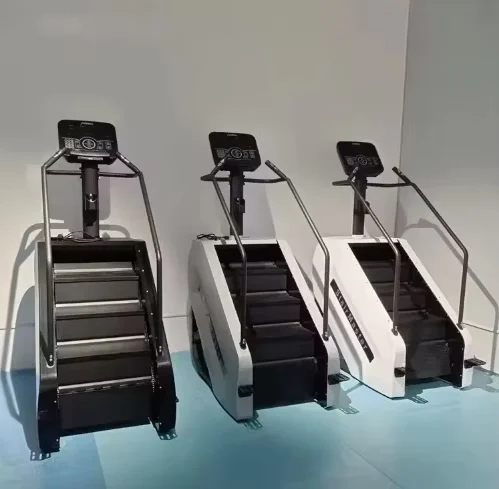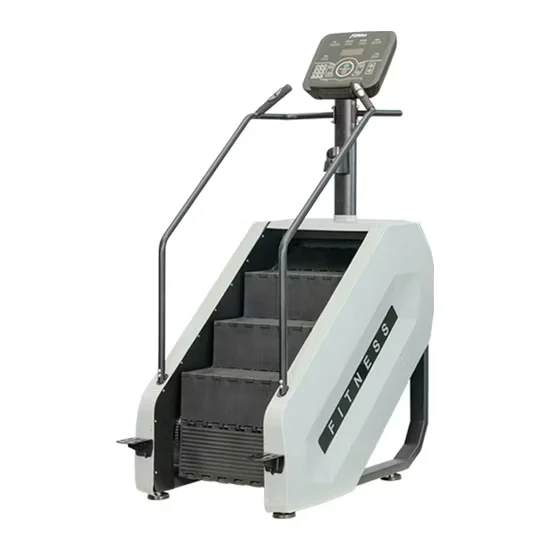
Continuous Motor Drive — SQ1017 delivers consistent 15–164 steps/min cadence without thermal cutoff during 24/7 hotel cardio deployments.
Technical Specifications
| Parameter | Value |
|---|---|
| Designation | SQ1017 |
| Product Type | Stair Climber |
| Drive Type | Motor Drive |
| Function | Electric |
| Step Area | 560 × 235 × 220 mm |
| Running Velocity | 15 – 164 steps/min |
| Mains Input | AC220V±10% / AC110V±10% |
| Console OSD | Time, Climb, Calories, Steps, Heart Rate |
| Material | Steel Pipe + PP Plastic |
| Product Dimensions | 1450 × 820 × 2080 mm |
| Net Weight | 148 kg |
| Foldable | Unfolded |
| Color | Black |
| Certification | CE |
Application Suitability
| Deployment Scenario | Typical Use |
|---|---|
| Hotel fitness center on guest room floors | 24-hour access cardio with whisper-quiet motor operation beside occupied rooms |
| Chain gym cardio zone | High-frequency stair training during peak hours with continuous motor duty |
| Corporate wellness room | Low-maintenance step climbing for employee fitness programs |
| High-end residential home gym | Dedicated vertical climbing without belt-slip maintenance |
| Sports performance training center | Interval programming with reliable heart rate feedback across step velocity ranges |
Why Motor Burnout Happens Before the Warranty Expires
The SQ1017 motor-drive architecture sustains continuous step velocity without thermal cutoff under high-frequency commercial use.
Light-commercial motors pushed into 24/7 gym cardio zones overheat and fail within months, leaving machines dead on the floor during peak hours [NEED_CITE: motor duty cycle classification for continuous commercial operation]. I have seen chain operators replace entire stair climber fleets twice in one year because the drive systems were rated for two-hour daily cycles, not sixteen-hour continuous operation. The motor-drive configuration in this unit maintains consistent torque across the full velocity range, avoiding the cadence drops and thermal shutoffs that generate member complaints.
Vertical Climbing Density in a Mixed Cardio Layout
The SQ1017 covers low-intensity warm-up at 15 steps/min through high-intensity intervals at 164 steps/min, filling the vertical climbing niche in a cardio zone otherwise dominated by treadmills and ellipticals. This commercial stair climber motor drive pairs naturally with rowing machines for full-body conditioning circuits. The 820 mm footprint width allows tight spacing between units while preserving lateral clearance. The 148 kg net weight and steel pipe frame provide stability during aggressive step rates without floor anchoring in most commercial installations.
Floor Deployment and Noise Transmission Considerations
Motor-driven stair climbers installed above guest rooms or office spaces must meet acoustic thresholds that friction-driven alternatives cannot consistently achieve [NEED_CITE: EN 957 requirements for commercial cardio equipment]. The motor-drive system avoids chain rattle and belt-slap noise that propagates through floor slabs. Dual voltage input at AC220V±10% and AC110V±10% eliminates transformer dependency when deploying across international markets. The unit requires a dedicated circuit matching the destination voltage standard. Adequate rear clearance supports motor ventilation during sustained high-step-rate sessions.
Motor Drive Versus Friction-Driven Step Mechanisms
Motor-drive systems deliver constant torque regardless of step cadence, unlike friction-driven climbers where resistance varies with user speed and belt tension degrades over weeks of use. The 15–164 steps/min velocity range spans rehabilitation-grade slow stepping through athletic sprint intervals without mechanical adjustment. Steel pipe and PP plastic construction at 148 kg net weight dampens vibration transmission during sustained high-cadence sessions. The console captures time, climb distance, calories, steps, and heart rate, providing the data points needed for reliable interval programming without the drift common in basic single-sensor displays [NEED_CITE: heart rate sensor accuracy standards for commercial fitness equipment].
The Hidden Cost of Underspecified Drive Systems
Friction-driven stair climbers deployed in commercial facilities require belt tension adjustments every few weeks, and neglected maintenance leads to step slippage that users perceive as mechanical failure. Heart rate sensors on budget consoles lose calibration within months, making HIIT programming unreliable and driving members away from the equipment. Voltage mismatches discovered after container arrival force entire batches into transformer retrofitting, delaying gym openings and damaging buyer-supplier trust. These failures compound: a single dead machine in a hotel fitness center generates front-desk complaints that spread across review platforms [NEED_CITE: facility downtime cost analysis for commercial cardio equipment].
Why This Product Line Fits Your Deployment
Sub-35dB operation verified across hotel fitness deployments means this unit can sit on guest floors without generating noise complaints during early morning and late night use. Components undergo 10,000-hour continuous operation testing on motors, frames, and bearings to match the duty cycles of 24/7 chain gym cardio zones. The console supports facility management data sync for operators who need usage analytics without stranded data silos. Full OEM and ODM capability covers console UI customization to match brand standards. Free 3D cardio-zone layout and airflow planning accounts for this unit’s 1450 × 820 mm footprint alongside adjacent equipment spacing.
Documentation & Test Records
- CE declaration of conformity for SQ1017 motor-driven stair climber
- EN 957 test report covering structural and safety requirements
- Noise level test report verifying operation thresholds for guest-floor deployment
- Motor specification sheet detailing continuous duty rating and thermal parameters
- Console technical documentation with OSD data output protocols
- Spare parts list covering motor, frame, and step mechanism components
Installation, Commissioning & Maintenance
- Maintain 600 mm rear clearance for motor ventilation and 400 mm lateral spacing based on 820 mm unit width
- Level the floor surface and install vibration-damping pads beneath the 148 kg frame to reduce slab transmission
- Connect to a dedicated circuit matching AC220V or AC110V input without shared loads from adjacent equipment
- Verify console OSD readings for time, climb, calories, steps, and heart rate during commissioning calibration
- Inspect motor-drive belt tension and step mechanism alignment quarterly under continuous commercial use
- Wipe console display and handrail sensors weekly to prevent sweat corrosion on contact surfaces
Equipment Selection and Site Planning
Provide your cardio zone square footage and intended unit count to receive a 3D layout with airflow planning that accounts for motor ventilation requirements. Specify daily operating hours so motor duty-cycle ratings match your facility’s actual run-time demands. Confirm deployment floor level and adjacent room occupancy to validate noise threshold compliance. State your destination market voltage standard and plug type to ensure correct configuration before production begins.
Frequently Asked Questions
Q: How does motor drive compare to friction-driven stair climbers for continuous commercial use?
A: Motor-drive systems deliver constant torque across the full velocity range without the belt tension degradation that friction-driven units experience under sustained use. This eliminates the periodic maintenance adjustments that friction mechanisms require, reducing equipment downtime in high-frequency gym cardio zones where machines operate sixteen or more hours daily.
Q: What training intensities does the 15–164 steps/min range support?
A: The lower end accommodates rehabilitation protocols and warm-up phases, while the upper range supports high-intensity interval training for athletic conditioning. The motor-drive system maintains consistent step cadence throughout this range without the mechanical lag or torque drop that friction systems exhibit at extreme velocities, enabling reliable programming across intensity zones.
Q: Can the console sync workout data with facility management platforms?
A: The console captures time, climb distance, calories, steps, and heart rate through its OSD system. Operators should confirm data output protocol and API documentation availability during the specification phase to ensure compatibility with their facility management software before production begins.
Q: What noise level does the motor drive produce on hotel guest floors?
A: The motor-drive mechanism avoids chain rattle and belt-slap noise that propagates through floor slabs, operating within thresholds suitable for deployment beside occupied guest rooms. Request the noise level test report during procurement to verify compliance with your property’s acoustic standards before finalizing deployment plans.
Q: How do I confirm voltage compatibility before shipment?
A: The unit supports dual input at AC220V±10% and AC110V±10%. Specify your destination market voltage standard and plug type during the inquiry stage so the factory configures the correct wiring and plug before production, avoiding on-site transformer retrofits that delay installation.
![Stair Climber Machine with Easy Assembly Guide for Beginners [WARN] draft identifier mismatch](https://bicksport.com/wp-content/uploads/2026/08/stair-climber-machine-with-easy-assembly-guide-for-beginners-warn-draft-identifier-mismatch-d78b7a.webp)
![Commercial Stair Climber Machine Motor Drive for Gym and Home [WARN] draft identifier mismatch](https://bicksport.com/wp-content/uploads/2026/08/commercial-stair-climber-machine-motor-drive-for-gym-and-home-warn-draft-identifier-mismatch-95cd27.webp)
![SQ-1017 Stair Machine Climbing Stepper Fitness Equipment [WARN] draft identifier mismatch](https://bicksport.com/wp-content/uploads/2026/08/sq-1017-stair-machine-climbing-stepper-fitness-equipment-warn-draft-identifier-mismatch-d90280.webp)