
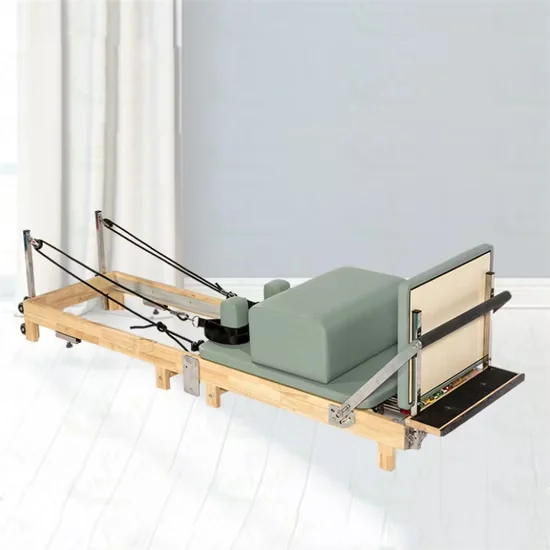
Whisper-Quiet Construction — Solid wood frame absorbs vibration naturally, keeping carriage movement quiet enough for shared residential floors.
Technical Specifications
| Parameter | Value |
|---|---|
| Designation | SRY-20C |
| Product Type | Pilates Reformer |
| Material | Wood |
| Color | Solid Color (customizable) |
| Accessory Options | Long Box / Jump Board / Platform |
| Product Dimensions | 2400 × 600 × 350 mm |
| Net Weight | 100 kg |
| Foldable | Yes |
| Warranty | 3 Years |
| Customization | Available (Logo, Color) |
| Age Group | Adult |
| Gender | Unisex |
Application Suitability
| Deployment Scenario | Typical Use |
|---|---|
| High-end residential home gym | Daily Pilates sessions where floor noise transmission to lower levels is a concern |
| Boutique Pilates studio | Space-efficient group or private classes with customizable branding on equipment |
| Corporate wellness room | Compact multi-purpose fitness space requiring foldable equipment between meetings |
| Private fitness center | One-on-one reformer instruction with accessory-driven exercise variety |
| Hotel spa and wellness floor | Guest-accessible Pilates equipment with low noise and premium aesthetics |
Why Noise Complaints Reach the Front Desk Before Maintenance Does
Structural vibration through floors is the silent membership killer in shared-space deployments.
When steel-framed reformers sit on guest room floors or above occupied offices, every carriage roll and spring release transmits directly through the structure. Operators rarely learn about the problem from maintenance logs — they learn from noise complaints filed by the people one floor below. A wooden folding Pilates reformer for home use or commercial deployment changes the equation because solid wood inherently dampens vibration before it reaches the subfloor. In hotel deployments where cardio and reformer zones occupy upper levels, this material choice prevents the kind of structural noise that triggers formal guest complaints [NEED_CITE: vibration transmission comparison between wood and steel frames in fitness equipment].
Where This Reformer Fits in a Mixed Cardio and Recovery Zone
This reformer covers low-impact, controlled-resistance movement patterns that complement high-intensity cardio stations already running in the main training area. In a typical facility layout, it occupies the recovery or mind-body zone alongside mat work and stretching stations rather than competing for space next to treadmills or climbers. The 2400 mm deployed length requires adequate clearance at both ends for safe carriage travel, while the folding capability lets operators reclaim the floor during non-class hours. It accommodates adult users across a wide height range thanks to adjustable spring anchoring points, and the included Long Box, Jump Board, and Platform accessories allow instructors to program exercises spanning rehabilitation through athletic conditioning. The wooden folding Pilates reformer bridges the gap between clinical precision and studio versatility.
Continuous Deployment and Spatial Requirements for Shared Environments
Daily usage in a studio or hotel environment means this reformer will cycle through multiple classes or guest sessions per day, placing repeated load on the carriage rails, spring anchors, and folding hinge mechanism. The solid wood construction manages vibration at the source, but deployment still requires attention to floor flatness — an uneven surface introduces lateral carriage drift that accelerates wheel wear. For upper-floor installations, the 100 kg net weight provides inherent stability without requiring bolted anchoring, though a quality floor mat beneath the unit further isolates residual vibration. Operators planning multi-unit rooms should maintain adequate lateral spacing between adjacent reformers for safe limb extension during supine and kneeling exercises. Ventilation is less critical than with motorized cardio equipment, but ambient humidity control remains important to protect the wood finish from seasonal expansion and contraction [NEED_CITE: wood frame dimensional stability requirements in climate-controlled fitness environments].
Reading the Specs That Actually Matter on a Wood-Frame Reformer
The solid wood frame is not merely an aesthetic choice — wood’s cellular structure dissipates vibrational energy that steel would otherwise channel straight into the floor assembly. This makes the SRY-20C particularly suited for installations where structural noise transfer is a dealbreaker. The folding mechanism demands careful engineering review: the hinge must maintain precise carriage rail alignment when deployed, because even slight misalignment creates uneven wheel contact and audible rumbling. Spring-based resistance on this platform delivers progressive load that increases proportionally with carriage travel distance, giving users and instructors predictable feedback throughout each exercise. The included accessories — Long Box for extended prone work, Jump Board for plyometric loading, and Platform for standing and balance exercises — expand the movement vocabulary without adding separate pieces of equipment. Customization options covering logo application and solid color finish allow the unit to align with a facility’s interior palette or brand identity.
What Happens When Spec Compromises Are Discovered After Delivery
A reformer that looks correct in a showroom photograph can still create operational problems if the folding hinge tolerances are loose, the carriage rails are not precision-machined, or the spring anchors lack sufficient fatigue resistance for daily commercial cycles. Facilities that accepted equipment based on appearance alone have faced carriage wobble within weeks, spring tension inconsistency between otherwise identical units, and hinge mechanisms that develop play after repeated folding and unfolding. In a studio running four or five classes daily, these issues compound quickly — instructors lose confidence in the equipment’s consistency, and members notice the difference between sessions. Wooden reformers also demand more careful humidity management than steel equivalents, and a facility that neglects climate control may see finish checking or joint loosening over time [NEED_CITE: long-term durability testing standards for commercial Pilates equipment].
Why This Product Line Deserves a Closer Look
Every SRY-20C that leaves the factory has been through structural load testing and carriage cycle verification before packing. The Biketon Sport manufacturing environment applies the same quality discipline used across its commercial cardio range — ISO 9001 process control, component-level inspection, and finished-unit functional testing. The folding design was engineered with commercial deployment frequency in mind, meaning the hinge and lock mechanisms are rated for repeated daily operation rather than occasional home use. Facility operators can request OEM customization including logo placement and color matching to align equipment aesthetics with interior design specifications. The Biketon Sport technical team provides 3D layout planning that accounts for reformer spacing, instructor sightlines, and participant flow patterns — this unit’s 2400 mm footprint and folding capability are factored directly into the floor plan. Post-delivery support includes a three-year warranty and spare parts availability covering springs, wheels, and accessory components.
Documentation & Test Records
- CE declaration of conformity covering the SRY-20C structural and mechanical safety
- EN 957 test report validating load capacity and carriage mechanism integrity
- ISO 9001 certificate for the manufacturing quality management system
- Noise and vibration test record documenting wood frame damping performance
- Durability test record for folding hinge and carriage rail cycle life
- Console and accessory technical documentation with Long Box, Jump Board, and Platform specs
Installation, Commissioning & Maintenance
- Verify floor flatness across the 2400 × 600 mm footprint and shim as needed before positioning the SRY-20C
- Maintain minimum clearance on both ends and laterally for full carriage travel and safe limb extension
- Inspect carriage rail alignment and wheel seating after unfolding and before each operating day
- Lubricate carriage wheels and spring anchor pivot points according to the included maintenance schedule
- Wipe down wood surfaces with non-abrasive cleaner after sessions to prevent sweat residue buildup
- Check folding hinge tightness and lock engagement monthly under commercial usage frequency
Before You Specify — What We Need From Your Side
Provide the room dimensions and planned unit count so the technical team can generate a 3D layout addressing reformer spacing, instructor circulation, and participant entry flow. Confirm whether the deployment floor sits above occupied spaces, which determines whether additional vibration isolation mats are advisable beneath each unit. Share the target market and facility type to ensure customization options — logo, color finish, and accessory package — align with the project specification. Indicate the expected daily class frequency so hinge and rail durability expectations can be confirmed against the SRY-20C’s tested cycle rating.
Frequently Asked Questions
Q: How does a wood frame affect vibration and noise compared to steel reformers?
A: Solid wood’s natural cellular structure absorbs and dissipates vibrational energy before it transfers into the floor assembly. Steel frames, by contrast, tend to conduct vibration directly through the legs and into the subfloor, which becomes a problem on upper levels or above occupied rooms. This damping characteristic makes the SRY-20C suitable for hotel floors, shared residential buildings, and quiet studio environments where structural noise complaints are a real operational concern.
Q: What should I check about the folding mechanism before committing to a multi-unit order?
A: Request the folding hinge cycle test record and verify that carriage rail alignment is maintained after repeated fold-unfold sequences. A mechanism that develops lateral play over time will cause uneven carriage travel and audible rumbling during use. Also confirm that the locking mechanism positively engages in both deployed and stored positions, preventing any inadvertent movement during class or while the unit is being repositioned in the room.
Q: Can the reformer accommodate users of different heights with the standard carriage setup?
A: The SRY-20C includes adjustable spring anchoring positions and shoulder rest settings that accommodate a wide range of adult body sizes. Instructors can modify footbar distance and spring configuration to suit individual proportions. For facilities serving populations at the extreme ends of the height spectrum, it is worth verifying carriage travel range against the specific limb length requirements of your most common exercise programming.
Q: What customization options are available for branding and color?
A: Logo application and solid color finish customization are available through the OEM program. Facilities can match the reformer’s visual appearance to existing interior design palettes or brand guidelines. Lead time and minimum order quantity depend on the scope of customization, so providing color references and logo artwork early in the specification process helps keep the project timeline on track.
Q: Which accessories are included and how do they expand the exercise options?
A: The SRY-20C ships with Long Box, Jump Board, and Platform accessories as selectable options. The Long Box extends the carriage surface for prone and supine exercises requiring full torso support. The Jump Board converts the reformer into a controlled plyometric station. The Platform provides a stable standing surface for balance and unilateral work. Together, these accessories allow a single reformer to cover exercise categories that would otherwise require multiple dedicated pieces of equipment.


