
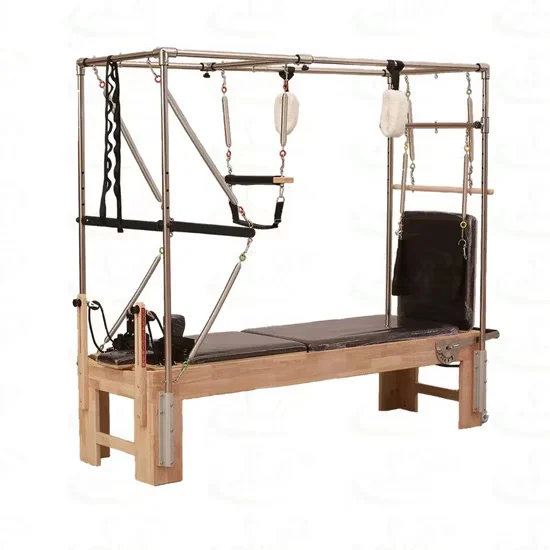
Steel Frame Stability — 150 kg net weight with reinforced steel construction ensures structural rigidity under continuous studio use.
Technical Specifications
| Parameter | Value |
|---|---|
| Designation | SRY-101A |
| Product Dimensions | 24007702160mm |
| Net Weight | 150 kg |
| Accessory | Long Box / Jump Board / Platform |
| Color | Solid Color (OEM customization available) |
| Max User Weight | Adult capacity |
| Logo | Customized |
| Warranty | 3 Years |
| Production Capacity | 80 Pieces/Month |
| HS Code | 9506911900 |
Application Suitability
| Deployment Scenario | Typical Use |
|---|---|
| Boutique Pilates studio | Full-method Pilates instruction combining reformer, Cadillac and jump board sequences |
| Rehabilitation center | Controlled spring-resistance therapy for mobility recovery and post-injury conditioning |
| Hotel fitness center | Multi-discipline equipment supporting guest wellness programs in limited floor space |
| Corporate wellness room | Compact three-in-one solution for employee fitness and stress-relief sessions |
| High-end residential home gym | Professional-grade Pilates training without requiring multiple standalone machines |
Why Spring Consistency Matters More Than Accessory Count in a Commercial Pilates Cadillac Reformer 3-in-1 Equipment
Linear resistance curves prevent the mid-session disruptions that erode client trust.
When a spring set loses tension consistency, the resistance profile jumps between rep counts instead of transitioning smoothly. Instructors must then compensate verbally, breaking the rhythm of group sessions and one-on-one appointments alike. We have seen studio operators cycle through multiple spring replacements per year because lower-grade coils develop non-linear pull characteristics after repeated full-extension cycles. This directly affects session quality in environments where acoustic calm and movement fluidity define the client experience. [NEED_CITE: spring fatigue testing standards for Pilates resistance systems]
Equipment Positioning Within a Pilates Studio Layout
This commercial Pilates Cadillac reformer 3-in-1 equipment occupies the center of a full-method training zone. It supports reformer footwork and arm work on the sliding carriage, Cadillac tower exercises with push-through and roll-down bars, and jump board plyometric sequences — all without moving the participant to a second or third machine. In studio configurations, this unit typically anchors one training station while mat areas and chair units fill adjacent positions. The 2400 mm length accommodates full-body extension for taller users, and the steel frame handles dynamic loading during jump board work without lateral sway.
Continuous Operation Demands and Studio Environment Fit
A Pilates studio running six to eight sessions daily places repetitive load cycles on every spring and pulley. The SRY-101A is engineered for this cadence: the spring resistance system maintains linearity across extended rep counts, and the frame absorbs dynamic forces without resonance transfer to the floor. [NEED_CITE: acoustic transmission requirements for multi-level fitness facilities] Placement matters — units installed above occupied rooms in hotel properties benefit from the solid steel base reducing vibration transfer compared to lighter aluminum-alloy frames. The 770 mm width allows standard corridor and door clearance during delivery, while the 2160 mm height requires ceiling clearance verification before final positioning.
Decoding the Spring Resistance and Frame Engineering
The spring resistance system on this unit delivers graduated tension without the cable-lag common in pulley-only setups. High-grade steel springs produce a predictable force curve from initial engagement through full extension, which is critical for rehabilitation protocols where resistance must scale proportionally with range of motion. The 150 kg net weight reflects a solid steel frame that dampens oscillation during jump board sequences — lighter frames tend to walk across the floor under repetitive plyometric loading. The included Long Box extends the carriage surface for seated and supine exercises, while the Platform attachment converts the reformer bed into a stable Cadillac surface. Each accessory locks into the frame without tools, reducing changeover time between clients.
The Hidden Cost of Underspecified Pilates Equipment
Studios that source budget spring systems often face compounding costs: springs that develop dead spots require instructor workarounds, clients notice inconsistency and attrition follows. Frame flex under jump board loading generates audible rattling that disrupts adjacent sessions. When a studio replaces equipment within two years, the original capital saving is erased by repeat procurement, installation downtime, and client churn. For hotel deployments, guest complaints about equipment noise or instability reach management before maintenance is notified, making prevention through specification more economical than reactive replacement. [NEED_CITE: equipment replacement frequency in commercial Pilates studios]
Why This Product Line Fits Deployment-First Buyers
The SRY-101A supports OEM customization for logo and color, letting branded studios maintain visual consistency across equipment. Senrui’s manufacturing capability covers the full cardio and Pilates equipment range, so operators consolidating treadmill zones and Pilates studios under one supplier reduce procurement complexity. The 2400×770 mm footprint fits standard studio bay planning, and 3D layout support accounts for instructor circulation space around each unit. Spring systems undergo load-cycle verification before shipment, and the three-year warranty covers structural and spring components for commercial duty. 24/7 technical support addresses alignment and tension calibration issues that arise after installation.
Documentation & Test Records
- CE declaration of conformity covering structural and mechanical safety
- Load and stress test records for steel frame under dynamic jump board use
- Spring tension linearity verification across full extension range
- OEM customization specification sheet for color and logo application
- Installation guide covering floor leveling and frame assembly sequence
- Spare parts list with spring replacement intervals and accessory reorder codes
Installation, Commissioning & Maintenance
- Allocate minimum 600 mm clearance on all sides of the 2400×770 mm footprint for instructor access
- Verify floor levelness before assembly; shim the 150 kg steel frame to eliminate carriage drift
- Inspect spring tension calibration after initial assembly and recheck every 500 session hours
- Lubricate carriage rails with manufacturer-specified grease quarterly under daily studio use
- Confirm jump board mounting pins engage fully before each plyometric session
- Clean vinyl upholstery with pH-neutral solution to prevent salt-induced cracking
Planning Your Studio Deployment
Provide your studio floor area and planned equipment count to receive a 3D layout showing circulation paths and sightlines around each unit. Specify your session volume per day so spring duty cycles can be matched to expected usage intensity. Confirm ceiling height at the installation point to accommodate the 2160 mm frame plus overhead bar clearance. State whether OEM branding on frame color and logo is required for your studio identity.
Frequently Asked Questions
Q: How does spring resistance differ from cord-based systems for studio use?
A: Spring systems deliver progressive resistance that increases with extension length, giving instructors predictable load scaling through each movement phase. Cord systems offer fixed resistance levels that change discretely rather than continuously. For rehabilitation and precision-focused Pilates work, springs allow finer control. Cords require less maintenance but can develop slack over time. The choice depends on whether your programming emphasizes smooth resistance gradation or simplified level selection.
Q: What deployment advantage does the 3-in-1 design offer over separate machines?
A: A single commercial Pilates Cadillac reformer 3-in-1 equipment replaces three standalone units, reducing floor space requirements and maintenance points. Studios gain the ability to transition clients from reformer sequences to Cadillac tower work and jump board drills without relocating. This consolidation also means one set of springs and one frame to inspect rather than maintaining multiple independent resistance systems across the training floor.
Q: How does frame construction affect long-term durability under daily studio sessions?
A: The 150 kg steel frame resists the lateral forces generated during jump board plyometrics, preventing the frame walk and joint loosening that affect lighter constructions. Weld integrity at the tower-to-base junction is critical — units with bolted-only tower connections develop play over repeated loading cycles. A heavier, fully welded frame maintains alignment longer and reduces the frequency of fastener retightening during scheduled maintenance.
Q: What OEM customization options are available and how do they affect lead time?
A: Logo placement, frame color, and accessory configuration can be customized to match studio branding. Production capacity is 80 pieces per month, so standard customization orders ship within the normal production cycle. Highly specific color matches or non-standard accessory combinations require advance specification during the quotation phase. Confirming OEM scope early prevents delays once the proforma invoice is issued.
Q: What is the typical spring replacement cycle for commercial studio use?
A: Spring lifespan depends on daily session count and maximum extension frequency. High-volume studios running eight or more sessions daily should inspect springs for dead spots and reduced tension quarterly. Springs showing inconsistent resistance curves should be replaced as a complete set to maintain uniform load across all attachment points. Keeping documented replacement records supports warranty claims and helps predict future maintenance budgets.
![Wooden Cadillac Pilates Reformer Commercial Studio Equipment SRY-01 [WARN] draft identifier mismatch](https://bicksport.com/wp-content/uploads/2026/08/wooden-cadillac-pilates-reformer-commercial-studio-equipment-sry-01-warn-draft-identifier-mismatch-6b4b84.webp)
![Reformer Pilates Equipment Fitness White Pilates Reformer MachineCommercial Pilates Reformer Machine for Studio Use [WARN] draft identifier mismatch](https://bicksport.com/wp-content/uploads/2026/08/reformer-pilates-equipment-fitness-white-pilates-reformer-machinecommercial-pilates-reformer-machine-for-studio-use-warn-draft-identifier-mismatch-4815c3.webp)
![Beech Wood Pilates Reformer High Quality Senrui Fitness [WARN] draft identifier mismatch](https://bicksport.com/wp-content/uploads/2026/08/beech-wood-pilates-reformer-high-quality-senrui-fitness-warn-draft-identifier-mismatch-1685b0.webp)
