
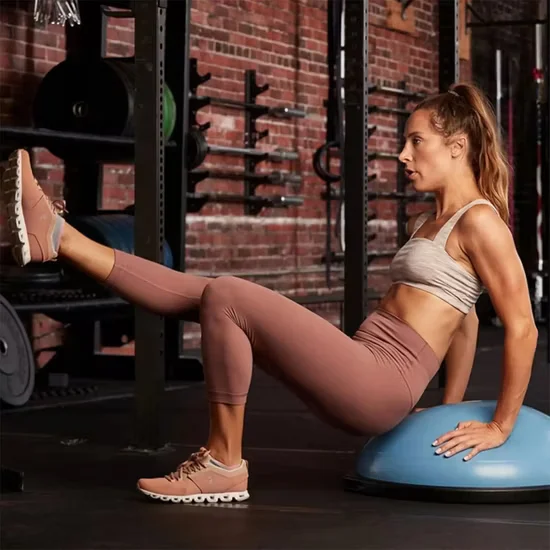
Engineered For Durability — Validated through continuous high-frequency load testing to withstand multi-user commercial environments without material deformation or structural fatigue.
Technical Specifications
| Parameter | Value |
|---|---|
| Product Type | Balance Training Ball |
| Specification | 58 cm |
| Color | Customized |
| Logo | Customized Logo Available |
| Age Group | Adult |
| Gender | Unisex |
| MOQ | 50 PCS |
| Production Capacity | 5000 Units / Year |
Application Suitability
| Deployment Scenario | Typical Use |
|---|---|
| Corporate wellness center functional zones | Core stabilization and proprioception drills during group sessions |
| Community fitness facility training areas | Balance integration into circuit and functional movement stations |
| Professional sports training centers | Injury prevention and rehabilitation-specific balance protocols |
| High-end residential home gyms | Compact multi-modal training supplement for strength and mobility work |
| Physical therapy and rehabilitation studios | Post-injury stability recovery and neuromuscular re-education exercises |
Why Surface Degradation Forces Early Replacement Cycles in Shared Training Spaces
Commercial-grade elastomer formulation resists deformation under repeated loading across hundreds of daily user contacts.
Facilities that deploy consumer-grade balance trainers frequently encounter surface cracking and base warping within the first operational season. The material simply cannot handle continuous sweat exposure, shifting body loads, and the abrasion from footwear during dynamic movements. Maintenance teams end up cycling through replacements, and the visual inconsistency undermines the facility brand identity that operators spend significant budget establishing [NEED_CITE: material degradation patterns in high-frequency fitness accessories]. A commercial balance training ball custom logo option lets operators standardize both durability and visual identity from a single sourcing decision.
Positioning the Half Balance Ball Within Functional Training Zones
This 58 cm profile balance trainer occupies the stability and neuromuscular activation segment of functional training environments. It pairs with resistance equipment for compound movements requiring proprioceptive challenge and complements free weight stations by adding an instability variable to standard strength exercises. The unit suits moderate to high-density deployment in dedicated functional zones where floor space is allocated for multi-directional movement patterns. Users across a wide body weight range can engage the platform for both static balance holds and dynamic transitional drills. A commercial balance training ball custom logo application maintains brand continuity across the entire functional training floor.
Deployment Environment Factors That Affect Long-Term Stability Performance
Daily usage intensity directly determines how quickly the elastomer shell compresses and whether the rigid base maintains planar contact with the floor surface. Facilities running continuous group sessions need units rated for sustained multi-user loading throughout operating hours. Floor surface composition affects stability — the rigid base requires level, non-deformable flooring to prevent lateral drift during loaded exercises [NEED_CITE: flooring requirements for instability training equipment]. Ambient temperature fluctuation in unconditioned spaces can accelerate material hardening over time. Sweat accumulation on the textured surface demands routine cleaning protocols to preserve grip characteristics throughout the equipment lifecycle.
Elastomer Shell Thickness and Base Rigidity Explained
The half balance ball’s performance envelope depends on the interplay between shell compliance and base stiffness. A thicker elastomer shell provides greater deformation range, allowing users to challenge balance through deeper instability excursions, while the rigid platform base anchors the unit and transfers ground reaction forces predictably. The 58 cm diameter establishes the contact area — wider platforms distribute load more evenly and accommodate users with larger foot placements during single-leg stance work. Surface texture depth determines traction under perspiration, which becomes critical during high-repetition dynamic movements where sweat accumulates rapidly. Non-slip base geometry prevents lateral translation on smooth commercial flooring surfaces. The commercial balance training ball custom logo integration process must preserve surface texture integrity to maintain grip safety standards.
The Hidden Cost of Specifying Consumer-Grade Balance Equipment for Public Facilities
Procurement decisions driven by unit price alone create compounding downstream costs that operators rarely anticipate. Consumer-grade elastomer formulations crack along stress points within months of continuous public use, forcing replacement purchases that erase any initial savings. Visual fragmentation emerges when mismatched replacement units arrive in different colors or dimensions, degrading the branded environment. Staff time diverts toward inspecting and rotating deteriorating inventory rather than focusing on member programming [NEED_CITE: total cost of ownership for commercial fitness accessories]. The commercial balance training ball custom logo option eliminates this fragmentation by locking in both material grade and brand identity from initial procurement.
Why This Balance Training Line Matches Commercial Deployment Requirements
Material composition undergoes load-bearing validation to confirm the elastomer shell withstands repeated compression without permanent deformation or surface splitting. The rigid base platform is tested for planar stability under offset loading conditions typical of single-leg balance work. Full OEM customization extends across logo placement, color matching, and packaging specifications so the unit integrates with existing facility branding without visual compromise. The 58 cm profile allows planners to allocate functional zone footprint efficiently, maintaining adequate spacing between adjacent training stations for safe movement transitions. The 50-unit minimum order threshold supports phased rollout across multi-site deployments. Technical documentation accompanies each shipment to support commissioning verification and ongoing maintenance scheduling.
Documentation & Test Records
- CE declaration of conformity applicable to balance training equipment category
- EN 957 test report covering structural integrity and load-bearing performance
- ISO 9001 certificate validating manufacturing quality management processes
- Material composition and durability test record for elastomer shell formulation
- Surface texture anti-slip performance verification under simulated sweat conditions
- Custom logo proofing specification and color matching approval documentation
Installation, Commissioning & Maintenance
- Position on level flooring with adequate clearance for full-range balance movements around the 58 cm perimeter
- Verify rigid base sits flush without rocking on the installed floor surface material
- Inspect elastomer shell for molding consistency and surface texture uniformity upon delivery
- Establish routine cleaning protocol using non-solvent cleaners to preserve grip texture integrity
- Rotate unit positioning periodically to distribute wear evenly across the contact surface
- Schedule visual inspections for stress cracking at shell-to-base junction during quarterly maintenance reviews
Equipment Selection and Deployment Inquiry
Provide your functional training zone dimensions and planned unit count so we can generate a 3D layout addressing spacing, sightlines, and member flow through balance training stations. Specify daily usage volume and session types to confirm the elastomer formulation matches your operational intensity. Indicate your facility branding requirements including logo placement preferences and Pantone color references for custom matching. Confirm target delivery timeline to align production scheduling with your deployment phase.
Frequently Asked Questions
Q: What material standards ensure long-term durability in commercial environments?
A: The elastomer shell is formulated for repeated compression loading without permanent deformation or surface cracking under continuous multi-user conditions. The rigid base platform maintains planar stability under offset loads typical of single-leg balance exercises. Material composition undergoes verification testing against commercial-grade durability benchmarks before production approval, ensuring the unit withstands high-frequency public facility usage cycles without premature degradation or structural compromise.
Q: How does custom logo placement affect surface grip and user safety?
A: Logo application is confined to designated zones that do not overlap with primary foot-contact or hand-grip surfaces. The textured anti-slip pattern remains uninterrupted across all functional contact areas where users establish stability during exercises. Color matching and logo proofing are confirmed before production begins, ensuring brand alignment without compromising the surface traction characteristics that the elastomer texture provides during perspiration-heavy training sessions.
Q: Can the balance ball integrate with existing facility branding and color schemes?
A: Full color customization is available with Pantone reference matching to align the elastomer shell and base platform with your facility brand palette. Logo application options include embossed, printed, or debossed placement depending on the surface zone and durability requirement. Custom packaging specifications are also supported, allowing operators to maintain consistent visual identity from warehouse receipt through floor deployment across multiple facility locations.
Q: What is the recommended replacement cycle under high-frequency public use?
A: Replacement timing depends on daily user volume, exercise intensity profiles, and adherence to routine cleaning and inspection protocols. Facilities running continuous group programming with multiple daily sessions should schedule quarterly visual inspections for surface wear indicators and base stability verification. Material formulation is engineered to extend service intervals beyond consumer-grade alternatives, though actual replacement cycles should be determined through documented condition assessments rather than predetermined timelines.
![Non-Slip Medicine Balls for Commercial Gym Training [WARN] draft identifier mismatch](https://bicksport.com/wp-content/uploads/2026/08/non-slip-medicine-balls-for-commercial-gym-training-warn-draft-identifier-mismatch-4f545f.webp)
![Eco-Friendly TPE Foam Balance Cushion for Commercial Fitness Use [WARN] draft identifier mismatch](https://bicksport.com/wp-content/uploads/2026/08/eco-friendly-tpe-foam-balance-cushion-for-commercial-fitness-use-warn-draft-identifier-mismatch-fd5d50.webp)

