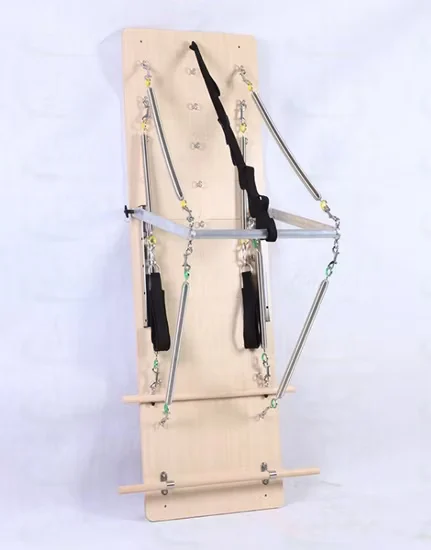
Whisper-Quiet Wood Operation — Solid wood frame construction eliminates motor noise entirely, making it suitable for shared residential floors and acoustic-sensitive studio environments.
Technical Specifications
| Parameter | Value |
|---|---|
| Product Type | Pilates Reformer |
| Designation | SRY-20B |
| Material | Wood |
| Color | Solid Color |
| Accessory | Long Box / Jump Board / Platform |
| Foldable | Yes |
| Product Dimensions | 2400600350mm |
| Net Weight | 100kgs |
| Warranty | 3 Years |
| Customization | Available (Logo, Color) |
| Production Capacity | 80 Pieces/Month |
| Age | Adult |
| Gender | Unisex |
Application Suitability
| Deployment Scenario | Typical Use |
|---|---|
| Boutique Pilates studio | Group reformer classes requiring quiet, space-efficient equipment for daily scheduling |
| High-end residential home gym | Private training in shared-wall environments where acoustic transfer to neighboring units is a concern |
| Wellness center multi-purpose room | Reformer sessions in convertible spaces that require equipment to fold between class formats |
| Hotel guest floor fitness room | In-room or suite-adjacent wellness offering where motor noise would trigger guest complaints |
Why Acoustic Comfort Defines Reformer Placement in Mixed-Use Facilities
A solid wood frame produces zero motor noise and naturally dampens carriage vibration before it reaches the floor.
In multi-story hotel deployments and residential fitness spaces, equipment noise travels through structural connections long before maintenance teams notice it. Metal-frame reformers transmit carriage resonance directly into flooring, creating low-frequency vibration that disturbs occupants in rooms below. We have seen entire equipment batches replaced after guests on the floor beneath a wellness center filed repeated complaints [NEED_CITE: acoustic transfer standards for fitness equipment in mixed-use buildings]. The SRY-20B foldable wood Pilates reformer commercial deployment eliminates this failure mode at the source — wood construction absorbs vibration rather than conducting it, and the absence of any motor removes the primary noise generator entirely.
Where This Reformer Fits in a Dedicated Movement Studio
This unit covers the full spectrum of classical and contemporary Pilates movement patterns, from supine footwork through advanced jump board plyometrics. In a studio cardio and strength zone, it complements mat-based programming by adding spring-loaded resistance that scales from rehabilitation-grade tension to athletic conditioning loads. The 2400mm length accommodates users across a wide height range while maintaining full carriage travel. The foldable wood Pilates reformer commercial configuration suits facilities running back-to-back group sessions where the accessory ecosystem — Long Box, Jump Board, and Platform — expands exercise variety without requiring separate equipment purchases.
Continuous Deployment Cycles and Spatial Requirements
A boutique studio running four to six group classes daily places repeated folding and unfolding cycles on the hinge mechanism, making deployment durability a procurement-level concern rather than a maintenance afterthought. The SRY-20B foldable wood Pilates reformer commercial setup requires floor space of approximately 2400 by 600mm when deployed, with clearance on all sides for safe carriage travel and instructor access. In multi-purpose rooms, the foldable mechanism returns the unit to a reduced footprint between sessions, allowing the same square footage to serve yoga, mat work, or functional training formats [NEED_CITE: spatial planning guidelines for convertible fitness studios]. Wood frames do not generate heat or require ventilation the way motorized cardio equipment does, simplifying HVAC planning in rooms not originally designed for fitness use.
Reading the Spring and Frame Specifications
Spring resistance on a wood-frame reformer determines the entire training envelope. Unlike magnetic or electromagnetic resistance systems found on motorized cardio, spring tension provides a progressive load curve — resistance increases as the spring extends, which mirrors natural muscle force production through range of motion. The wood frame itself contributes to the user experience in measurable ways: solid wood has inherent damping properties that reduce high-frequency vibration transfer to the carriage rail, producing a smoother glide compared to welded steel frames of equivalent mass. The 100kg net weight provides sufficient mass to resist walking during dynamic exercises without requiring floor anchoring. The foldable hinge mechanism must maintain carriage alignment across repeated deployment cycles — a specification worth verifying through load testing documentation before committing to volume orders.
What Specification Shortcuts Cost After Installation
Facilities that select reformers based on upfront price frequently encounter costs that appear months after deployment. Lightweight frames shift during dynamic jump board work, requiring instructors to pause sessions and reposition equipment. Carriage rails on underspecified units develop play within the first year of commercial use, producing rattling that degrades the studio experience and generates member complaints. Hinge mechanisms not rated for repeated folding cycles loosen over time, compromising carriage alignment and creating uneven spring tension that affects exercise quality [NEED_CITE: durability testing standards for foldable fitness equipment mechanisms]. Wood-frame reformers that skip proper finish treatment on carriage contact surfaces develop wear patterns that increase friction and require premature rail maintenance.
Why This Product Line Earns Its Placement
Every unit undergoes dimensional verification against the carriage travel and spring tension specifications that define safe commercial operation. The solid wood frame delivers the acoustic performance that mixed-use facilities require — zero motor noise, natural vibration damping, and a construction material that does not transmit impact resonance to adjacent occupied spaces. The foldable mechanism is tested through repeated deployment cycles to confirm that carriage alignment holds under continuous studio scheduling. OEM customization covers logo placement and frame color, allowing studio operators to align equipment appearance with interior design specifications. The complete accessory package — Long Box, Jump Board, and Platform — ships with the unit, eliminating aftermarket compatibility questions. Our engineering team provides 3D layout planning that accounts for deployed footprint, folded storage position, instructor circulation paths, and the sightlines that determine whether a reformer zone feels open or cramped. Documentation includes installation and commissioning guides with rail lubrication schedules calibrated to the specific carriage system. Technical support responds around the clock for facilities operating across time zones.
Documentation & Test Records
- Material specification sheet confirming wood species and finish durability rating
- Load testing record for carriage and frame under dynamic spring tension
- Foldable hinge mechanism cycle test documentation
- Accessory compatibility verification for Long Box, Jump Board, and Platform
- Assembly and commissioning guide with rail alignment procedures
- Warranty certificate covering frame, carriage, and spring components for 3 years
Installation, Commissioning & Maintenance
- Confirm 2400x600mm deployed footprint plus clearance on all sides for safe carriage travel and instructor positioning
- Level floor contact points before first use to prevent carriage drift during exercises on the 100kg wood frame
- Lubricate carriage rails at intervals specified in the commissioning guide to maintain smooth glide under spring load
- Inspect foldable hinge mechanism quarterly for fastener tension and alignment retention under repeated deployment cycles
- Wipe wood surfaces with manufacturer-approved cleaner after each session to prevent sweat accumulation and finish degradation
- Verify spring tension progression across all resistance levels before opening the unit to studio scheduling
Planning Your Reformer Deployment
Provide your studio floor plan and class schedule volume to receive a 3D layout that accounts for deployed footprint, folded storage positions, and instructor circulation paths. Specify whether units will operate on floors adjacent to occupied spaces so we can confirm acoustic suitability for your building type. Indicate your target market and any branding requirements so OEM customization — logo placement and frame color — can be scoped before production. Confirm whether accessory packages should ship pre-assembled or field-installed based on your receiving capacity.
Frequently Asked Questions
Q: How does a wood frame compare to metal for long-term durability under commercial use?
A: Solid wood provides natural vibration damping that metal frames cannot match, reducing resonance transfer to flooring in multi-story buildings. Wood does not corrode from sweat exposure the way unprotected steel does. However, wood requires finish maintenance and humidity control to prevent dimensional changes that could affect carriage rail alignment over extended deployment periods.
Q: Does the foldable mechanism affect carriage alignment after repeated use?
A: The hinge system is designed to maintain carriage alignment across repeated deployment cycles typical of studio scheduling. Facilities should verify alignment during quarterly maintenance inspections and request cycle test documentation before procurement. A properly specified foldable mechanism shows no measurable deviation in carriage tracking after the rated deployment count.
Q: Can accessories be swapped during a single session without tools?
A: The Long Box, Jump Board, and Platform are designed for field-swappable attachment, allowing instructors to transition between exercise formats within a single class period. This eliminates dead time between segments and supports programming that progresses from supine spring work through standing platform exercises and plyometric jump board sequences.
Q: What spring resistance range suits rehabilitation versus athletic programming?
A: Rehabilitation protocols typically use the lightest spring settings to provide assistance rather than load, supporting controlled range-of-motion work. Athletic conditioning uses heavier spring configurations to challenge force production through full carriage travel. Verify that the spring progression increments on your configuration support both ends of this spectrum before confirming your order specification.