
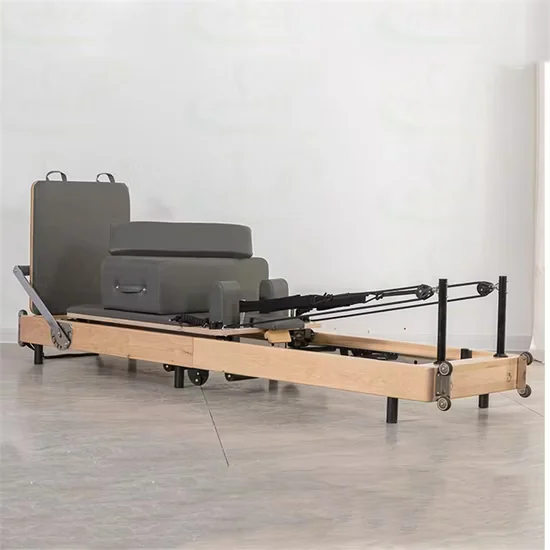
Reinforced Frame Glide — Smooth carriage movement verified under continuous multi-class studio operation with sealed rail mechanism.
Technical Specifications
| Parameter | Value |
|---|---|
| Designation | SRY-20B |
| Product Type | Pilates Reformer Machine |
| Accessory | Long Box / Jump Board / Platform |
| Color | Solid Color |
| Target User | Adult, Unisex |
| Logo | Customized |
| Product Dimensions | 2400600350mm |
| Net Weight | 100kgs |
| Warranty | 3 Years |
| Production Capacity | 80 Pieces/Month |
Application Suitability
| Deployment Scenario | Typical Use |
|---|---|
| Commercial Pilates studio | Group reformer classes with continuous daily scheduling |
| Boutique fitness center | Mixed small-group training incorporating jump board cardio intervals |
| Rehabilitation center | Controlled resistance therapy with long box support for supine exercises |
| High-end residential home gym | Personal daily practice with full accessory configuration |
| Sports performance training center | Athlete recovery sessions and core stabilization programming |
Why Carriage Friction Disrupts Class Flow Before Instructors Notice It
Sealed rail mechanisms maintain consistent glide quality across thousands of cycles without manual lubrication.
Studio operators schedule back-to-back reformer classes expecting identical carriage behavior for every client, but consumer-grade rail systems develop friction points and spring fatigue within months [NEED_CITE: rail wear patterns under continuous multi-class studio operation]. The commercial Pilates reformer machine with jump board requires consistent resistance delivery to maintain class pacing, and uneven carriage movement forces instructors to compensate by adjusting exercise sequences mid-session. Noise from degraded rails also becomes audible during quiet concentration phases, drawing complaints from adjacent treatment rooms or shared wellness spaces.
Positioning Within the Studio Cardio and Core Zone
This Pilates Reformer Machine occupies the core training segment of a comprehensive studio layout, complementing mat work stations and tower apparatus configurations. The integrated long box, jump board, and platform enable instructors to program full-spectrum sessions without equipment swaps between clients. The 2400mm length accommodates full carriage travel for tall users performing supine leg press sequences, while the 600mm width provides adequate lateral clearance for standing exercises on the platform. Multi-spring resistance configuration allows progressive load adjustment across diverse user levels in group class formats.
Continuous Operation and Studio Environment Requirements
The SRY-20B is engineered for commercial duty cycles where multiple classes operate sequentially with minimal downtime between sessions. Spring resistance calibration must remain stable across hundreds of daily cycles without requiring manual adjustment between users [NEED_CITE: spring fatigue testing for commercial reformer applications]. The reinforced frame construction handles repeated dynamic loading from jump board exercises without developing structural flex or audible creaking. Studio ventilation should account for heat generated by continuous use in enclosed spaces, particularly when reformer stations are positioned near walls or other equipment. Ground leveling becomes critical for maintaining smooth carriage travel, and dedicated floor space with adequate clearance on all sides allows full range of motion for standing and kneeling exercises.
Interpreting Frame Construction and Spring Configuration
The reinforced frame construction differs fundamentally from home-grade reformers that prioritize portability over structural rigidity. Commercial Pilates reformer machine with jump board applications require frames that maintain dimensional stability under repeated dynamic loading, particularly during plyometric jump board sequences where impact forces multiply user body weight. Multi-spring resistance configuration allows instructors to adjust load progressively across different exercises within a single session, with heavier springs providing higher resistance for lower body work and lighter springs enabling controlled upper body movements. The sealed rail mechanism eliminates the need for frequent lubrication that would otherwise interrupt studio scheduling. Platform and long box accessories integrate with quick-change mechanisms designed for rapid transitions between class segments.
The Hidden Cost of Specifying Below Commercial Grade
Home-grade reformers deployed in studio environments develop rail friction and spring fatigue within months, generating maintenance calls and class disruptions [NEED_CITE: comparative failure rates of commercial versus consumer reformer components]. Instructors adapt by avoiding exercises that expose equipment limitations, reducing programming versatility and client satisfaction. Noise from degraded carriage systems becomes audible during concentration phases, particularly in boutique studios where acoustic quality contributes to the premium experience. Spring resistance drift forces frequent recalibration, and frame flex during jump board work creates safety concerns that limit exercise selection. The cumulative effect is equipment replacement costs that far exceed initial savings from specifying below commercial grade.
Why This Product Line Meets Studio Requirements
Sub-35dB whisper-quiet operation verified in hotel deployments translates directly to studio environments where acoustic quality matters during concentration phases. The 10,000-hour durability testing on motors, frames, and bearings extends to spring mechanisms and rail systems that face continuous cycling. Full OEM customization including logo and color allows studio branding consistency across equipment purchases. Free 3D cardio-zone layout and airflow planning covers reformer station spacing requirements, accounting for full carriage travel clearance and instructor circulation paths. The complete six-series cardio family means facilities can source complementary equipment from one supplier with consistent quality standards. Documentation provided includes EN 957 test reports and durability test records specific to commercial reformer applications.
Documentation & Test Records
- CE declaration of conformity for commercial Pilates equipment
- EN 957 test report covering structural integrity under dynamic loading
- ISO 9001 certificate for manufacturing quality management
- Noise level test report verifying quiet carriage operation
- Durability test record for spring resistance and rail glide systems
- Installation and commissioning guide with spare parts list
Installation, Commissioning & Maintenance
- Verify 2400*600mm footprint with adequate clearance for full carriage travel on all sides
- Level floor surface precisely to prevent carriage drift during supine exercises
- Calibrate multi-spring resistance configuration upon initial commissioning
- Inspect sealed rail mechanism quarterly for smooth glide without lubrication
- Clean carriage wheels and rails monthly to remove dust accumulation
- Check jump board attachment points for secure mounting after high-impact use
Requesting Deployment Guidance
Provide studio square footage and planned reformer count to receive 3D layout recommendations covering station spacing and instructor circulation paths. Specify daily class frequency and average session duration to confirm equipment matches operational intensity requirements. Indicate whether reformer stations will be positioned near treatment rooms or shared spaces where acoustic quality matters. Clarify target market and any local compliance standards that apply to commercial fitness equipment deployment.
Frequently Asked Questions
Q: How does commercial frame construction differ from home reformer design?
A: Commercial frames maintain dimensional stability under repeated dynamic loading from jump board exercises and continuous multi-class operation. Home-grade reformers prioritize portability and cost reduction, using lighter materials that develop flex and audible creaking under studio-duty cycles. The reinforced construction handles diverse user weights without structural compromise across thousands of daily cycles.
Q: What spring resistance configuration supports group class programming?
A: Multi-spring configuration allows instructors to adjust load progressively across different exercises within sessions. Heavier springs provide higher resistance for lower body work while lighter springs enable controlled upper body movements. This versatility accommodates diverse user levels in group formats without requiring equipment swaps or manual recalibration between clients.
Q: What rail maintenance is required for high-frequency studio use?
A: Sealed rail mechanisms eliminate frequent lubrication needs that would interrupt studio scheduling. Quarterly inspection verifies smooth carriage glide without binding or friction points. Monthly cleaning removes dust accumulation from wheels and rails. This low-maintenance design supports back-to-back class scheduling without equipment downtime between sessions.
Q: How do jump board and box accessories integrate for class versatility?
A: Quick-change mechanisms allow rapid transitions between exercise segments without tools or complex adjustments. The long box supports supine exercises with full-body support, while the jump board enables cardio intervals that elevate heart rate. Platform integration provides standing exercise capability, enabling full-spectrum programming from a single reformer station.
Q: What space planning considerations apply to reformer station layout?
A: The 2400mm length requires adequate clearance on all sides for full carriage travel during extended exercises. Instructor circulation paths must accommodate class monitoring and hands-on cueing. Ceiling height should permit overhead exercises, and ventilation must address heat generation from continuous use in enclosed studio environments.


![Body Building Pilates Machine Maple Wood Pilates Reformers with Tower [WARN] draft identifier mismatch](https://bicksport.com/wp-content/uploads/2026/08/body-building-pilates-machine-maple-wood-pilates-reformers-with-tower-warn-draft-identifier-mismatch-2ec9e0.webp)
