
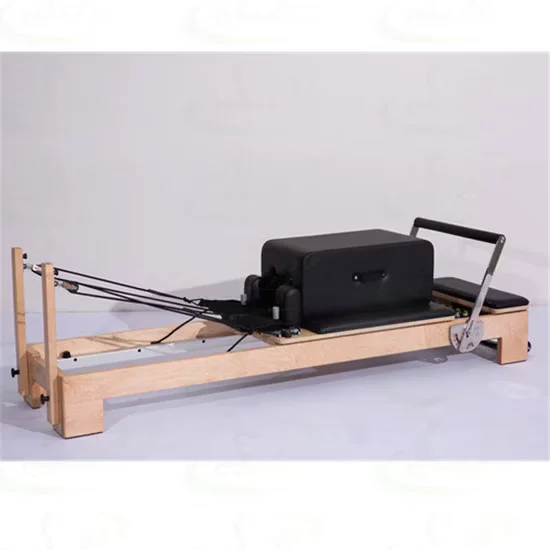
Solid Frame Stability — Oak wood construction minimizes vibration transfer, keeping operational noise low enough for shared studio environments.
Technical Specifications
| Parameter | Value |
|---|---|
| Product Type | Pilates Reformer |
| Dimensions | 2460 × 730 × 680 mm |
| Net Weight | 100 kg |
| Frame Material | Solid Oak Wood |
| Color Options | Solid Color finishes available |
| Included Accessories | Long Box, Jump Board, Platform |
| User Demographic | Adult, Unisex |
| Logo Customization | Available upon request |
| Warranty | 3 Years |
Application Suitability
| Deployment Scenario | Typical Use |
|---|---|
| Boutique Pilates studio | Daily group reformer classes and private sessions |
| Multi-location fitness chain | Standardized, branded apparatus across franchise locations |
| Rehabilitation center | Low-impact therapeutic movement and post-injury conditioning |
| High-end residential home gym | Personal practice in shared living spaces requiring quiet operation |
| Hotel wellness facility | Guest-accessible Pilates programming in spa and fitness areas |
Why Vibration Complaints Start Before the Reformer Even Moves
Solid oak wood frames absorb micro-vibrations that metal frames transmit into flooring and adjacent walls.
When Pilates studios occupy floors above occupied spaces — hotel guest rooms, offices, or residential units — the repetitive carriage glides and spring-loaded impacts generate structure-borne noise. Metal-framed reformers often amplify these vibrations through rigid joints and resonant frequencies [NEED_CITE: structure-borne noise propagation in multi-story commercial fitness deployments]. Facilities that installed lighter or hollow-section metal frames report complaints within weeks of opening, forcing retrofits or complete equipment swaps. An oak wood Pilates reformer addresses this at the source: the natural density and cellular structure of solid wood dampens vibration before it reaches the floor, reducing the acoustic signature transmitted to rooms below.
Where This Reformer Sits in a Studio Equipment Matrix
The reformer covers full-range resistance-based movement patterns from beginner foundational work through advanced athletic conditioning. It complements Cadillac and chair apparatus by handling supine, prone, and seated exercises that require linear carriage travel. The included long box, jump board, and platform extend the exercise library without requiring additional floor space or separate apparatus purchases. Studios typically position this commercial Pilates reformer oak wood unit along perimeter walls with adequate clearance for carriage extension and instructor circulation paths on both sides.
Continuous Studio Scheduling and Environmental Demands
Back-to-back group classes mean the carriage and spring system operates for extended daily periods with minimal rest intervals between sessions. The 100 kg frame mass anchors the unit during dynamic jump board work without shifting or requiring floor bolting [NEED_CITE: equipment stability requirements for dynamic loading in commercial Pilates]. Studios in humid climates or coastal regions must monitor wood finish integrity, as moisture fluctuation can cause dimensional changes that affect carriage rail alignment. Floor leveling is critical — an uneven surface creates uneven carriage glide and accelerates wear on rail contact points. Adequate spacing between units ensures instructor access and prevents acoustic overlap when multiple reformers operate simultaneously.
Reading the Frame and Carriage Engineering Decisions
Solid oak wood provides consistent density throughout the frame, unlike engineered wood products that contain voids or laminations with varying stiffness. The 2460 mm length accommodates full carriage travel for tall users while maintaining structural rigidity without intermediate support braces that would obstruct exercise positions. The 100 kg net weight reflects material mass rather than added ballast — this weight distributes across the frame footprint to resist tipping during off-center loading on the jump board. Accessory compatibility depends on mounting point standardization; confirming that the long box and platform share consistent attachment geometry across units prevents operational friction in multi-reformer classes.
What Frame Material Compromise Costs a Studio Over Time
Lighter frames reduce shipping costs but introduce resonance issues that manifest as rattling during spring transitions and audible squeaking during slow controlled movements. Studios that selected hollow-section aluminum frames for weight savings report that carriage noise escalates within months as connection points wear and fasteners loosen [NEED_CITE: fastener fatigue and noise escalation in high-frequency Pilates equipment]. Finish degradation on lower-grade wood or veneered surfaces exposes raw material to sweat absorption and discoloration, creating visual inconsistency across a studio’s fleet. Units that cannot support standardized accessory mounting force instructors to adapt programming around equipment limitations rather than client needs.
Why Studios Source This Equipment Line
The oak wood frame undergoes finishing processes verified for resistance to perspiration and repeated cleaning agents used in commercial environments. Each unit passes dimensional accuracy checks that ensure carriage rail parallelism — a critical factor for smooth, consistent glide throughout the reformer’s service life. The three-year warranty reflects confidence in the frame’s structural integrity under continuous studio scheduling. Studios outfitting multiple locations benefit from consistent OEM customization including logo placement and color matching, ensuring brand continuity across deployments. The complete accessory package — long box, jump board, and platform — arrives with the unit, eliminating secondary procurement cycles and ensuring compatibility.
Documentation & Test Records
- Load capacity and structural integrity verification report for the oak wood frame
- Surface finish durability assessment against commercial cleaning agents and perspiration exposure
- Accessory compatibility confirmation across long box, jump board, and platform attachments
- Dimensional accuracy certification for carriage rail parallelism and glide smoothness
- Assembly and commissioning guide with floor leveling and alignment procedures
- Spare parts catalog covering springs, carriage wheels, and rope assemblies
Installation, Commissioning & Maintenance
- Position with minimum clearance on all sides for instructor access and carriage over-travel safety
- Verify floor levelness before assembly; shim frame contact points to eliminate carriage drift on rails
- Inspect carriage wheel contact with rails after initial assembly and retension after the first week of use
- Apply manufacturer-specified lubricant to rail contact surfaces at intervals matching studio class volume
- Wipe oak wood surfaces with pH-neutral cleaner after each session to prevent sweat penetration into grain
- Check all fastener torque quarterly as wood seasonal movement may affect joint clamping force
Planning Your Studio Equipment Deployment
Provide your studio floor plan and planned class capacity to receive a layout addressing equipment spacing, instructor circulation, and acoustic zoning. Specify daily scheduling intensity so spring and carriage specifications match your operational tempo. Identify floor construction and adjacent occupied spaces to confirm whether supplemental acoustic isolation is necessary beneath the units. Confirm target market requirements for wood finish color and logo placement lead times before finalizing order quantities.
Frequently Asked Questions
Q: How does oak wood construction affect noise levels compared to metal frames?
A: Solid oak wood naturally dampens vibration through its cellular structure, preventing the resonance and rattling common in metal-framed reformers during spring transitions and carriage movement. This characteristic makes it suitable for studios located above occupied spaces where structure-borne noise generates complaints from tenants or guests below.
Q: What customization options are available for branding and color?
A: Logo placement and solid color finish options are available through OEM customization. Studios operating multiple locations can standardize branding elements across their entire equipment fleet for visual consistency. Lead times for customized finishes and logo application should be confirmed during the inquiry stage to align with project schedules.
Q: Are accessories interchangeable between different reformer models?
A: The long box, jump board, and platform are designed to mount on standardized attachment points on this reformer. When ordering multiple units or expanding an existing studio fleet, confirming mounting geometry consistency ensures that accessories can be shared across units during class rotations without compatibility issues.
Q: What maintenance is required for wood frames in humid environments?
A: Studios in high-humidity regions should monitor the oak wood finish for signs of moisture absorption, which can cause dimensional changes affecting carriage rail alignment. Regular application of manufacturer-recommended wood conditioner preserves finish integrity. Maintaining consistent indoor climate control reduces seasonal wood movement that may affect fastener tension.
Q: How does the 3-year warranty compare to industry standards for commercial use?
A: The three-year coverage period reflects the frame’s structural durability under continuous studio scheduling. This warranty encompasses the oak wood frame and primary structural components, addressing the most critical failure points in commercial Pilates environments where equipment operates across multiple daily sessions with varied user loading patterns.
![Factory Sales Spring Board Pilates Wall for Studio [WARN] draft identifier mismatch](https://bicksport.com/wp-content/uploads/2026/08/factory-sales-spring-board-pilates-wall-for-studio-warn-draft-identifier-mismatch-89d7ef.webp)
![Senrui Fitness Aluminium Alloy Half Tower Pilates Reformer Bed [WARN] draft identifier mismatch](https://bicksport.com/wp-content/uploads/2026/08/senrui-fitness-aluminium-alloy-half-tower-pilates-reformer-bed-warn-draft-identifier-mismatch-ea79df.webp)
![Wood Foldable Pilates Reformer Bed for Home Use and Yoga Studio [WARN] draft identifier mismatch](https://bicksport.com/wp-content/uploads/2026/08/wood-foldable-pilates-reformer-bed-for-home-use-and-yoga-studio-warn-draft-identifier-mismatch-9d916e.webp)
