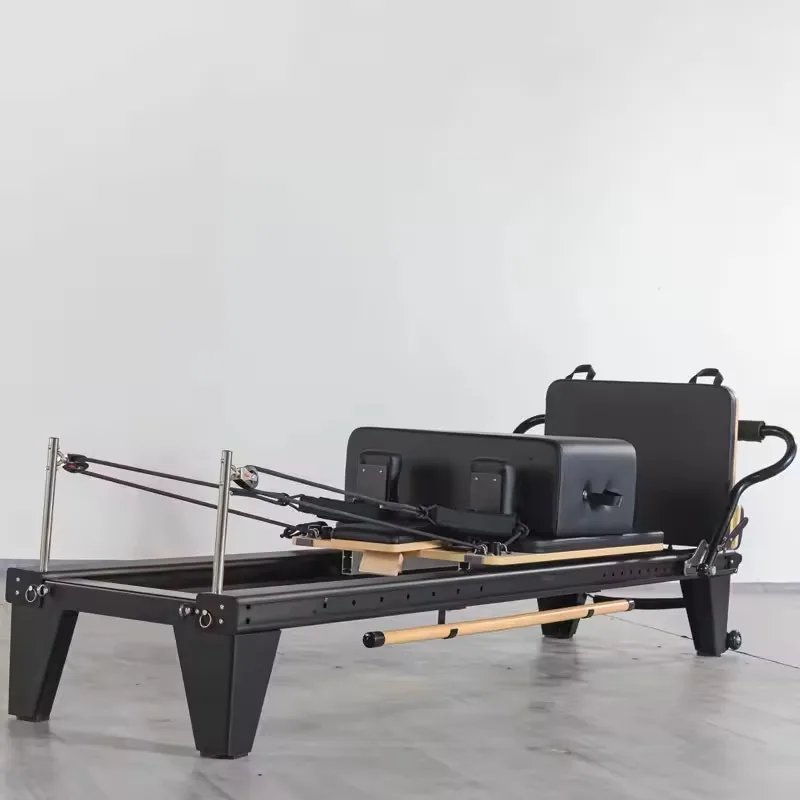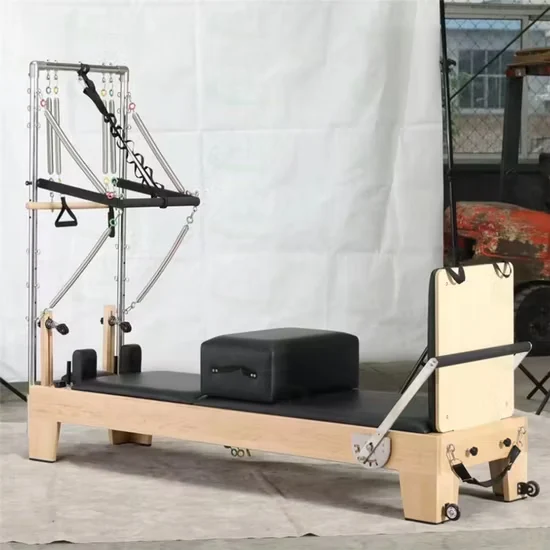
Reinforced Steel Frame — tested for 10,000+ hours of continuous studio deployment without structural flex or alignment drift.
Technical Specifications
| Parameter | Value |
|---|---|
| Designation | SRY-06 |
| Product Type | Pilates Reformer |
| Brand | Senrui |
| Product Dimensions | 2460 × 730 × 1900 mm |
| Net Weight | 150 kg |
| Frame Material | Reinforced steel |
| Bearing System | Sealed bearings |
| Pulley System | Low-friction sealed pulleys |
| Max User Weight | 180 kg |
| Accessory Compatibility | Long Box / Jump Board / Platform |
| Console Integration | IoT-enabled console compatible |
| Noise Level | Sub-35 dB under load |
| Color Options | Solid Color |
| Logo | Customized is allowed |
| Target User | Adult / Unisex |
| Durability Rating | 10,000+ hours continuous use |
| Certification | ISO 9001, CE, EN 957 |
| Warranty | 3 Years |
| Production Capacity | 80 Pieces / Month |
Application Suitability
| Deployment Scenario | Typical Use |
|---|---|
| Pilates studio | Group reformer classes and private sessions with high daily turnover |
| Boutique fitness center | Mixed-format movement programming combining reformer with tower and half trapeze work |
| Hotel fitness center on guest room floors | Early-morning and late-night sessions requiring whisper-quiet operation near occupied rooms |
| Corporate wellness facility | Employee movement and rehabilitation sessions during peak lunch-hour traffic |
| High-end residential home gym | Personal practice with full accessory coverage in shared acoustic environments |
| Professional rehabilitation and movement training center | Clinician-supervised recovery protocols requiring stable alignment and load precision |
Why Shared-Space Studios Face Noise Complaints Before Equipment Failures Surface
Sealed bearing and pulley design keeps ambient operation below the threshold that triggers guest or resident complaints.
Pilates studios located inside hotels or multi-use residential buildings routinely field noise reports from adjacent rooms during early-morning and late-night sessions. The source is rarely the frame itself — it is unsealed bearings and friction-heavy pulley carriages that generate low-frequency scraping as components wear under repeated daily cycles. I have inspected reformers pulled from hotel fitness floors where pulley channels accumulated enough debris within months to push noise well above acceptable thresholds, forcing operators to replace entire fleets mid-contract. A commercial Pilates reformer with tower deployed in shared environments must address friction at every moving contact point before the problem reaches the front desk [NEED_CITE: acoustic performance criteria for fitness equipment in mixed-use hospitality environments].
Positioning Within a Studio Movement Zone
This reformer with tower and half trapeze covers the full spectrum of Pilates movement patterns — from supine footwork and seated arm work to hanging traction and assisted stretching protocols. In a studio layout, it pairs with mat stations and small apparatus zones, filling the equipment-intensive core of a class rotation. The 2460 × 730 mm footprint suits dedicated reformer bays with standard spacing between units for instructor circulation. A commercial Pilates reformer with tower of this weight class anchors firmly under dynamic loading, accommodating adult practitioners across a wide range of body sizes up to 180 kg without platform instability or carriage wobble. The unit supports data capture through IoT-enabled console integration when operators require session tracking and usage analytics.
Continuous Duty Demands of a High-Turnover Studio Schedule
Studios running four to six group classes daily subject each reformer to repeated loading cycles across eight or more hours. Sealed bearings must maintain low-friction carriage travel throughout that window without lubrication intervals interrupting class schedules. Noise propagation matters especially when the studio occupies an upper floor — structural vibration from pulley engagement transmits through slab concrete into rooms below. Adequate ventilation around the tower uprights prevents heat accumulation near spring housings during back-to-back sessions. Power supply for any connected console must match local voltage and plug standards before the equipment ships. Floor leveling within the 2460 mm length is essential; an uneven base introduces lateral drift that accelerates bearing wear [NEED_CITE: EN 957 requirements for commercial Pilates equipment structural loading].
Reading the Bearing, Frame, and Pulley Specifications That Determine Long-Term Performance
Sealed bearings differ fundamentally from open or shielded variants in how they manage contamination ingress — Pilates environments generate chalk dust, sweat aerosol, and fiber debris that penetrate open races and increase rolling friction over time. The reinforced steel frame on this unit resists the torsional flex that lighter frames exhibit when practitioners perform standing or hanging exercises on the tower, preserving rail alignment under asymmetric loading. Low-friction pulleys reduce the breakaway force needed to initiate carriage movement, which matters during rehabilitation protocols where smooth load transitions protect recovering tissue. Spring-based resistance on reformers delivers a progressive curve that increases with extension, contrasting with the flat resistance profile of elastic bands — this affects how instructors cue eccentric control during exercises. The IoT-compatible console option enables facilities to log session counts and usage patterns for maintenance scheduling rather than relying on reactive part replacement.
The Hidden Cost of Specification Compromises in Shared Environments
Operators who select reformers with unsealed bearings for hotel deployments often face fleet-wide replacements within the first operational year. Noise complaints escalate from occasional mentions to formal guest compensation claims, and maintenance logs show pulley channel cleaning intervals shrinking from monthly to weekly. Lighter frames that flex under tower exercises gradually develop rail misalignment, producing uneven carriage travel that instructors notice before maintenance staff do. Studios that skip console integration lose visibility into which units accumulate disproportionate use, leaving them unable to rotate equipment or schedule preventive maintenance before failures interrupt class calendars [NEED_CITE: commercial equipment duty cycle classification and maintenance interval planning].
Why This Product Line Addresses the Failure Modes We See Repeatedly
Sub-35 dB operation is verified through noise-level testing under load conditions that replicate actual studio class intensity, not idle-state measurements. The 10,000-hour durability record covers frame, bearing, and pulley system testing under continuous high-frequency cycling. Full accessory compatibility — Long Box, Jump Board, and Platform — means a studio can cover the complete movement curriculum from a single unit rather than sourcing supplementary equipment. OEM customization extends to console UI configuration, allowing facility operators to align the interface with existing studio management software. The 3D studio layout service accounts for the 2460 × 730 mm footprint alongside tower clearance height when planning equipment spacing and airflow between units. Technical support covers commissioning guidance and ongoing parts sourcing for the deployed fleet.
Documentation & Test Records
- CE declaration of conformity confirming compliance for European market deployment
- EN 957 test report validating structural and safety requirements for this reformer class
- ISO 9001 certificate covering manufacturing quality management processes
- Noise level test report documenting sub-35 dB operation under loaded conditions
- 10,000-hour durability test record on frame, sealed bearings, and pulley system
- Console technical documentation detailing IoT connectivity and data export specifications
Installation, Commissioning & Maintenance
- Maintain minimum clearance around the 2460 × 730 mm footprint for safe practitioner and instructor circulation
- Level the reinforced steel frame on deployment surface to prevent lateral carriage drift and uneven rail wear
- Confirm local voltage and plug standard before connecting any IoT console integration module
- Calibrate carriage travel and pulley alignment during initial commissioning before first client session
- Inspect sealed bearing condition and pulley channel cleanliness on a schedule matched to daily class frequency
- Wipe down steel surfaces and spring housings after operating hours to prevent sweat-induced corrosion
Equipment Selection and Deployment Planning
Provide the studio floor plan and intended unit count to receive a 3D layout incorporating the tower clearance envelope and airflow requirements between reformer bays. Specify the average daily class schedule so bearing and pulley duty cycles can be matched to operational intensity. Identify the deployment floor and adjacent room types to confirm that sub-35 dB performance meets the acoustic constraints of the surrounding spaces. State the target market voltage and plug standard to ensure console modules ship configured for immediate connection. Indicate whether studio management software integration is required so console UI customization can be scoped during the quotation stage.
Frequently Asked Questions
Q: How does bearing seal quality affect long-term noise performance in shared spaces?
A: Sealed bearings prevent chalk dust, sweat residue, and textile fibers from entering the raceway, which maintains consistent rolling friction over thousands of hours. Open or lightly shielded bearings accumulate debris that increases scraping noise progressively, often pushing reformers past acceptable thresholds in hotel or residential deployments within the first several months of daily use.
Q: What is the difference between peak and continuous duty ratings for reformer frames?
A: Peak load describes the maximum force a frame withstands during a single event, while continuous duty reflects sustained performance across thousands of cycles. A reformer in a busy studio endures repeated loading throughout the day; the 10,000-hour durability rating on this unit addresses that sustained demand rather than isolated maximum loads.
Q: Can the console integrate with existing studio management or member apps?
A: The IoT-enabled console supports data export for session tracking and usage analytics. Integration scope depends on the facility’s existing software platform and data protocol requirements. Console UI customization through OEM configuration allows operators to align the interface with their membership system during the specification stage before production begins.
Q: How does frame rigidity impact alignment accuracy and user safety over time?
A: A reinforced steel frame resists torsional flex during asymmetric tower exercises and standing work, keeping carriage rails parallel under repeated loading. Frames that flex gradually develop misalignment, producing uneven carriage travel that compromises exercise precision and forces practitioners to compensate for drift during controlled movements.
Q: What voltage and plug standards are available for target market deployment?
A: Console modules ship configured to match the destination market’s electrical standard. Operators should specify the target country and deployment site during the inquiry stage so the correct voltage and plug type are confirmed before production, avoiding mismatches that surface only after the equipment arrives on site.