
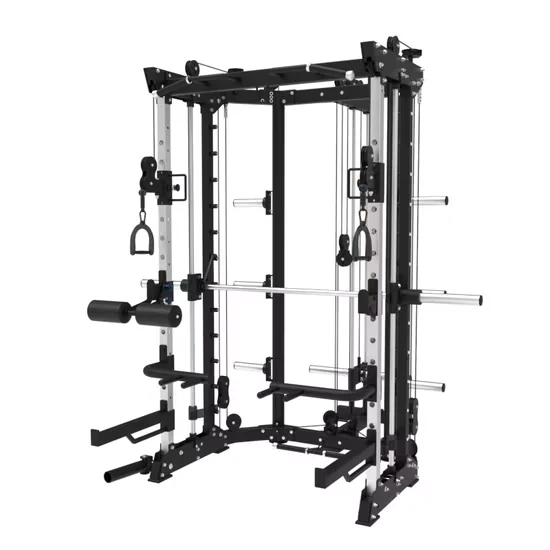
Zero-Motor Noise — Manual resistance design eliminates motor hum, keeping facility acoustics below complaint thresholds across 24/7 operation cycles.
Technical Specifications
| Parameter | Value |
|---|---|
| Product Type | Smith Machine Power Rack |
| Material | Steel |
| Tube Thickness | 3mm |
| Resistance Type | Manual |
| Max User Weight | 180kg |
| Product Dimensions | 1660 × 2009 × 2285 mm |
| Net Weight | 280kg |
| Frame Color | Customizable (Yellow, Black, Orange, Pink, etc.) |
| Cushion Color | Customizable (Yellow, Black, Orange, Pink, etc.) |
| Foldable | Unfolded |
| Power Source | Manual (No electrical requirement) |
| Certification | CE |
| OEM/ODM | Available |
| Development History | More than 10 years |
Application Suitability
| Deployment Scenario | Typical Use |
|---|---|
| Chain gym strength training zone | Primary compound lift station for squats, presses, and rack pulls under high-frequency daily use |
| Corporate wellness room | Space-efficient multi-function station covering full-body resistance training without multiple separate units |
| High-end residential home gym | Custom-color coordinated equipment matching interior finishes with zero motor noise bleed to adjacent rooms |
| Hotel fitness center | Unattended 24/7 strength training station with no electrical dependency or motor maintenance requirements |
| Sports performance training center | Controlled barbell path training for athletes requiring consistent movement mechanics during supervised sessions |
Why Frame Rigidity Becomes a Liability Claim Before Warranty Expires
A commercial smith machine power rack cable crossover lives or dies by what happens when a loaded barbell reaches the bottom of a squat.
I once walked into a regional chain gym where members were refusing to use the Smith stations. Not because of discomfort or programming gaps — the frames were visibly flexing under moderate loads. The uprights were spec’d at 2mm wall thickness, fine for light-duty cycles but incapable of managing torsional stress during eccentric phases with heavier plates [NEED_CITE: structural deformation thresholds for commercial strength frames]. Members notice wobble long before they notice anything else, and when confidence erodes in a controlled-path machine, the equipment becomes furniture.
Positioning Within the Strength Training Zone
This commercial smith machine power rack cable crossover serves as a primary compound movement hub covering squat, press, row, and cable fly patterns from a single footprint. It pairs naturally with free-weight benches and dumbbell stations, absorbing the guided-path training volume while dedicated racks handle pure barbell work. The 180kg max user capacity accommodates most commercial demographics without requiring separate heavy-duty units. Suitable for high-density placement where floor space is at a premium.
Continuous Use Without Electrical Infrastructure
Because the resistance system is entirely manual, this unit draws zero power and generates no motor heat, removing the duty-cycle constraints that govern motorized cardio equipment. Deployment on upper floors or in spaces without dedicated electrical circuits presents no complication. The 280kg frame mass provides inherent stability without floor anchoring in most concrete-subfloor installations [NEED_CITE: floor load requirements for static commercial strength equipment]. The primary environmental requirement is adequate ceiling clearance — the 2285mm height demands measurement against HVAC ducting and lighting fixtures before finalizing placement.
Decoding the Structural Specifications
The 3mm tube thickness represents the most consequential specification on this frame. Thinner-walled steel can achieve similar static load ratings but will exhibit measurable deflection under dynamic loading — the difference between a bar that tracks cleanly through a squat and one that shudders at the reversal point. The manual resistance system removes every failure point associated with motors, circuit boards, and power supplies. No drive belt to replace, no electronic calibration to drift, no control board vulnerable to voltage spikes. The pulley and cable system for the crossover function operates on mechanical advantage alone, with sealed bearings at each redirect point managing friction without scheduled lubrication intervals.
What Specification Compromises Actually Cost
Gyms that source 2mm-wall frames discover the gap between static load testing and real-world dynamic use within the first year. Frames develop audible play at weld joints, pulley alignment shifts under lateral cable loading, and members migrate to equipment that feels planted. Facilities deploying electrically driven alternatives in this category face motor service calls that pull revenue-generating stations offline for days at a time [NEED_CITE: average downtime cost per station in commercial fitness facilities]. The manual design here removes that entire failure vector — when nothing can burn out, nothing requires emergency replacement.
Why This Product Line Delivers on Its Claims
Every unit undergoes structural load testing that exceeds the published 180kg user rating, verifying frame behavior under dynamic rather than static conditions alone. The 3mm steel construction matches the engineering standard applied across Biketon Sport’s commercial range, ensuring structural consistency whether a facility orders a single station or outfits an entire floor. Custom frame and cushion colors run through the same OEM/ODM pipeline, meaning brand-aligned aesthetics do not require separate sourcing. The 3D layout planning service accounts for the 1660 × 2009mm footprint plus required clearance arcs for loaded barbell travel, preventing the congestion that leaves equipment underused. Technical support covers structural inspection protocols and cable tensioning schedules rather than troubleshooting proprietary electronics that do not exist on this unit.
Documentation & Test Records
- CE declaration of conformity confirming European market safety compliance for this unit
- EN 957 test report documenting structural and functional safety verification
- ISO 957 certification supporting quality management across the manufacturing process
- Frame load and durability test records at dynamic stress levels
- Cable and pulley system wear-cycle documentation
- Customization specification sheets for frame color and cushion options
Installation, Commissioning & Maintenance
- Confirm ceiling clearance exceeds 2285mm plus barbell travel allowance before uncrating
- Level frame on concrete subfloor using integrated adjustable feet to eliminate torsional pre-load
- No dedicated electrical circuit required — position independent of power outlet locations
- Verify pulley alignment and cable tension across full travel range during first assembly
- Inspect cable sheathing and bearing smoothness at scheduled intervals based on usage frequency
- Wipe steel surfaces and cushion upholstery after use to prevent sweat corrosion
Planning Your Strength Equipment Deployment
Submit your facility floor plan and intended user volume to receive a 3D layout accounting for this unit’s footprint, barbell clearance arcs, and adjacent equipment spacing. Specify whether the deployment environment includes humidity-controlled spaces or unconditioned areas to confirm finish durability requirements. Indicate target market for any regional compliance documentation needed beyond CE. Confirm whether custom color matching requires sample approval before production commitment.
Frequently Asked Questions
Q: What is the fundamental difference between a Smith machine and a free-weight power rack?
A: A Smith machine constrains the barbell to a fixed vertical or near-vertical path, reducing the stabilizer muscle demand and allowing solo training without a spotter. A free-weight power rack requires the user to control bar path in all planes, engaging more muscle groups but demanding greater skill. Many facilities deploy both to serve different training populations.
Q: How does 3mm tube thickness compare to 2mm in actual gym use?
A: Under dynamic loading — particularly during eccentric phases of squats or presses — 3mm steel exhibits noticeably less flex and vibration than 2mm construction. Members perceive this as stability and confidence in the equipment. Over extended use cycles, thicker walls also resist fatigue cracking at weld points far longer than thinner alternatives.
Q: Does the manual resistance system require any regular maintenance?
A: The manual design eliminates motor servicing, electronic calibration, and power supply checks entirely. Maintenance focuses on mechanical inspection: verifying cable tension, checking pulley bearing smoothness, and confirming bolt torque at structural connections. These tasks require standard hand tools and integrate into routine facility maintenance schedules.
Q: Are weight plates for the cable crossover system included in the standard quotation?
A: Weight plates and Olympic barbells are typically quoted as accessories separate from the frame assembly. This allows facilities to specify plate quantities based on their user population’s strength levels and to source compatible plates from existing inventory or preferred suppliers. Confirm plate inclusion during the quotation stage.
Q: What does on-site assembly involve after delivery?
A: The unit ships partially disassembled to reduce transport volume. On-site assembly involves bolting the main frame sections together, installing the pulley and cable system, and tensioning all connections. Two technicians with standard tools typically complete assembly within a working session. The installation guide specifies torque values and assembly sequence.

![Commercial Multi-Functional Smith Machine Cable Crossover Power Rack [WARN] draft identifier mismatch](https://bicksport.com/wp-content/uploads/2026/08/commercial-multi-functional-smith-machine-cable-crossover-power-rack-warn-draft-identifier-mismatch-7605dc.webp)

![Dual Pec Fly Power Cage Commercial Gym Strength Training Machine PX-1069 [WARN] draft identifier mismatch](https://bicksport.com/wp-content/uploads/2026/08/dual-pec-fly-power-cage-commercial-gym-strength-training-machine-px-1069-warn-draft-identifier-mismatch-c8a764.webp)