
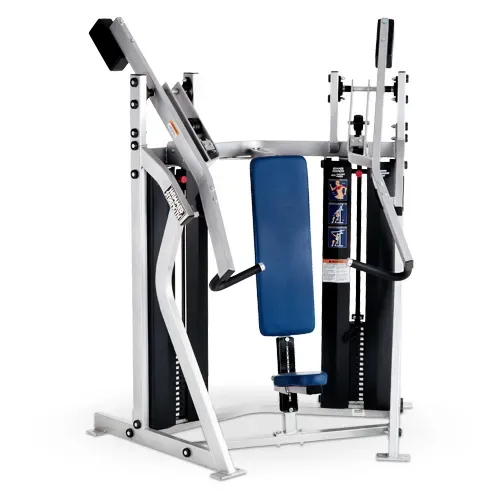
10,000-Hour Durability — MTS-8014 ISO-lateral reciprocating mechanism tested through continuous high-frequency load cycles to ensure structural integrity in commercial gymnasium environments.
Technical Specifications
| Parameter | Value |
|---|---|
| Designation | MTS-8014 |
| Product Type | ISO-Lateral Reciprocating Machine |
| Dimensions (L x W x H) | 122 cm x 145 cm x 140 cm |
| Net Weight | 385 kg |
| Weight Stack | 70 kg x 2 Stacks |
| Machine Grade | Commercial Use |
| Resistance Type | Weight Stack |
| Frame Construction | Reinforced Steel |
| Movement Pattern | ISO-Lateral Independent |
| Customization | Available (Color, Logo, Pad Material) |
| Certification | CE, ISO, RoHS, SGS |
Application Suitability
| Deployment Scenario | Typical Use |
|---|---|
| Chain gym strength zone | High-frequency hypertrophy and isolation training for general membership |
| Professional sports training center | Correcting unilateral strength imbalances in athlete conditioning programs |
| High-end hotel fitness center | Durable, self-guided resistance work for independent guest use |
| Corporate wellness room | Moderate-intensity muscle conditioning for employees during breaks |
| High-end residential home gym | Space-efficient, dual-stack resistance training for dedicated personal facilities |
Why Frame Resonance and Cable Friction Dictate Equipment Lifespan
A heavy-duty frame and sealed bearings prevent the mechanical degradation that forces early replacements in busy facilities.
When a commercial gym strength zone operates at capacity, the continuous loading and unloading of weight stacks generate significant vibration. In lighter machines, this leads to frame resonance, which eventually compromises weld points and guide rod alignment. The commercial ISO-lateral reciprocating machine MTS-8014 addresses this through its 385 kg net weight and reinforced steel structure, which absorbs operational stress and maintains trajectory consistency [NEED_CITE: structural fatigue analysis of commercial gym equipment frames under cyclic loading]. If the guide rods warp even slightly under repetitive stress, the cable friction increases, causing a rough feel and accelerating wear on pulleys and belts.
Equipment Role and Intensity Profile in the Strength Zone
The MTS-8014 ISO-Lateral Reciprocating Machine serves as a primary compound movement station, typically targeting large muscle groups through independent bilateral resistance. In a comprehensive cardio and strength layout, it complements free-weight areas by providing guided, isolateral motion that minimizes stabilization demands while maximizing target muscle recruitment. This equipment is designed for high-use density placement, where member turnover is rapid and intuitive seat and pad adjustments are necessary to accommodate a wide range of user statures. The dual 70 kg stacks allow for precise load increments, supporting both high-intensity athletic protocols and moderate rehabilitation or general fitness work.
Continuous Operation and Facility Environment Requirements
For facilities running 12 to 24 hours daily, the mechanical duty cycle of any strength station must account for thousands of repetitions per week. This MTS-8014 unit relies on a robust weight stack system rather than electronic motors, reducing the risk of thermal failure associated with continuous use [NEED_CITE: duty cycle classifications for commercial weight stack mechanisms]. Deployment requires a level, high-density rubber floor to dampen vibration transmission to adjacent spaces or lower floors. Adequate clearance around the 122 cm x 145 cm footprint is essential for safe loading and unloading, while environmental control prevents humidity-induced corrosion on the guide rods and weight plates.
Mechanics of the Dual-Stack and ISO-Lateral System
The ISO-lateral design allows each side of the machine to move independently, which is critical for identifying and correcting unilateral strength deficits that fixed-path machines often mask. By utilizing two separate 70 kg weight stacks, the system ensures that the dominant side cannot compensate for the weaker side during reciprocating movements. The 385 kg machine weight provides a stable base, preventing any lateral shift or "walking" during heavy, explosive repetitions. Commercial-grade sealed bearings within the pivot points reduce friction and eliminate the need for frequent lubrication, maintaining a consistent resistance curve throughout the entire range of motion. This mechanical precision ensures that the load felt by the user remains accurate, which is vital for progressive overload programming in professional training centers.
The Hidden Costs of Specifying Light-Commercial Alternatives
Choosing equipment with lighter frames or lower-grade pulley systems often results in premature cable fraying and misaligned weight stacks within the first year of commercial operation. These failures lead to equipment downtime, member complaints about "sticky" or uneven resistance, and ultimately, the cost of emergency replacements. In high-end hotel or residential deployments, the audible clatter of worn plastic bushings or vibrating sheet metal can generate noise complaints, forcing operators to relocate or discard the units entirely [NEED_CITE: maintenance cost comparison of commercial vs. light-commercial strength equipment]. Data shows that facilities prioritizing initial cost over structural mass frequently face higher total cost of ownership due to these mechanical attrition issues.
Why This Product Line Meets Facility Demands
The engineering focus here is on acoustic and mechanical longevity, verified through 10,000-hour durability testing on moving parts and frame welds. For this MTS-8014, that means the guide rods and pulleys are tested to withstand continuous high-frequency use without developing play or noise. The full OEM/ODM capability allows operators to match the equipment aesthetics—pad materials and frame colors—to their specific interior design. Furthermore, the 3D layout planning service ensures this 122 cm x 145 cm unit is positioned with proper sightlines and airflow, preventing the creation of congested zones. Backed by 24/7 technical support, the supply chain ensures spare parts availability for the dual-stack system, minimizing operational downtime.
Documentation & Test Records
- CE declaration of conformity for commercial strength equipment safety.
- EN 957 test report verifying structural integrity and stability.
- ISO 9001 certificate covering manufacturing quality control processes.
- RoHS compliance documentation for material safety standards.
- Durability test record for weight stack and cable systems.
Installation, Commissioning & Maintenance
- Ensure 122 cm x 145 cm footprint has 60 cm safety clearance on all sides.
- Level the 385 kg frame on high-density rubber matting to prevent shifting.
- Verify guide rod lubrication and cable tension during initial commissioning.
- Inspect dual 70 kg stack cables and pulleys quarterly for wear.
- Clean pads and frame weekly to prevent sweat-induced corrosion.
Inquiry Guidance for Equipment Selection
To determine if the MTS-8014 ISO-lateral reciprocating machine fits your facility, provide the total square footage of your strength zone and the desired equipment density. Specify your daily operating hours so we can confirm the mechanical duty cycle aligns with your traffic volume. If deploying on upper floors or in noise-sensitive hotel environments, mention the adjacent room types so we can advise on vibration isolation requirements. Finally, indicate if you require specific OEM customization for pad materials or frame colors to match your brand identity.
Frequently Asked Questions
Q: What is the difference between ISO-lateral and fixed-path equipment?
A: ISO-lateral equipment allows each side of the machine to move independently, which is essential for correcting muscle imbalances. Unlike fixed-path machines that lock both limbs into a single bar, this MTS-8014 design ensures the stronger side cannot compensate for the weaker one, providing more accurate isolation and reducing the risk of injury during heavy compound movements.
Q: How do commercial venues assess the durability of strength equipment?
A: Procurement teams evaluate the total machine weight, frame welding quality, and the rating of guide rods and pulleys. A unit like the 385 kg MTS-8014 is tested for 10,000 hours of continuous operation. Facilities also look for sealed bearings and commercial-grade cables that resist fraying under high-frequency repetition cycles typical of busy gymnasium environments.
Q: What actual benefit does a dual weight stack design provide?
A: A dual 70 kg stack system provides independent resistance for each limb, which is critical for balanced development and rehabilitation. It allows users to perform unilateral work without the machine binding or pulling to one side. This setup also facilitates drop sets and supersets more efficiently, as the independent stacks can be adjusted rapidly without affecting the opposite side.
Q: What are the maintenance priorities for weight stack machines?
A: The primary maintenance tasks involve inspecting the selector pins, cables, and pulleys for signs of wear or fatigue. Guide rods must be kept clean and lightly lubricated to ensure the weight stack moves smoothly without friction or noise. Regular checks of the frame bolts and pad integrity are also necessary to maintain safety and comfort for users.
Q: How should I plan the layout for these machines in a strength zone?
A: When planning a layout, account for the 122 cm x 145 cm footprint plus a minimum of 60 cm on all sides for user entry and plate loading. Consider the sightlines so instructors can monitor form, and ensure adequate ventilation between heavy compound stations. Positioning ISO-lateral units near free-weight areas creates a logical progression for members moving between training modalities.

![Body Building ISO-Lateral Rear Deltoid Machine Commercial Gym Equipment [WARN] draft identifier mismatch](https://bicksport.com/wp-content/uploads/2026/08/body-building-iso-lateral-rear-deltoid-machine-commercial-gym-equipment-warn-draft-identifier-mismatch-9567ab.webp)
