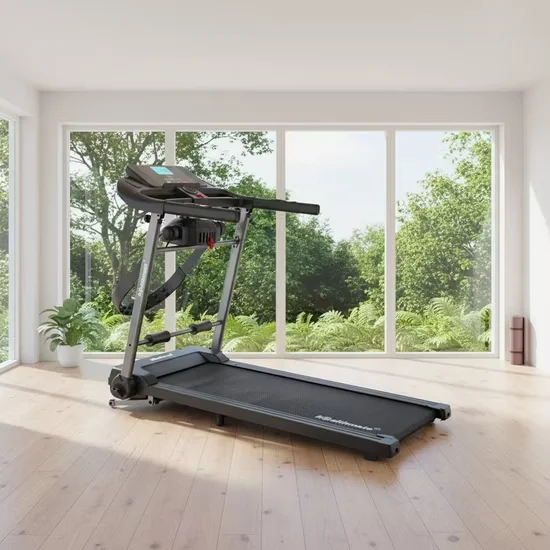
![Mt026m Waterproof Electric Fold Home Silent Treadmill for Fat Burning [WARN] draft identifier mismatch](https://bicksport.com/wp-content/uploads/2026/08/mt026m-waterproof-electric-fold-home-silent-treadmill-for-fat-burning-warn-draft-identifier-mismatch-864393.webp)
Whisper-Quiet Residential Operation — DC motor platform and foldable chassis engineered for shared-wall and above-floor deployments where noise transmission is the primary constraint.
Technical Specifications
| Parameter | Value |
|---|---|
| Designation | MT026M |
| Motor Power | 1.5HP * |
| Speed Range | 1–12 km/h |
| Running Surface | 1200 x 460 mm |
| Console Type | LCD (Speed / Distance / Time / Calories / Pulse) |
| Programs | 12 preset programs |
| Heart Rate | Handgrip pulse sensor |
| Product Dimensions (Unfolded) | 1465 x 750 x 1150 mm |
| Product Dimensions (Folded) | 1465 x 750 x 390 mm |
| Net Weight | 46.0 kg |
| Foldable | Yes |
| Material | ABS |
| Color Options | Multicolor |
| OEM/ODM Custom | Available |
| Certification | CE, RoHS |
* Peak or continuous rating not specified in source — verify against manufacturer motor specification sheet before deployment.
Application Suitability
| Deployment Scenario | Typical Use |
|---|---|
| High-end residential home gym | Daily personal cardio in noise-sensitive shared living environments |
| Compact apartment fitness corner | Foldable storage between sessions, limited permanent footprint |
| Corporate wellness room | Light-to-moderate employee use during workday breaks |
| Community fitness center | Moderate daily usage cycles with residential adjacency |
| Boutique hotel guest floor fitness alcove | Quiet operation on occupied floors with adjacent guest rooms |
Why Noise Complaints Reach the Front Desk Before Maintenance Does
A treadmill that sounds acceptable in an open showroom becomes a liability when installed above occupied rooms.
In shared-wall and above-floor deployments, motor vibration and belt noise travel through structural elements that were never designed to absorb cardio-frequency resonance. I have seen batch deployments pulled from hotel guest floors within weeks because the DC motor platform was never evaluated for sustained quiet operation at the actual deployment speed range — the unit was selected on horsepower alone. [NEED_CITE: structural noise transmission standards for cardio equipment on suspended floors] When a foldable home treadmill 1.5HP silent electric unit runs at 10 km/h on the eighth floor, the guest in 704 does not file a maintenance ticket; they file a complaint at reception.
Positioning the MT026M Within a Compact Cardio Zone
This foldable home treadmill 1.5HP silent electric unit covers steady-state walking through moderate running at speeds up to 12 km/h, making it suitable for general cardiovascular conditioning rather than sprint or interval training. In a multi-equipment cardio zone, it pairs naturally with a seated stepper or compact elliptical to provide an upright walking and running option alongside lower-impact alternatives. The 1200 x 460 mm running surface accommodates users of average to above-average height for walking and jogging gaits, though taller users at faster speeds may find the deck length limiting. The foldable chassis allows the unit to be stored against a wall, reducing its permanent footprint in multi-use rooms that serve other functions throughout the day.
Continuous Operation and Deployment Environment Requirements
The DC motor platform is designed for light-to-moderate daily duty cycles typical of residential and corporate wellness settings rather than continuous commercial operation. [NEED_CITE: motor duty cycle classification for light-commercial versus full-commercial cardio equipment] Noise output at operating speed should be confirmed via test report before deploying on suspended floors or adjacent to occupied rooms, as structural transmission varies significantly with building construction. The unit requires a standard single-phase power supply; voltage and plug configuration must match the target market before production. Adequate ventilation around the motor housing is necessary during extended sessions, and a level floor with a vibration-dampening mat is recommended to minimize structural noise transfer in above-floor installations.
Reading the Motor and Drive Specifications
The 1.5HP motor rating requires clarification: without a stated distinction between peak and continuous output, the figure alone does not confirm whether the motor can sustain that output across a full training session or only in short bursts. DC motors in this class typically offer quieter operation than equivalent AC motors, which is relevant for residential and hotel floor deployments where acoustic performance matters more than raw power. The 1–12 km/h speed range covers walking through moderate jogging, positioning this unit outside the performance envelope needed for high-speed interval work. The handgrip pulse sensor provides basic heart rate feedback, though users should understand that grip-based capture is inherently less stable than chest-strap monitoring during dynamic movement. The LCD console displays five core metrics — speed, distance, time, calories, and pulse — across 12 preset programs, offering straightforward workout tracking without app synchronization or facility management data export.
What Specification Shortcuts Cost After Deployment
Selecting a treadmill on horsepower alone, without confirming continuous duty rating against the intended daily usage frequency, leads to premature motor burnout when light-residential units are placed in corporate or community settings. Noise output that was never measured at actual deployment speed generates guest complaints and unit replacement cycles that far exceed the cost of upfront acoustic testing. [NEED_CITE: total cost of cardio equipment replacement due to duty cycle mismatch] The absence of confirmed maximum user weight data creates liability exposure when facility demographics include users near or above unverified load limits. Voltage mismatches discovered after container arrival force entire batches into rework or transformer dependency, delaying deployment and eroding buyer confidence.
Why This Product Line Fits the Brief
The MT026M is part of a six-series cardio family that allows a facility to source every discipline from a single manufacturing line, simplifying specification alignment and spare parts logistics. The foldable chassis reduces permanent footprint to 1465 x 750 x 390 mm, which directly informs spacing calculations in 3D cardio zone layouts for compact rooms. OEM and ODM customization extends to color, console interface, and specification parameters at flexible minimum order quantities. Components are tested for 10,000 hours of continuous high-frequency operation under the manufacturer’s commercial durability protocol. Free 3D cardio zone layout and airflow planning covers square footage, sightlines, and member flow — including foldable unit storage positioning — before a single unit ships. Technical support is available around the clock for commissioning and post-deployment issues.
Documentation & Test Records
- CE declaration of conformity for MT026M foldable treadmill
- EN 957 test report covering structural and performance requirements
- ISO 9001 certificate for manufacturing quality management
- RoHS compliance documentation for material restrictions
- Motor specification sheet with continuous and peak rating clarification
- Console technical documentation with display parameter definitions
- Installation and commissioning guide with wiring diagrams
- Spare parts list with component identification numbers
Installation, Commissioning & Maintenance
- Maintain minimum 600 mm clearance behind and 300 mm on each side of the 1465 x 750 mm unfolded footprint
- Install on a level surface with vibration-dampening mat to reduce structural noise transfer on suspended floors
- Connect to a dedicated single-phase circuit matching target market voltage and plug standard
- Run initial belt alignment and tension check after first two hours of operation
- Lubricate running belt at intervals specified in the commissioning guide based on cumulative usage hours
- Wipe LCD console and handgrip pulse sensors after each session to prevent sweat corrosion on contacts
Equipment Selection and Inquiry Parameters
Provide the cardio zone area and equipment count to receive a 3D layout with airflow planning that accounts for the foldable storage footprint. Specify expected daily usage hours per unit so the motor duty cycle can be confirmed against the deployment scenario. Identify the deployment floor and adjacent occupied spaces to determine whether acoustic testing documentation is required before shipment. Confirm target market voltage and plug standard, and indicate whether console data output to facility management systems is a requirement for your procurement specification.
Frequently Asked Questions
Q: What is the difference between peak and continuous motor horsepower, and why does it matter?
A: Peak horsepower represents the maximum output a motor can deliver in short bursts, while continuous horsepower reflects sustained output over an extended session. For daily use, continuous rating determines whether the motor will perform reliably without thermal shutdown. Always request the motor specification sheet to confirm which rating applies before finalizing deployment plans.
Q: How does DC motor noise compare to AC motor noise in shared-wall residential deployments?
A: DC motors generally produce lower audible noise and less vibration than equivalent AC motors at similar output levels. This makes them preferable for apartments, hotel guest floors, and other environments where sound transmission through walls and floors is a concern. Actual noise output should always be confirmed with a test report at the intended operating speed.
Q: Can the LCD console data sync with facility management software or member apps?
A: The MT026M LCD console displays real-time workout metrics including speed, distance, time, calories, and pulse, but the source documentation does not confirm IoT connectivity or app synchronization capability. If data integration is required for your deployment, specify this requirement during the inquiry stage so an appropriate console configuration can be evaluated.
Q: What should I verify about maximum user weight before deploying this treadmill?
A: The maximum user weight is not specified in the source documentation and must be confirmed against the manufacturer catalog before deployment. Matching the rated capacity to your facility user demographic prevents structural overload, frame fatigue, and potential liability exposure in commercial and community settings.
Q: How does the foldable mechanism affect frame rigidity during daily use?
A: Foldable chassis designs introduce hinge points that can affect lateral stability compared to fixed-frame units. The MT026M folds from 1150 mm to 390 mm in height for storage, but long-term durability under repeated daily folding and unfolding should be evaluated against the expected deployment frequency and user weight profile.
![MT296 Low Noise ABS Smart Electric Treadmill for Fitness Training[result]MT296 Low Noise ABS Electric Treadmill for Commercial Fitness Training [WARN] draft identifier mismatch[/result]](https://bicksport.com/wp-content/uploads/2026/08/mt296-low-noise-abs-smart-electric-treadmill-for-fitness-trainingresultmt296-low-noise-abs-electric-treadmill-for-commercial-fitness-training-warn-draft-identifier-mismatch-result-8e06e1.webp)