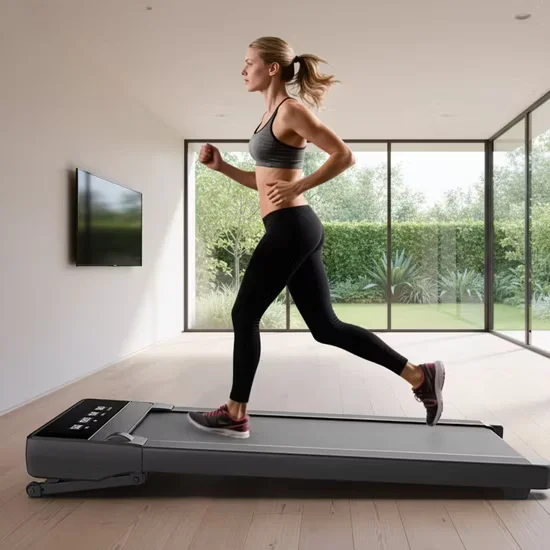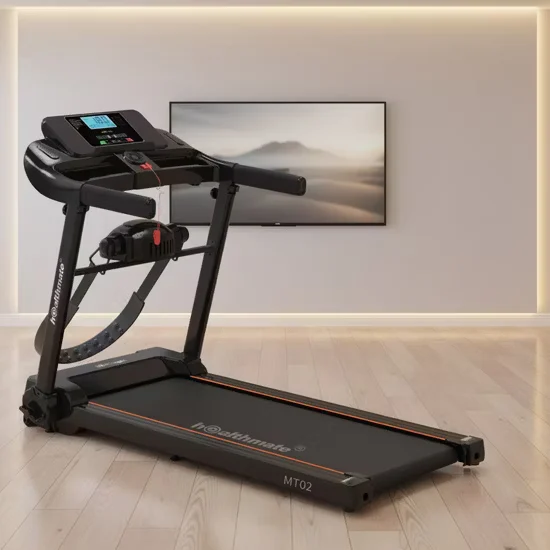
Space-Efficient Footprint — A foldable chassis reduces storage depth to 390 mm, enabling flexible deployment in multi-use residential and corporate fitness rooms.
Technical Specifications
| Parameter | Value |
|---|---|
| Designation | MT026M |
| Product Type | Foldable Treadmill |
| Motor Type | DC |
| Motor Power | 1.5 HP (peak or continuous not specified in source) |
| Speed Range | 1 – 12 km/h |
| Running Surface | 1200 × 460 mm |
| Console Type | LCD (Speed / Distance / Time / Calories / Pulse) |
| Programs | 12 preset programs |
| Foldable | Yes |
| Product Unfold Size | 1465 × 750 × 1150 mm |
| Product Folded Size | 1465 × 750 × 390 mm |
| Net Weight | 46.0 kg |
| Certification | CE, RoHS |
| Material | ABS |
| OEM/ODM | Available |
Application Suitability
| Deployment Scenario | Typical Use |
|---|---|
| high-end residential home gym | Daily walking and light jogging for household members, folded away when not in use |
| corporate wellness room | Intermittent use during breaks by employees, requiring compact footprint in shared spaces |
| light-commercial fitness studio | Supplementary cardio unit in multi-purpose training areas with limited square footage |
| residential fitness room in apartment complexes | Shared facility cardio option where storage flexibility and acoustic output are considerations |
What a 1.5 HP Rating Conceals About Continuous Operation
Matching motor duty cycle to expected daily run-time prevents premature thermal failure in shared facilities.
Facilities that deploy home-grade treadmills in lightly trafficked corporate rooms or residential fitness areas often encounter motor burnout when actual usage patterns exceed the design envelope [NEED_CITE: motor duty cycle classification for continuous commercial operation]. A foldable electric treadmill DC motor LCD console configuration like the MT026M targets intermittent, lighter-duty cycles where the equipment is not expected to run continuously for hours on end. When procurement decisions focus solely on peak horsepower without verifying continuous duty ratings, the resulting thermal stress accumulates over weeks, eventually leading to unexpected downtime. Operators who experience repeated motor failures in shared residential fitness rooms frequently trace the issue back to a mismatch between the motor’s rated duty cycle and the actual number of daily users logging extended sessions.
Positioning Within a Compact Cardio Zone
This unit covers walking through light jogging intensity ranges at speeds up to 12 km/h, making it suitable for warm-up protocols, steady-state cardio, and cool-down phases. In a mixed-modality fitness room, it complements bodyweight training stations and resistance equipment by providing accessible cardiovascular stimulus without dominating floor space. The 1200 × 460 mm running surface accommodates walking and light jogging for users of average build, though taller individuals conducting sustained running sessions may require a longer deck. The foldable electric treadmill DC motor LCD console design allows facility planners to position the unit against walls or in corners, freeing central floor area for group activities or functional training equipment.
Deployment Constraints for Intermittent-Use Environments
Daily run-time expectations should be matched against the DC motor’s thermal capacity, as sustained back-to-back usage in shared residential facilities can push the system beyond its designed duty cycle [NEED_CITE: thermal management requirements for DC motors in fitness equipment]. The foldable frame introduces structural considerations: when deployed for use, the unit must sit on a level surface with adequate clearance behind the deck for safe mounting and dismounting. Noise transmission through floor structures should be evaluated when placing the unit on upper levels of residential buildings or hotel guest floors, as DC motor acoustic output, while generally lower than AC alternatives, still propagates through rigid floor connections. Standard single-phase power supply is sufficient for this unit’s requirements, though voltage and plug compatibility must be confirmed before production for the target export market. The LCD console operates as a standalone display, so facilities requiring usage data integration with management software should verify connectivity options before finalizing specifications.
Understanding the DC Drive and LCD Data Capture
DC motors in this power class deliver adequate torque for walking and light jogging profiles but operate under different thermal constraints than the AC motors found in heavy-duty commercial units. The distinction between peak and continuous horsepower is critical here: a peak rating describes momentary output capability, while continuous rating reflects sustained thermal dissipation capacity under load. The 12 preset programs modulate speed across the 1-12 km/h range, providing structured interval options without requiring manual adjustment during the session. The LCD console captures speed, distance, elapsed time, estimated calorie expenditure, and pulse rate through handgrip sensors, offering real-time feedback for basic workout tracking. Handgrip pulse sensors provide convenience for quick readings, though users requiring continuous heart rate monitoring for interval training may need supplementary chest strap or optical devices for stable data capture during dynamic movement. The foldable frame design reduces the storage profile substantially, but the hinge mechanism and folding joints must maintain structural rigidity during use to prevent lateral sway at higher walking speeds.
The Hidden Costs of Specifying Below Deployment Requirements
Residential fitness rooms that procure home-grade treadmills for shared multi-family use frequently encounter accelerated wear when the equipment faces higher cumulative run-time than individual household patterns [NEED_CITE: equipment lifespan expectations in shared residential fitness facilities]. Motor thermal protection trips interrupt user sessions and generate maintenance tickets that strain on-site facility staff. Insufficient deck cushioning specification leads to user discomfort during extended walking sessions, resulting in lower utilization rates as residents gravitate toward alternative exercise options. When LCD consoles lack data export capability, facility operators lose visibility into usage patterns, making it difficult to justify equipment rotation schedules or capital replacement planning. Voltage mismatches discovered after shipment force costly transformer additions or complete unit returns, delaying facility opening timelines.
Why This Product Line Addresses Light-Duty Deployment Gaps
The MT026M fills a specific niche where full commercial specification exceeds actual usage demands and budget allocation. Units within this product family undergo durability testing protocols aligned with the 10,000-hour benchmark applied across the commercial cardio range, providing a reference point for expected service life under appropriate duty cycles. The six-series cardio family allows facilities to source complementary equipment — ellipticals, bikes, rowing machines — from a single product ecosystem with consistent OEM customization options. Console UI customization is available across the product line, enabling branded interfaces for corporate wellness programs or residential community identity. The 3D cardio zone layout service covers square footage planning, equipment spacing, and airflow considerations, ensuring that even compact deployments account for user circulation and ventilation requirements. Technical support availability extends to commissioning guidance and spare parts logistics, reducing the operational burden on facility management teams handling multiple equipment categories.
Documentation & Test Records
- CE declaration of conformity covering electrical safety and electromagnetic compatibility requirements
- RoHS compliance documentation confirming restricted substance limits in electronic components
- EN 957 test report validating structural integrity and safety requirements for stationary training equipment
- Motor specification sheet detailing electrical characteristics, thermal ratings, and duty cycle parameters
- Console technical documentation with LCD display specifications and preset program descriptions
- Spare parts list with component identification for maintenance and replacement planning
Installation, Commissioning & Maintenance
- Maintain minimum clearance of 500 mm behind the 1465 mm deck length for safe user entry and exit
- Position on level flooring with vibration-dampening mat to reduce structure-borne noise transmission
- Confirm single-phase voltage and plug type match target market standards before powering the DC motor
- Verify LCD console powers on and all 12 preset programs cycle correctly during initial commissioning
- Inspect running belt alignment and tension on the 1200 × 460 mm surface after the first 30 days of operation
- Clean handgrip pulse sensors and ABS surfaces weekly to prevent sweat residue accumulation
Equipment Selection Guidance for Procurement
Provide the intended deployment scenario and expected daily user count so motor duty cycle can be matched to actual operational demands. Specify the target market and voltage requirements to ensure electrical compatibility before production begins. Indicate whether the unit will be placed on upper floors or adjacent to occupied spaces so acoustic considerations can be factored into placement recommendations. Clarify whether usage data collection is required for facility management purposes, as this determines whether additional connectivity specifications are necessary.
Frequently Asked Questions
Q: What is the difference between continuous duty and peak horsepower for treadmill motors?
A: Peak horsepower describes the maximum momentary output a motor can produce, while continuous duty reflects the sustained power it can deliver without overheating. For commercial or shared residential environments where multiple users operate equipment throughout the day, continuous duty rating is the relevant specification. Operating a motor consistently near its peak rating accelerates thermal degradation and shortens service life considerably.
Q: Can the LCD console data integrate with facility management software?
A: The LCD console displays real-time metrics including speed, distance, time, calories, and pulse, but data export capability depends on the specific console configuration selected. Facilities requiring usage tracking for management purposes should confirm connectivity options during the specification phase. Alternative solutions include third-party monitoring devices that capture session data independently of the console hardware.
Q: How does the foldable design affect running stability compared to fixed-frame treadmills?
A: Foldable frames introduce hinge points that must maintain structural rigidity during use. The MT026M’s frame is engineered for walking and light jogging at speeds up to 12 km/h, where lateral forces remain within the design envelope. Users conducting sustained running sessions or those exceeding average body weight may notice more frame deflection than with fixed-frame commercial units, which is why matching equipment specification to expected usage patterns matters.
Q: Is the 1200 × 460 mm running surface adequate for taller users?
A: The 1200 mm deck length accommodates walking and light jogging comfortably for users of average to above-average height. Taller individuals conducting sustained running sessions with longer stride patterns may find the deck length constraining. For facilities serving diverse user populations, positioning this unit alongside longer-deck commercial treadmills allows members to select equipment matching their biomechanical requirements.
![HSM Foldable Design Walking Treadmill with LED Console Compact for Home [WARN] draft identifier mismatch](https://bicksport.com/wp-content/uploads/2026/08/hsm-foldable-design-walking-treadmill-with-led-console-compact-for-home-warn-draft-identifier-mismatch-f9227d.webp)

![Mt026m Fold Home Use Electric Treadmill for Improving Physical Fitness [WARN] draft identifier mismatch](https://bicksport.com/wp-content/uploads/2026/08/mt026m-fold-home-use-electric-treadmill-for-improving-physical-fitness-warn-draft-identifier-mismatch-7de8a2.webp)