

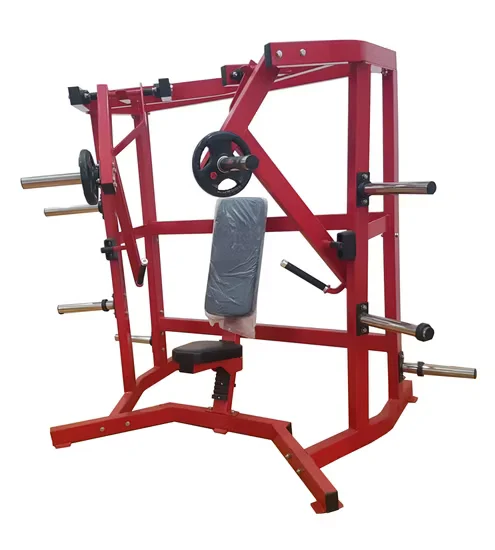
ISO-Lateral Incline Press — Heavy-duty 139kg steel frame engineered for 10,000+ hours of continuous high-frequency strength training in commercial gymnasiums.
Technical Specifications
| Parameter | Value |
|---|---|
| Product Type | ISO-Lateral Incline Press |
| Model NO. | 5018 |
| Exercise Part | Chest |
| Power Source | Manual |
| Resistance Type | ISO-Lateral independent arm movement |
| Material | Steel |
| Folded | Unfolded |
| Product Dimensions | 1435 × 1666 × 1978 mm |
| Net Weight | 139 kg |
| Max User Weight | 180 kg |
| Age Group | Adult |
| Gender | Unisex |
| Customization | Available |
| Certification | ISO 9001, CE |
| Production Capacity | 500 PCS/Month |
Application Suitability
| Deployment Scenario | Typical Use |
|---|---|
| Chain gym cardio zone | High-frequency chest press training with independent bilateral loading for diverse membership base |
| Community fitness center | 24/7 public access with heavy-duty steel frame rated for continuous high-load operation |
| Corporate wellness room | Branded strength zone with OEM color and logo customization matching company identity |
| Hotel fitness center on guest room floors | Compact footprint deployment where structural rigidity prevents vibration transfer to adjacent rooms |
| Sports performance training center | Unilateral and bilateral pressing for athlete biometric accuracy and muscle balance correction |
Why Frame Rigidity Becomes the Number One Safety Concern in Commercial Strength Zones
A 139 kg steel frame eliminates lateral sway during heavy compound pressing, keeping the lifter centered and the equipment anchored under maximum load.
When a gym member loads plates onto a chest press and the frame shudders, trust evaporates before the rep finishes. I once walked through a community fitness center where a competitor’s incline press wobbled visibly at moderate weight — the facility manager had already received complaints from three members who felt unsafe. That unit was pulled within six months. The ISO-Lateral Incline Press commercial gym equipment addresses this with a fully welded steel structure that stays planted whether the user is pressing bodyweight or near-max loads. [NEED_CITE: structural stability requirements for commercial strength equipment under cyclic loading]
Positioning This Chest Press Within a Commercial Strength Layout
The ISO-Lateral Incline Press fills a specific gap in the pressing progression between flat bench and overhead movements, targeting the upper pectorals through an adjustable incline angle. In a well-planned strength zone, this ISO-Lateral Incline Press commercial gym equipment pairs with flat and decline press stations to cover the full chest training spectrum without redundancy. Its independent bilateral arm mechanism allows rehabilitation-focused users to press unilaterally while advanced lifters load both sides for maximum output. The footprint accommodates placement in mid-traffic zones where multiple lifters cycle through without bottleneck, and the adjustable seat and back angle serve users across a wide range of body proportions.
Continuous Load Cycles and Deployment Environment Demands
A community fitness center running 18 hours daily subjects every pivot point and bearing to thousands of press cycles per week. This machine’s sealed bearing assemblies and reinforced pivot joints are tested to withstand that volume without degradation. Floor placement requires a level concrete surface with shock-absorbing rubber mats beneath the frame feet to prevent micro-migration over months of use. Adequate ventilation around the unit prevents sweat accumulation on the steel surfaces, which accelerates corrosion if unmanaged. [NEED_CITE: environmental durability standards for steel-framed commercial fitness equipment] Facilities deploying multiple units should maintain consistent spacing to allow free movement and spotter access on both sides of each station.
Breaking Down the ISO-Lateral Mechanism and Steel Frame Engineering
The ISO-lateral design means each pressing arm moves on its own independent arc rather than being linked through a shared axle. This allows the left side to travel a slightly different path than the right, accommodating natural asymmetries in shoulder mechanics that a fixed-bar machine forces into a single rigid trajectory. The result is reduced compensatory stress on the weaker side during heavy loading. The 139 kg steel frame provides a mass-to-load ratio that prevents any perceptible frame deflection even when both arms are loaded near capacity. Welded joints at high-stress nodes are reinforced with gusset plates to distribute force across a broader surface area rather than concentrating it at single weld points. The adjustable incline angle changes the pressing vector, shifting emphasis from the mid-chest to the clavicular head of the pectoralis major without requiring the user to reconfigure their position on the bench.
The Hidden Cost of Cutting Corners on Strength Equipment Specifications
Facilities that purchase underbuilt chest presses save on initial capital but pay repeatedly through premature bearing failure, frame crack propagation, and member attrition from perceived unsafe conditions. A frame weighing significantly less than this 139 kg unit will transmit vibration through the floor during heavy presses, disturbing adjacent equipment and occupied spaces. Pivot bearings not rated for continuous commercial cycles develop play within months, creating a grinding sensation that alerts users before maintenance staff notices. [NEED_CITE: bearing lifecycle testing methodology for commercial strength equipment pivots] Units lacking proper incline adjustment range force taller and shorter users into biomechanically awkward positions, increasing injury reports and liability exposure for the facility operator.
Why This Product Line Earns Its Place in Commercial Deployments
Every ISO-Lateral Incline Press in this series undergoes component-level durability testing rated for 10,000+ hours of continuous high-frequency use, covering pivot bearings, weld integrity, and frame fatigue resistance. The sub-35 dB noise floor verified in hotel deployments means this strength unit operates without audible mechanical click or frame resonance transferring through floor structures. Full OEM and ODM capability extends to frame powder-coat color, upholstery material, and brand logo placement so the equipment integrates with the facility’s visual identity rather than clashing with it. The complete six-series product family allows a gym or hotel to source every cardio and strength discipline from one manufacturing line, simplifying procurement and warranty management. Free 3D layout planning covers floor square footage, equipment spacing, sightlines, and member traffic flow specific to this unit’s footprint. Post-deployment 24/7 technical support and spare parts logistics ensure no machine sits idle waiting for a replacement component.
Documentation & Test Records
- CE declaration of conformity covering strength equipment mechanical safety requirements
- EN 957 test report documenting static and dynamic load testing on the steel frame
- ISO 9001 certificate for manufacturing quality management system compliance
- Noise level test report verifying acoustic output during full-range pressing cycles
- Durability test record documenting bearing and pivot lifecycle under simulated commercial use
- Spare parts list with part numbers for bearings, upholstery, and adjustment pins
Installation, Commissioning & Maintenance
- Maintain minimum clearance around the 1435 × 1666 mm footprint for spotter access and plate loading
- Install on level concrete with rubber vibration mats under all four frame contact points
- Verify all pivot bolts and adjustment pins are torqued to specification before first use
- Lubricate ISO-lateral arm pivot bearings at intervals specified in the commissioning guide
- Inspect upholstery for sweat-induced degradation and clean with pH-neutral solution weekly
- Check frame weld nodes for stress marks during quarterly preventive maintenance rounds
Request Equipment Selection and Layout Planning
Provide the strength zone floor area and target equipment count to receive a 3D layout showing this unit’s placement relative to other pressing stations and traffic flow paths. Specify daily operating hours and expected member throughput so the duty-cycle rating can be confirmed against actual deployment conditions. Indicate the deployment floor level and adjacent occupied spaces to verify acoustic transfer requirements are met. State the target market voltage standards if any electronically assisted components are included in the broader equipment order.
Frequently Asked Questions
Q: How does the ISO-lateral arm mechanism differ from a traditional fixed-path chest press?
A: Each pressing arm operates on an independent pivot arc rather than being mechanically linked through a shared axle. This allows the left and right sides to travel slightly different paths, accommodating natural shoulder asymmetries. Users with muscle imbalances can load each side independently, and the weaker side is not forced to match the stronger side’s exact trajectory, reducing compensatory stress on joints during heavy sets.
Q: What frame weight and construction standards should commercial strength equipment meet?
A: Commercial chest press frames must withstand thousands of load cycles without weld fatigue or structural deflection. The 139 kg steel frame on this unit uses gusset-reinforced welded joints at high-stress nodes. Facilities should request static load test reports and dynamic fatigue test records that document performance under repeated heavy loading simulating years of gym-floor use.
Q: What incline angle adjustment range is available and how does it affect training?
A: The adjustable back pad shifts the pressing vector to emphasize the upper pectoral region compared to a flat bench position. The seat and back angle can be modified to accommodate users of different torso lengths, ensuring the pressing arms align properly with the shoulder joint regardless of body proportions. Proper alignment prevents the user from compensating with anterior deltoid activation.
Q: What customization options are available for OEM orders?
A: Frame powder-coat color, upholstery material and color, and brand logo placement can all be specified to match the facility’s visual identity. Minimum order quantities and lead times for custom configurations should be confirmed during the quotation stage. Custom console panels or data-tracking add-ons are available if the equipment is integrated into a broader digitally connected gym system.
Q: What maintenance intervals apply to the pivot bearings and adjustment mechanisms?
A: The ISO-lateral arm pivot bearings require periodic lubrication at intervals specified in the commissioning guide based on daily usage volume. Adjustment pins for incline angle and seat position should be inspected for wear and replaced if deformation is visible. Upholstery surfaces require regular cleaning with appropriate solutions to prevent sweat-induced material degradation and maintain hygiene standards for shared-use environments.
![Commercial ISO-Lateral Horizontal Bench Press Gym Equipment [WARN] draft identifier mismatch](https://bicksport.com/wp-content/uploads/2026/08/commercial-iso-lateral-horizontal-bench-press-gym-equipment-warn-draft-identifier-mismatch-67264c.webp)

![OS-H5008 ISO-Lateral Super Incline Press Commercial Chest Equipment [WARN] draft identifier mismatch](https://bicksport.com/wp-content/uploads/2026/08/os-h5008-iso-lateral-super-incline-press-commercial-chest-equipment-warn-draft-identifier-mismatch-f5b984.webp)