
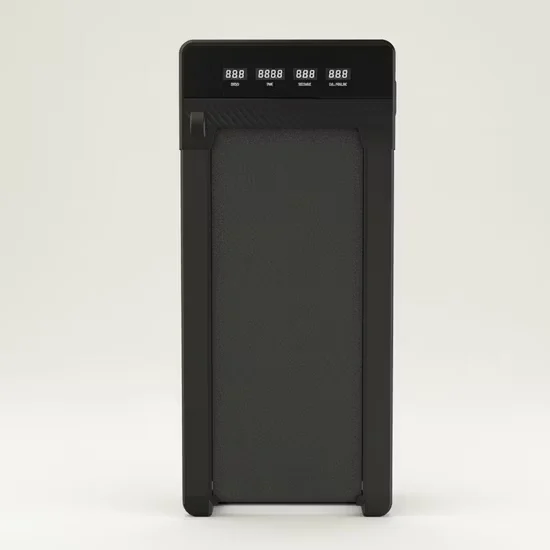
Space-Efficient Deployment — Foldable chassis with integrated transport wheels allows rapid repositioning in compact residential fitness zones.
Technical Specifications
| Parameter | Value |
|---|---|
| Product Type | Foldable Treadmill |
| Designation | W04H1 |
| Motor Type | DC Motor |
| Speed Range | 1–6 km/h |
| Running Surface | 1000 × 400 mm |
| Maximum Speed | <15 km/h |
| Console Type | LED Screen (Speed / Distance / Time / Calories) |
| Programs | 6 Preset Programs |
| Foldable | Unfolded |
| Transport Wheels | Yes |
| Product Dimensions | 1250 × 520 × 125 mm |
| Certification | CE, RoHS |
| Power Requirement | Standard household voltage |
Application Suitability
| Deployment Scenario | Typical Use |
|---|---|
| High-end residential home gym | Daily walking routines in compact living spaces |
| Apartment shared fitness room | Low-speed walking for multiple residents across extended hours |
| Corporate wellness break area | Light walking sessions during work breaks |
| Senior living community lounge | Supervised low-intensity mobility exercise |
Why Residential Treadmills Generate Noise Complaints Before the Warranty Expires
Low-speed walking demands a different motor duty cycle than most home units are engineered to sustain.
When a home use walking treadmill foldable unit operates at 1–6 km/h for extended sessions, the motor runs under low-load, continuous conditions that expose poor thermal management and bearing quality [NEED_CITE: motor thermal behavior under continuous low-load walking conditions]. In multi-story apartments, the low-frequency vibration from underspecified drive systems transmits through floor slabs into occupied rooms below. I have seen entire batches of residential treadmills returned because the magnetic gap was misaligned at the factory, causing resistance stutter that residents felt as rhythmic thudding through the structure. The problem is rarely the belt itself — it is the cumulative vibration signature that only appears after weeks of daily use.
Walking-Speed Cardio Positioning Within a Home Fitness Zone
This home use walking treadmill foldable model occupies the dedicated walking and low-intensity mobility slot in a residential fitness setup. It pairs naturally with a stationary bike or elliptical for users who alternate between seated and standing cardio throughout the week. The 1000 × 400 mm running surface accommodates a natural walking stride without demanding the floor space of a full-size running treadmill. The slim 125 mm profile when stored means the unit tucks against a wall or into a closet, keeping the room functional for other activities. It serves users from light daily movement through structured walking programs, and the 1-6 km/h range covers everything from slow recovery walks to brisk pace work.
Continuous Operation and Residential Deployment Constraints
A walking treadmill in a shared residential environment may see multiple users across a day, each running 30- to 60-minute sessions back to back. The DC motor must dissipate heat effectively at low speeds where the internal fan moves less air [NEED_CITE: DC motor cooling efficiency at walking-speed RPM]. Deploying the unit on an upper floor requires attention to vibration isolation — a dense rubber mat beneath the frame reduces structure-borne noise transmission to rooms below. Standard household voltage is sufficient, but the circuit should not share a line with high-draw appliances that cause voltage fluctuation. The LED console operates independently without requiring network connectivity, which eliminates firmware-related downtime in shared residential installations.
Reading the Drive and Console Specifications
The 1–6 km/h speed range places this unit firmly in the walking category, meaning the motor operates at a fraction of its peak output during normal use. This low-load continuous operation is actually harder on motor windings than intermittent high-speed running, because sustained current at low RPM generates heat that the cooling fan cannot shed efficiently [NEED_CITE: winding thermal stress under sustained low-RPM load]. The LED console displays speed, distance, time, and calorie estimates — a straightforward readout that avoids the complexity and failure points of touchscreen systems. Six preset programs provide structured session variety without requiring app connectivity. Transport wheels integrated into the frame let a single user tilt and roll the 1250 × 520 mm footprint across hard floors without lifting. The unfolded deck height of 125 mm keeps the center of gravity low during use, contributing to stability on smooth residential flooring.
The Hidden Cost of Underspecified Walking Treadmills
Residential walking treadmills built with hobby-grade motors typically fail within the first year when subjected to daily multi-user schedules. The motor windings overheat at sustained low RPM, insulation degrades, and the unit develops an electrical hum before the controller board eventually faults. Noise complaints in apartment buildings escalate quickly — one unit generating low-frequency vibration through a concrete slab can prompt building management to ban all fitness equipment from shared rooms. When the deck cushioning compresses prematurely, users report joint discomfort and stop using the machine entirely, leaving an expensive piece of equipment gathering dust in a corner [NEED_CITE: deck cushioning compression lifecycle under daily walking loads].
Why This Product Line Fits the Brief
Sub-35 dB whisper-quiet operation has been verified in hotel deployments where treadmills sit directly above guest rooms, and that same acoustic discipline applies to this walking platform in residential settings. Components across the cardio range undergo 10,000-hour continuous operation testing, covering motors, bearings, and frame joints under high-frequency use cycles. The LED console on this model delivers essential workout data without the connectivity dependencies that cause downtime in shared installations. OEM customization extends to console UI, color, and logo application at flexible minimum order quantities. Free 3D cardio-zone layout planning accounts for this unit’s compact footprint, ensuring adequate clearance for safe mounting and dismounting within the allocated space. Technical support is available around the clock for commissioning and spare parts inquiries.
Documentation & Test Records
- CE declaration of conformity for the W04H1 foldable treadmill platform
- EN 957 test report covering structural integrity and safety requirements
- ISO 9001 certificate for the manufacturing quality management system
- RoHS compliance documentation for restricted substance limits
- Noise level test report under continuous walking-speed operation
- Motor specification sheet with duty cycle and thermal performance data
Installation, Commissioning & Maintenance
- Position the W04H1 with clearance on three sides for safe mounting and ventilation around the motor housing
- Place a high-density rubber mat beneath the frame to isolate vibration from residential floor structures
- Connect to a dedicated household circuit to avoid voltage drops from shared appliance loads
- Run the belt at low speed for initial alignment check and verify LED console readings against measured distance
- Inspect belt tension and deck lubrication at intervals specified in the commissioning guide
- Wipe the running surface and frame after each session to prevent sweat corrosion on exposed steel
Planning Your Equipment Inquiry
Provide the floor plan and total square meters of the intended walking zone so the layout team can map clearance, sightlines, and user flow around each unit. Specify the expected daily usage hours and number of users to confirm the motor duty cycle matches the deployment environment. Confirm the deployment floor level and adjacent room types so acoustic requirements can be validated against the noise test data. State the target market voltage and plug standard to ensure the unit ships with the correct power configuration.
Frequently Asked Questions
Q: How does the 1000 × 400 mm running surface affect walking comfort compared to full-size treadmill decks?
A: The 1000 mm length supports a natural walking stride at speeds up to 6 km/h without requiring the user to shorten their step. The 400 mm width provides adequate lateral room for comfortable walking posture. This reduced footprint is the trade-off that enables the foldable design and compact storage profile, making it practical for residential rooms where a full-size deck would dominate the floor space.
Q: What maintenance does the foldable mechanism require over its service life?
A: The folding hinge and latch points should be inspected periodically for play or looseness, particularly in shared environments where multiple users fold and unfold the unit daily. Lubrication of the pivot hardware at intervals specified in the maintenance guide prevents metal-on-metal wear. Transport wheels should be checked for debris buildup that could impede smooth rolling across different floor surfaces.
Q: Can the LED console output data to external fitness applications or facility management systems?
A: The LED console on this model provides standalone readouts for speed, distance, time, and calories without network connectivity or Bluetooth transmission. This design eliminates firmware update dependencies and connectivity failures in shared residential installations. Facilities requiring data-synced consoles can explore other models in the product range that offer IoT-enabled touchscreen options with app integration.
Q: Are the transport wheels suitable for carpet and hardwood flooring alike?
A: The transport wheels are designed to roll across hard surfaces such as tile, laminate, and hardwood without marking or scratching. On thick-pile carpet, rolling resistance increases and the user may need to tilt the unit at a steeper angle to clear the surface. Testing wheel compatibility with the specific flooring in the deployment space before final placement is recommended.
Q: What distinguishes the motor requirements for a walking-speed treadmill versus a running-speed model?
A: Walking treadmills operate the motor at low RPM for sustained periods, which generates heat differently than the higher RPM bursts of running. The motor must manage thermal buildup under continuous low-load conditions rather than peak output demands. This requires winding specifications and cooling design optimized for endurance at walking speeds, not just maximum horsepower ratings.
![Mt296 Electric Treadmill for Home Use with Strong Cushioning [WARN] draft identifier mismatch](https://bicksport.com/wp-content/uploads/2026/08/mt296-electric-treadmill-for-home-use-with-strong-cushioning-warn-draft-identifier-mismatch-ea47b9.webp)
![MT296 Electric Home Gym Treadmill with Low Noise DC Motor for Fitness Training [WARN] draft identifier mismatch](https://bicksport.com/wp-content/uploads/2026/08/mt296-electric-home-gym-treadmill-with-low-noise-dc-motor-for-fitness-training-warn-draft-identifier-mismatch-0cf462.webp)
![HSM W06D5 Foldable Treadmill with Table Holder for Home [WARN] draft identifier mismatch](https://bicksport.com/wp-content/uploads/2026/08/hsm-w06d5-foldable-treadmill-with-table-holder-for-home-warn-draft-identifier-mismatch-a05a90.webp)
