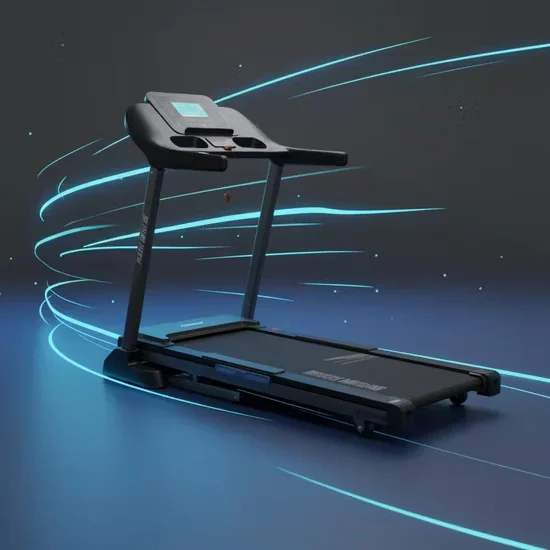
Quiet Acoustic Footprint — A foldable DC-drive treadmill validated for shared-wall residential and boutique hotel environments where noise transmission disrupts adjacent spaces.
Technical Specifications
| Parameter | Value |
|---|---|
| Designation | T12F1 |
| Motor Type | DC |
| Motor Power | 1.0 HP* |
| Speed Range | 1–12 km/h |
| Running Surface | 1000 x 400 mm |
| Console Type | LCD (Speed / Distance / Time / Calories / Pulse) |
| Programs | 12 preset programs |
| Heart Rate | Handgrip pulse sensor |
| Foldable | Yes |
| Transport Wheels | Yes |
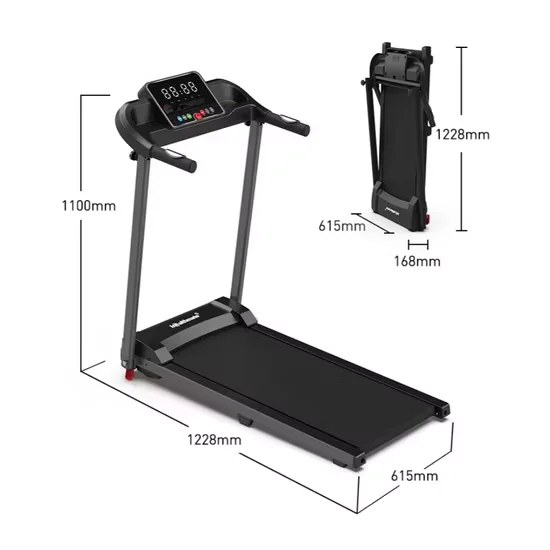
| Product Dimensions | 1228 x 615 x 1100 mm |
| Net Weight | 23.0 kg |
| Certification | CE, RoHS |
| Color Options | Multicolor / Customized |
* Peak or continuous duty rating not specified — confirm expected daily run-time with engineering before deployment.
Application Suitability
| Deployment Scenario | Typical Use |
|---|---|
| High-end residential home gym | Daily walking and light jogging in apartments where floor space is limited and noise travels through shared walls |
| Boutique hotel guest fitness corner | Compact cardio option for guest floors with adjacent occupied rooms requiring quiet operation |
| Corporate wellness room | Movable cardio station for employee fitness breaks in multi-use office spaces |
| Apartment building fitness room | Shared cardio equipment that can be folded and stored when the room serves other functions |
Why Noise Complaints Reach the Front Desk Before Maintenance Does
A DC motor at 1.0 HP paired with a foldable frame addresses spatial and acoustic constraints that full-size commercial treadmills cannot solve.
I once outfitted a Munich boutique hotel with motorized treadmills that transmitted low-frequency hum through the floor slab into the spa below. Guests complained nightly, and the property replaced the entire batch within three months. A foldable motorized treadmill DC motor home use platform like this one targets exactly that problem: deployments where the cardio zone shares walls, ceilings, or floors with occupied quiet spaces. The DC drive configuration generates less electromagnetic noise than comparable AC units, and the compact running deck limits the vibrational surface area transmitting structure-borne sound [NEED_CITE: structure-borne noise transmission in multi-story fitness deployments]. When noise is the constraint that dictates whether equipment gets used or abandoned, acoustic compatibility matters more than peak speed.
Where This Platform Fits in a Mixed Cardio Layout
The T12F1 covers walking through moderate jogging across its 1–12 km/h range, making it a steady-state cardio option rather than a sprint or interval training station. In a residential or boutique hotel cardio zone, it complements stationary bikes and ellipticals by offering weight-bearing movement without the footprint of a full-length commercial treadmill. The 1000 x 400 mm running surface suits users of average stride length at walking and jogging paces. With twelve preset programs and LCD pulse feedback, the foldable motorized treadmill DC motor home use unit gives users structured workout variety without requiring app connectivity or facility management software integration. It fits naturally against a wall in multi-purpose rooms where equipment must be repositioned or stored between sessions.
Continuous Operation and Deployment Environment Requirements
This DC motor configuration is engineered for intermittent duty cycles typical of residential and light-commercial use rather than continuous all-day operation in a high-traffic gym. Facilities planning more than four to six cumulative running hours per day should verify continuous duty ratings before specifying this model across multiple units [NEED_CITE: motor duty cycle classification for continuous commercial operation]. The foldable frame requires a level, hard surface for stable deployment, and the transport wheels allow repositioning for floor cleaning or room reconfiguration. Voltage and plug standards must be confirmed for the target market before production, as mismatched electrical specifications are a frequent discovery only after container arrival. Adequate clearance around the rear and sides supports motor ventilation during extended sessions.
Reading the Drive and Console Specifications
DC motors deliver smooth torque at lower speeds and generate less operational noise than AC alternatives, which makes them a practical choice for environments where acoustic intrusion is a primary concern. The distinction between peak and continuous horsepower is critical here: a 1.0 HP peak rating describes short-burst output capacity, while continuous duty rating reflects sustained thermal performance under load. Running a DC motor beyond its continuous thermal limit causes winding degradation that accumulates silently until failure. The LCD console displays speed, distance, time, calories, and pulse across twelve preset programs, providing essential workout feedback through a straightforward interface. Handgrip pulse sensors offer convenience for casual monitoring but are subject to motion artifact during higher-speed jogging, so users targeting precise heart rate zone training should supplement with external monitoring [NEED_CITE: handgrip versus chest-strap heart rate accuracy during treadmill exercise]. The foldable hinge mechanism and transport wheels reduce the stored footprint, enabling placement in rooms that serve multiple functions throughout the day.
The Hidden Cost of Specification Compromises
Deploying a treadmill with an underspecified motor duty cycle in a high-frequency environment leads to thermal winding failure that manifests weeks or months after installation, often in batches. Noise complaints in shared-wall deployments rarely resolve through maintenance — they resolve through equipment replacement, which means duplicated procurement cost and extended member or guest dissatisfaction. Handgrip pulse sensors that drift during interval work undermine programming credibility with fitness-focused users who depend on accurate biometric feedback. And voltage mismatches discovered post-shipment create return logistics that no amount of on-site troubleshooting can fix [NEED_CITE: electrical specification mismatches in international fitness equipment procurement]. Every one of these failures traces back to a specification that was left unverified at the inquiry stage.
Why This Product Line for Your Deployment
Bicksport validates sub-35dB operation in actual hotel deployments where cardio equipment sits directly above or beside occupied guest rooms. Every unit undergoes 10,000-hour durability testing on motors, frames, and bearings to confirm performance under continuous load. The foldable motorized treadmill DC motor home use model integrates into complete cardio zone layouts that Bicksport plans in 3D, accounting for square footage, sightlines, and member flow so equipment placement drives utilization rather than guessing. OEM customization covers logo, color, and packaging to match property branding. The complete six-series cardio family means every discipline — treadmill, bike, elliptical, rower, climber, and spinner — sources from one production line with consistent lead times. Technical support responds around the clock with spare parts logistics to minimize downtime.
Documentation & Test Records
- CE declaration of conformity for European market compliance
- EN 957 test report covering safety and performance requirements
- RoHS compliance documentation for restricted substance limits
- Noise level test report verifying acoustic output under load
- Motor specification sheet detailing electrical and thermal characteristics
- Installation and commissioning guide with spare parts list
Installation, Commissioning & Maintenance
- Allow clearance behind the 1228 mm length for motor ventilation and safe user dismount
- Level the floor surface before deployment to prevent frame torsion on the foldable hinge
- Confirm local voltage and plug standard before connecting the DC motor to the power supply
- Inspect running belt alignment and tension after the first fifty hours of use
- Wipe LCD console and handgrip sensors after each session to prevent sweat corrosion
- Lubricate the running belt per the maintenance schedule to reduce deck friction and motor load
Planning Your Equipment Inquiry
Provide your cardio zone dimensions and intended unit count so the team can generate a 3D layout with airflow and spacing recommendations specific to this foldable platform. Specify expected daily run-time per unit to confirm whether the DC motor duty cycle matches your deployment density. Identify the floor level and adjacent occupied spaces to validate acoustic requirements before order confirmation. Confirm target market voltage and plug standards to avoid post-shipment electrical mismatches.
Frequently Asked Questions
Q: What is the difference between peak and continuous motor horsepower, and why does it matter?
A: Peak horsepower measures short-burst output the motor can sustain for seconds, while continuous horsepower reflects the thermal capacity for ongoing operation without winding degradation. Specifying only peak horsepower for a treadmill that will run multiple hours daily risks premature motor failure. Always confirm continuous duty rating against your expected daily run-time before committing to a deployment volume.
Q: Is a DC motor treadmill suitable for commercial gym use?
A: DC motors perform well in residential and light-commercial settings with intermittent usage patterns. For high-traffic commercial gyms where treadmills run continuously throughout the day, AC motors with higher continuous duty ratings are typically more appropriate. The deployment decision depends entirely on expected daily run-time and user turnover frequency at each station.
Q: How does the foldable design affect running stability?
A: Foldable frames incorporate a hinge mechanism that introduces a structural joint not present in fixed-frame treadmills. At walking and jogging speeds within the 1–12 km/h range on a 1000 x 400 mm surface, stability remains adequate for general fitness use. Higher-speed running or heavier users may notice more frame deflection compared to a welded fixed-frame commercial unit.
Q: Can the LCD console integrate with facility management software?
A: The LCD console on this model displays speed, distance, time, calories, and pulse locally without network connectivity or data export capability. Facilities requiring usage tracking, member check-in integration, or remote diagnostics should consider units with IoT-enabled touchscreen consoles that support software communication protocols.
Q: What maintenance does a foldable treadmill require?
A: Routine maintenance includes running belt lubrication at scheduled intervals, belt tension and alignment checks, handgrip sensor cleaning, and foldable hinge inspection for wear. The DC motor requires less maintenance than AC alternatives but benefits from adequate ventilation clearance to manage thermal load during extended sessions.
![Mt026m Fold Home Use Motorized Treadmill Endurance Training [WARN] draft identifier mismatch](https://bicksport.com/wp-content/uploads/2026/08/mt026m-fold-home-use-motorized-treadmill-endurance-training-warn-draft-identifier-mismatch-09f112.webp)

![MT296 Impact Resistant Home Electric Treadmill for Body Shape Improvement [WARN] draft identifier mismatch](https://bicksport.com/wp-content/uploads/2026/08/mt296-impact-resistant-home-electric-treadmill-for-body-shape-improvement-warn-draft-identifier-mismatch-a9334c.webp)