
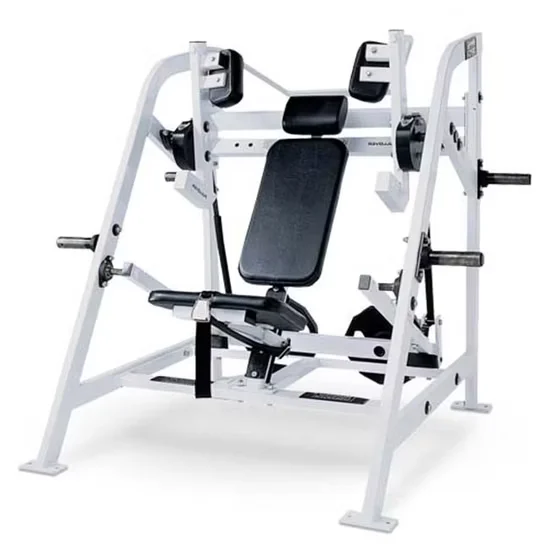
Heavy-Duty Steel Frame — reinforced welding and sealed pivot bearings tested for continuous high-frequency back training in commercial environments.
Technical Specifications
| Parameter | Value |
|---|---|
| Product Type | Pull Over Machine (Strength Equipment) |
| Exercise Part | Back |
| Material | Steel |
| Product Dimensions | 123113601503mm |
| Net Weight | 120kg |
| Max User Weight | Not specified in source — verify against manufacturer catalog |
| Appliance | Community, Gymnasium |
| OEM/ODM | Available |
| Certification | ISO 9001, CE |
| HS Code | 9506911900 |
Application Suitability
| Deployment Scenario | Typical Use |
|---|---|
| professional gym strength zone | high-frequency back isolation training for members |
| commercial fitness club | dedicated pull-over station in free-weight and selectorized areas |
| community fitness center | durable back training option for general membership |
| corporate wellness facility | strength training complement to cardio zones |
| hotel fitness center integrated strength area | compact back training for guests with limited floor space |
What Pivot Bearing Wear Reveals About Commercial Strength Equipment Longevity
Sealed bearings and reinforced pivot points determine whether a pull-over machine survives its first year in a busy gym.
Every facility manager has seen it: a strength station that squeaks within weeks, develops lateral play within months, and gets pulled from the floor before the second year ends. The commercial pull over machine strength equipment category sees this pattern repeatedly because pivot assemblies take concentrated lateral loads during the eccentric phase of the movement. When bearings are unsealed, sweat and chalk dust infiltrate the race, accelerating wear. [NEED_CITE: pivot bearing failure rates in commercial selectorized strength equipment]
The frame itself tells a parallel story. Thin-gauge steel tubing deflects under repetitive loading, creating micro-fractures at weld joints. In high-traffic commercial environments, structural rigidity is not a luxury — it is the difference between equipment that stays on the floor and equipment that generates service calls.
Positioning the Pull Over in a Commercial Strength Layout
The pull-over movement targets the latissimus dorsi through a range that cable machines and pull-up bars cannot fully replicate. In a commercial strength zone, this commercial pull over machine strength equipment fills the gap between compound pulling movements and isolation work. It pairs logically with chest press stations and seated row units, creating a complete upper-body circuit. The 1231*1360mm footprint allows placement along walls or between larger stations without blocking traffic flow. The steel frame and 120kg net weight keep the unit stable during loaded repetitions, accommodating users across a wide body-weight range without frame flex.
Continuous Deployment and Facility Environment Requirements
Commercial strength equipment operates under different duty cycles than residential units. A gym open sixteen hours daily subjects pivot bearings and cable pulleys to thousands of articulation cycles per week. Sealed bearing assemblies prevent contaminant ingress from chalk dust and humidity, extending service intervals. [NEED_CITE: EN 957 requirements for commercial strength equipment durability testing] Floor deployment requires level concrete with vibration-dampening pads beneath the feet to prevent migration under load. Ventilation matters less than with motorized cardio, but sweat accumulation on steel surfaces demands regular wiping to prevent corrosion at weld seams. Power is not a concern for this mechanical unit, eliminating voltage-mismatch risks common in international deployments.
Decoding the Structural Specifications That Matter
Steel frame construction in strength equipment is not monolithic — tube gauge, weld penetration depth, and joint geometry separate commercial-grade frames from light-commercial units. A 120kg net weight indicates substantial steel mass distributed across the base and upright structure, providing the inertial stability needed when users load heavy resistance. Sealed pivot bearings reduce friction at the articulation point, delivering consistent resistance feel throughout the range of motion while eliminating the grinding noise that drives member complaints. The OEM/ODM capability allows facility operators to specify frame color and branding, ensuring the equipment aligns with interior design requirements without compromising structural specification. ISO 9001 and CE certification confirm the manufacturing process meets quality management and safety standards required for commercial deployment across regulated markets.
The Hidden Cost of Specification Compromises
Light-commercial frames deployed in busy facilities develop weld fatigue within months, leading to frame replacement costs that exceed the original equipment price. Unsealed pivot bearings contaminated by chalk dust generate noise complaints and require monthly replacement, pulling the machine offline repeatedly. [NEED_CITE: maintenance downtime costs for commercial strength equipment with unsealed bearings] Cable systems rated for light use fray under high-frequency articulation, creating safety hazards that force premature retirement of the entire station. Facilities that source based on unit price rather than duty-cycle specification end up spending more on service labor and member attrition than they saved on procurement.
Why This Product Line Addresses Deployment Pain Points
The steel frame and reinforced weld joints on this commercial pull over machine strength equipment are built for the duty cycle of professional gyms and commercial fitness clubs. Sealed pivot bearings maintain quiet articulation through thousands of weekly cycles, reducing service calls. The OEM/ODM program extends to frame color, logo placement, and specification matching, so the equipment integrates with facility branding. Bicksport provides 3D layout planning that accounts for this unit’s footprint and member flow patterns within the strength zone. Documentation includes EN 957 test reports and ISO 9001 certificates for compliance submissions. Technical support operates around the clock for commissioning and troubleshooting.
Documentation & Test Records
- CE declaration of conformity for commercial strength equipment market access
- EN 957 test report covering structural integrity and safety requirements
- ISO 9001 certificate confirming quality management in manufacturing
- Durability test record for pivot bearing and cable pulley assemblies
- Frame weld inspection report and material specification sheet
- Installation guide with floor anchoring and clearance requirements
Installation, Commissioning & Maintenance
- Maintain minimum 600mm clearance on all sides for safe user access and loading plate movement
- Install on level concrete with anti-vibration pads beneath each foot to prevent migration
- Inspect sealed pivot bearings quarterly for smooth articulation and absence of lateral play
- Check cable tension and pulley alignment monthly; replace cables showing visible strand separation
- Wipe steel frame surfaces daily with pH-neutral cleaner to prevent sweat-induced corrosion at welds
- Verify all fastener torque values after first 500 use cycles and semi-annually thereafter
Sourcing Guidance for Facility Planners
Provide your strength zone dimensions and target equipment count to receive a 3D layout incorporating this unit’s footprint and member flow clearances. Specify your facility’s daily operating hours to confirm the pivot bearing and cable system duty cycle matches your usage profile. Indicate whether frame color or logo customization is required for interior design alignment. Confirm your market’s certification requirements so the correct documentation package ships with the order.
Frequently Asked Questions
Q: How does frame construction affect long-term durability in commercial environments?
A: Tube gauge and weld penetration depth determine whether a steel frame withstands repetitive loading without deflection or fatigue cracking. Reinforced joints at high-stress pivot points prevent lateral play from developing over thousands of articulation cycles. A 120kg net weight signals sufficient steel mass for inertial stability during loaded pull-over movements, keeping the unit planted without floor anchoring in most deployments.
Q: What maintenance is required for pivot bearings and cable systems?
A: Sealed pivot bearings require minimal maintenance compared to open assemblies, but quarterly inspection for smooth articulation and absence of grinding noise remains essential. Cable pulleys should be checked monthly for alignment and strand integrity. Facilities with high chalk usage may need more frequent bearing inspection despite seals, as fine particulate can eventually compromise any barrier over extended periods.
Q: Can the equipment be customized for facility branding and color matching?
A: The OEM/ODM program covers frame color, logo application, and specification adjustments to align with facility interior design requirements. Customization scope is confirmed during the quotation stage, where mock-ups and color samples are reviewed before production begins. This ensures the commercial pull over machine strength equipment integrates visually with existing equipment lines and branding standards.
Q: What certifications ensure compliance for international gym deployments?
A: ISO 9001 confirms the manufacturing quality management system, while CE marking indicates conformity with European health and safety directives applicable to commercial fitness equipment. EN 957 test reports provide specific performance and safety data for strength training machines. These documents are typically required by regulators, insurers, and facility compliance audits in international markets.
![Hammer Strength Multifunction Bench Commercial Gym Equipment H068 [WARN] draft identifier mismatch](https://bicksport.com/wp-content/uploads/2026/08/hammer-strength-multifunction-bench-commercial-gym-equipment-h068-warn-draft-identifier-mismatch-826fd0.webp)

