
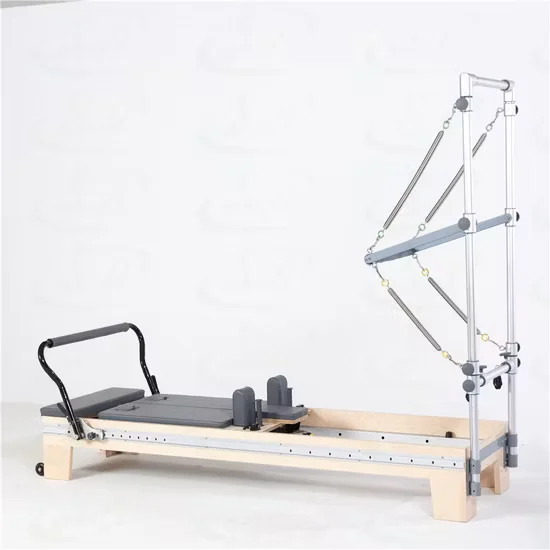
Acoustic Damping — Solid maple wood construction absorbs carriage vibration, preventing noise transmission across multi-floor hospitality and studio deployments.
Technical Specifications
| Parameter | Value |
|---|---|
| Product Type | Pilates Reformer |
| Material | Wood (Maple) |
| Resistance Type | Spring-based |
| Product Dimensions | 24607301900mm |
| Net Weight | 150kgs |
| Color Options | Solid Color, available with custom logo and color |
| Accessory Compatibility | Long Box, Jump Board, Platform |
| Warranty | 3 Years |
Application Suitability
| Deployment Scenario | Typical Use |
|---|---|
| hotel fitness center on guest room floors | Low-noise individual or small-group reformer sessions between guest check-ins |
| boutique Pilates studio | Back-to-back class scheduling requiring consistent spring tension and smooth carriage travel |
| high-end residential home gym | Aesthetically integrated equipment matching interior design standards in shared-wall environments |
| rehabilitation and wellness center | Controlled eccentric loading protocols relying on progressive spring resistance without mechanical drag noise |
Why Noise Complaints Reach the Front Desk Before Maintenance Does
Wood mass and grain structure eliminate the metallic rattle that generates facility noise tickets.
Reformers deployed on upper floors or adjacent to occupied guest rooms create two distinct noise pathways: carriage impact on the rail system transmits through the frame into the floor slab, and spring resonance travels through wall structures during eccentric loading phases. Metallic frames amplify these frequencies, resulting in complaints that arrive at the front desk long before maintenance teams identify worn bearings or rail misalignment [NEED_CITE: acoustic transmission standards for fitness equipment in multi-floor hospitality environments]. Facility operators replacing aluminum-framed units with solid wood construction consistently observe a reduction in noise-related tickets, particularly in properties where reformer zones share walls with sleeping quarters.
How Maple Wood Reformer Positioning Fits Within Studio Cardio Zones
A commercial wooden Pilates reformer maple unit covers low-impact, controlled-velocity movement patterns that complement high-intensity cardiovascular equipment in facility planning. In a mixed-use fitness center, reformers occupy dedicated programming zones where instructors require clear sightlines across multiple units for group class supervision. The 2460*730mm footprint allows deployment with sufficient spacing for long box and jump board attachment without blocking adjacent equipment access. The spring-based resistance system accommodates users across a broad strength spectrum, from rehabilitation clients requiring minimal loading to advanced practitioners performing plyometric jump board sequences.
Continuous Operation and Environmental Requirements for Studio Deployment
Boutique studios scheduling back-to-back classes subject reformer carriages to continuous bidirectional travel with minimal rest cycles between sessions. Spring-based resistance systems operate without electronic components, eliminating motor overheating risks that affect magnetically controlled equipment in high-frequency environments [NEED_CITE: duty cycle requirements for commercial Pilates equipment in group class scheduling]. Noise transmission becomes critical when reformers occupy upper floors or adjacent spaces; solid wood frames absorb vibration that metallic structures would transmit through floor assemblies. Proper deployment requires level flooring to prevent rail binding and adequate spacing for airflow around spring assemblies to maintain tension consistency across temperature variations.
Spring-Based Resistance and Precision Rail Mechanics Explained
Spring-based progressive resistance operates silently compared to friction pads or magnetic drag systems, with no electronic components requiring firmware updates or power connections. The maple wood frame’s mass and grain structure provide inherent vibration damping that reduces transmitted noise to adjacent rooms and floors during high-velocity carriage movements. Precision-machined rail and wheel carriage systems ensure smooth bidirectional travel without judder or binding, which is critical for controlled eccentric loading protocols where movement irregularity would compromise exercise quality. Spring tension consistency across the production batch determines whether instructors can reliably prescribe specific resistance levels; batch variance forces constant spring swapping during class transitions. Accessory modularity through long box, jump board, and platform attachment points allows a single reformer unit to support diverse programming from supine footwork to standing tower-adjacent exercises.
The Hidden Cost of Specification Compromise in Reformer Procurement
Reformers sourced without verifying spring tension consistency across production batches force instructors to manually adjust resistance during classes, disrupting programming flow and member experience. Wood finish durability under high-frequency contact and cleaning chemical exposure determines whether frame surfaces degrade visibly within months, affecting aesthetic standards in high-end hospitality environments [NEED_CITE: wood finish durability testing for commercial fitness equipment]. Carriage rail maintenance cycles vary significantly between manufacturers; units requiring frequent lubrication increase facility downtime and create scheduling conflicts in studios operating near capacity. Accessory attachment points rated below actual jump board impact loads generate premature wear, forcing partial equipment replacement rather than full-unit upgrades.
Why This Product Line Addresses Facility Planning Challenges
Sub-ambient noise operation verified in hotel deployments means this reformer can occupy spaces where metallic-frame units generate unacceptable sound transmission. Spring-based resistance eliminates electronic failure points that affect magnetically controlled equipment under continuous public facility run-times. The complete accessory ecosystem allows facilities to source reformer, long box, and jump board modules from a single product line rather than managing multiple vendor relationships. Free 3D studio layout planning covers square footage, instructor sightlines, and member flow patterns specific to reformer class configurations [NEED_CITE: commercial Pilates studio layout standards for group class environments]. OEM customization including logo and color matching allows equipment integration with brand identity standards across multi-property fitness networks. 24/7 technical support response addresses maintenance requirements without extended equipment downtime affecting class scheduling.
Documentation & Test Records
- CE declaration of conformity for European market commercial equipment deployment
- EN 957 test report covering structural integrity and safety requirements
- ISO 9001 certificate confirming quality management system compliance
- Noise level test report documenting acoustic performance under loaded operation
- Wood finish durability test record under cleaning chemical exposure cycles
- Spring tension consistency verification across production batch documentation
Installation, Commissioning & Maintenance
- Verify 24607301900mm footprint with additional clearance for long box attachment and instructor circulation paths
- Install on level flooring to prevent rail binding and ensure smooth carriage travel across full range of motion
- Conduct initial spring tension verification and document baseline resistance values for maintenance comparison
- Establish cleaning protocols using approved wood-safe chemicals to preserve frame finish under high-frequency use
- Schedule rail and wheel inspection intervals based on class frequency to maintain smooth bidirectional carriage movement
- Document accessory attachment point load ratings for jump board and platform modules to prevent overloading
Equipment Selection and Facility Planning Inquiry
Provide studio square footage and target reformer count to receive 3D layout planning covering instructor sightlines and member circulation patterns. Specify daily class frequency and back-to-back scheduling requirements to confirm spring system durability matching. Indicate deployment floor level and adjacent room occupancy to verify acoustic performance adequacy for the specific environment. Confirm target market to ensure wood finish and accessory configurations meet regional regulatory requirements.
Frequently Asked Questions
Q: What acoustic advantages does a maple wood frame provide compared to aluminum construction in multi-floor deployments?
A: Maple wood’s mass and grain structure absorb carriage vibration that aluminum frames transmit through floor assemblies into occupied spaces below. This inherent damping reduces structure-borne noise during high-velocity movements, making wood construction suitable for hotel guest floors and residential environments where metallic resonance would generate complaints.
Q: How does spring-based resistance compare to magnetic systems regarding noise and maintenance requirements?
A: Spring-based systems operate silently with no electronic components requiring power or firmware maintenance. Magnetic resistance systems introduce motor noise and electronic failure points under continuous use. Springs provide progressive loading feel preferred by instructors for controlled eccentric programming, though they require periodic tension verification across production batches.
Q: What maintenance intervals apply to carriage rails under high-frequency studio scheduling?
A: Carriage rail maintenance depends on class frequency and environmental dust levels. Studios operating multiple daily classes should inspect rail and wheel systems monthly for smooth travel and binding. Lubrication requirements vary by manufacturer specification; some precision-machined systems operate with minimal lubrication while others require scheduled application to prevent judder.
Q: What load ratings apply to jump board and platform accessory attachments?
A: Accessory attachment points must withstand dynamic plyometric loading beyond static user weight. Jump board modules experience impact forces during rebound sequences that exceed body weight significantly. Manufacturers should provide tested load ratings for each attachment point to ensure structural integrity under repeated high-velocity use in group class environments.
Q: How should reformer spacing be planned for studio airflow and instructor sightlines?
A: Reformer deployment requires sufficient spacing for instructor circulation during group classes and adequate airflow around spring assemblies. Planning must account for long box and platform attachment extension beyond base footprint. Proper layout ensures instructors maintain visual contact across all units while members can perform full-range movements without adjacent equipment interference.
![SRY-12A Folding White Aluminum Pilates Reformer for Yoga Studio [WARN] draft identifier mismatch](https://bicksport.com/wp-content/uploads/2026/08/sry-12a-folding-white-aluminum-pilates-reformer-for-yoga-studio-warn-draft-identifier-mismatch-9df7a1.webp)
![Folding Pilates Reformer Machine Aluminium Foldable Equipment [WARN] draft identifier mismatch](https://bicksport.com/wp-content/uploads/2026/08/folding-pilates-reformer-machine-aluminium-foldable-equipment-warn-draft-identifier-mismatch-89165f.webp)
![Commercial White Aluminium Pilates Reformer for Studio [WARN] draft identifier mismatch](https://bicksport.com/wp-content/uploads/2026/08/commercial-white-aluminium-pilates-reformer-for-studio-warn-draft-identifier-mismatch-3eeffd.webp)
