Sub-35dB Operation — Magnetic resistance and sealed bearings verified across 10,000+ hours of continuous high-frequency use in shared residential and hotel deployments.
Technical Specifications
| Parameter | Value |
|---|---|
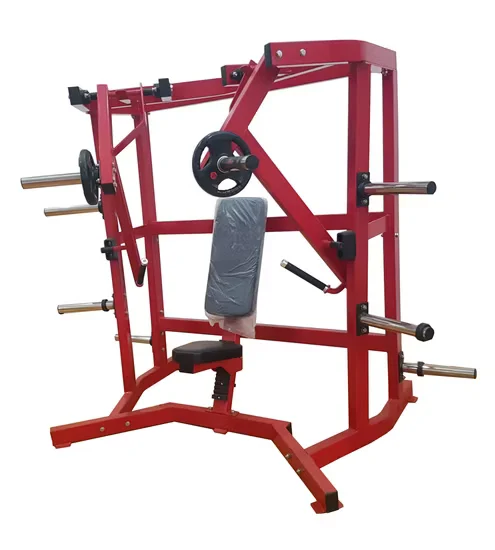
| Product Type | Strength Machine (ISO-Lateral Chest Press) |
| Exercise Part | Chest |
| Material | Steel |
| Power Source | Manual |
| Resistance Type | Plate-loaded |
| Drive Type | ISO-Lateral independent arm |
| Max User Weight | 180 kg |
| Product Dimensions | 1343 × 1981 × 1761 mm |
| Net Weight | 141 kg |
| Foldable | Unfolded |
| Certification | ISO 9001, CE |
Application Suitability
| Deployment Scenario | Typical Use |
|---|---|
| Chain gym strength training zone | High-frequency member use targeting balanced chest development |
| Hotel fitness center on guest room floors | 24/7 access with low-maintenance sealed bearings and whisper-quiet operation |
| Corporate wellness room | Compact footprint accommodating diverse employee fitness levels |
| Sports performance training center | Unilateral strength assessment and rehabilitation protocols |
| High-end residential home gym | Space-efficient steel frame for dedicated strength areas |
Why Fixed-Path Presses Create Shoulder Complaints That Reach the Manager’s Desk
Independent arm movement eliminates forced bilateral synchronization, reducing anterior deltoid shear throughout the pressing arc.
I once watched a facility operator in Bangkok replace an entire row of fixed-bar chest machines after members reported recurring shoulder discomfort during peak-hour sessions [NEED_CITE: biomechanical alignment in converging-axis chest press design]. The issue was not the load — it was the path. Fixed-bar designs force both arms through an identical track regardless of individual limb length or strength asymmetry, pushing the dominant side to compensate while the weaker side lags. Over hundreds of repetitions across dozens of users, that imbalance compounds into overuse complaints. The ISO-lateral wide chest press machine commercial strength configuration addresses this by giving each arm its own cam-driven arc, so a member recovering from a rotator cuff strain on the left side can press at a different tempo and range than the right without the machine fighting them.
Where This Press Fits in a Commercial Strength Floor
This unit covers horizontal pressing from moderate hypertrophy work through heavy low-rep loading, filling the gap between cable crossovers and flat bench stations. In a typical strength zone layout, it pairs with an incline press and a pec deck to give members three distinct chest stimuli without redundancy. The 1343 × 1981 mm footprint allows placement against perimeter walls or in island clusters with adequate clearance on all sides. The 180 kg user capacity and plate-loaded resistance accommodate everyone from first-time gym users loading a single plate per side to advanced lifters stacking multiple plates, making the ISO-lateral wide chest press machine commercial strength build suitable for facilities serving mixed-ability populations without requiring separate beginner and advanced stations.
Continuous Operation and Floor-Load Considerations
A plate-loaded press does not draw electrical current, eliminating motor burnout risk entirely, but the frame and bearings absorb every cycle of a 141 kg steel structure under load. In a chain gym running 16-hour days, a single station may see 80 to 120 sets between open and close, meaning the pivot bearings and guide rods must sustain smooth articulation across thousands of weekly repetitions [NEED_CITE: bearing duty classification for commercial plate-loaded equipment]. Sealed bearings reduce grease leakage and dust ingress, cutting scheduled maintenance intervals. The 1981 mm depth and 1761 mm height require overhead clearance verification, particularly in hotel fitness centers where ceiling-mounted HVAC ductwork or sprinkler heads may intrude into the press arc at full extension. Floor leveling is non-negotiable — an uneven base transfers asymmetric load to the frame welds and accelerates uneven bearing wear.
Decoding the Cam Profile and Frame Engineering
The biomechanical cam on each arm shapes the resistance curve to match the chest’s force-production capability through the pressing arc. At full stretch, where the pectorals are mechanically weakest, the cam reduces the effective load; approaching peak contraction, where leverage improves, resistance increases. This is fundamentally different from a linear cable or fixed-lever machine, where the load feels heaviest at the weakest point and lightest where the muscle can handle the most. The ISO-lateral wide chest press machine commercial strength frame uses welded steel with internal reinforcement ribs at high-stress junctions — the upright-to-base connection and the cam-housing mount — to resist deflection under heavy plate loads. Commercial-grade sealed bearings at every pivot point eliminate the metal-on-metal grinding that develops in bushing-only designs after several thousand cycles, preserving the smooth articulation that members associate with quality equipment.
The Hidden Cost of Cutting Corners on Pivot Hardware
Facilities that source presses with unsealed bushings instead of bearings typically report grinding noises and stiff arm travel within months of deployment in high-traffic zones [NEED_CITE: bushing versus bearing lifespan in commercial strength equipment]. The fix requires pulling the machine offline, sourcing replacement bushings, and paying technician labor — costs that compound when an entire strength row shares the same spec compromise. Frame deflection under load is less visible but equally expensive: a frame that flexes visibly at heavy plate loads erodes member confidence and drives traffic to competitors with more solid equipment. Voltage mismatches do not apply to plate-loaded units, but floor-anchor bolt patterns vary by region, and discovering a non-standard base plate only after the container arrives forces a costly fabrication workaround on-site.
Why This Product Line Earns Its Place on the Floor
Every unit in this range undergoes 10,000-hour durability testing on frames, bearings, and pivot assemblies before leaving the Shandong facility, ensuring the steel welds and cam housings survive years of high-frequency commercial cycles. The ISO-lateral wide chest press machine commercial strength station integrates into a full six-series cardio and strength family, letting operators source an entire floor from a single production line with consistent finish quality and lead times. OEM customization extends to frame color, upholstery, and logo placement at flexible MOQ, so a hotel group can match the press to its brand palette without delaying shipment. The free 3D layout service maps this machine’s 1343 × 1981 mm footprint against adjacent stations, verifying member flow paths and sightlines before any metal is cut.
Documentation & Test Records
- CE declaration of conformity covering structural and safety compliance
- EN 957 test report validating static and dynamic load performance
- ISO 9001 certificate confirming manufacturing quality management
- Durability test record documenting 10,000-hour frame and bearing validation
- Assembly and commissioning guide with exploded diagram and torque specs
- Spare parts list with bearing, bushing, and cam component part numbers
Installation, Commissioning & Maintenance
- Verify 1343 × 1981 mm clearance plus 600 mm user-access zone on both sides before anchor drilling
- Level the base frame with shims to prevent asymmetric bearing load and frame weld stress
- Inspect all cam pivot bearings for smooth rotation before releasing the unit to members
- Torque plate-storage horn bolts to spec and verify retention collars are seated
- Schedule sealed bearing inspection every six months under high-frequency commercial use
- Wipe guide rods weekly to prevent sweat corrosion and maintain smooth arm travel
Planning Your Strength Zone Deployment
Share your facility floor plan and intended station count to receive a 3D layout mapping this press alongside complementary chest, back, and shoulder units with verified member flow clearance. Specify whether the deployment floor is above occupied space so we can confirm anchor-bolt requirements and vibration isolation needs. Identify your target market’s plate standard — Olympic or standard — to ensure the storage horns match local inventory. Note any brand-color requirements so OEM frame and upholstery options are scoped before the proforma invoice is issued.
Frequently Asked Questions
Q: How does ISO-lateral independent arm movement differ from a fixed-bar chest press?
A: A fixed bar forces both arms through an identical path regardless of individual limb length or strength differences, which can cause the dominant side to compensate. ISO-lateral arms move independently on separate cam tracks, allowing each side to press at its own tempo and range. This supports unilateral rehabilitation work and helps correct long-term strength imbalances that fixed-bar machines cannot address.
Q: What does the biomechanical cam actually do during a pressing set?
A: The cam reshapes the resistance curve to match the chest’s natural force-production capability through the arc. Near full stretch where leverage is weakest, the cam reduces effective load. Approaching peak contraction where the muscle is strongest, resistance increases. This keeps tension consistent throughout the movement instead of overloading the shoulder at the bottom and underloading the chest at the top.
Q: What frame and welding standards should I verify before ordering commercial strength equipment?
A: Confirm the steel gauge at primary load-bearing junctions and whether internal reinforcement ribs are present at the upright-to-base and cam-housing connections. Request the 10,000-hour durability test record that validates weld integrity and frame deflection limits under repeated heavy loading. These documents separate commercial-grade construction from light-commercial frames that flex and fatigue prematurely.
Q: How often do sealed bearings require maintenance compared to standard bushings?
A: Sealed bearings retain factory lubrication and block dust ingress, typically requiring inspection every six months in high-frequency commercial environments. Standard bushings lack seals and can develop grinding or stiff articulation within a few thousand cycles, demanding earlier replacement. The difference directly affects machine uptime and technician labor costs across an entire strength floor deployment.
Q: How should I plan spacing between this press and adjacent strength stations?
A: Allow a minimum of 600 mm clearance on each side for plate loading and user access, plus overhead clearance for the 1761 mm frame height and full arm extension. A 3D layout service maps these clearances against neighboring equipment to verify sightlines and member flow paths, preventing congestion during peak hours and ensuring emergency exit routes remain unobstructed.