
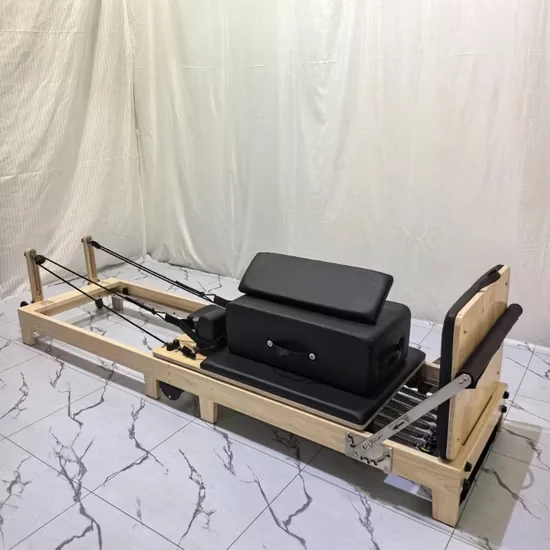
![Folding Maple Wood Pilates Reformer for Home Gym & Studio Fitness [WARN] draft identifier mismatch](https://bicksport.com/wp-content/uploads/2026/08/folding-maple-wood-pilates-reformer-for-home-gym-studio-fitness-warn-draft-identifier-mismatch-2adce9.webp)
Sub-35dB Glide — Solid maple rails dampen carriage resonance to keep reformer transitions quiet enough for shared residential floors.
Technical Specifications
| Parameter | Value |
|---|---|
| Designation | SRY-20B |
| Product Type | Pilates Reformer |
| Specification | 2400 × 600 × 350 mm |
| Net Weight | 100 kg |
| Rail Material | Solid maple wood |
| Frame | Steel-reinforced |
| Included Accessories | Long Box / Jump Board / Platform |
| Color | Solid Color (customizable) |
| Logo | Customized Is Allowed |
| Target User | Adult, Unisex |
| Warranty | 3 Years |
| Production Capacity | 80 Pieces/Month |
| HS Code | 9506911900 |
Application Suitability
| Deployment Scenario | Typical Use |
|---|---|
| Boutique Pilates and yoga studio | Group reformer classes with accessory-driven circuit programming |
| High-end residential home gym | Daily personal practice with jump board cardio and long box flexibility work |
| Corporate wellness room | Employee recovery and mobility sessions in shared office fitness suites |
| Hotel fitness center on guest room floors | Low-noise reformer training that does not disturb occupied rooms below |
| Sports performance training center | Athlete conditioning using platform and jump board for explosive power drills |
Why Carriage Noise Reaches the Studio Manager Before the Instructor Does
Maple wood rails absorb vibration instead of transmitting it into the floor slab.
Boutique studios built on suspended timber floors or multi-use commercial tenancies face the same problem as hotel fitness rooms: every carriage transition sends rolling vibration straight through the structure. Aluminum extrusion rails are rigid and cheap to produce, but they lack any natural damping, so the carriage wheels excite resonant frequencies that amplify at the floor boundary [NEED_CITE: structural vibration transmission in multi-tenant fitness facilities]. I have stood in a studio next door and heard the clatter through a party wall. A commercial Pilates reformer maple wood frame built from solid timber naturally dissipates that energy before it leaves the machine.
Where This Reformer Sits in a Full Cardio and Conditioning Layout
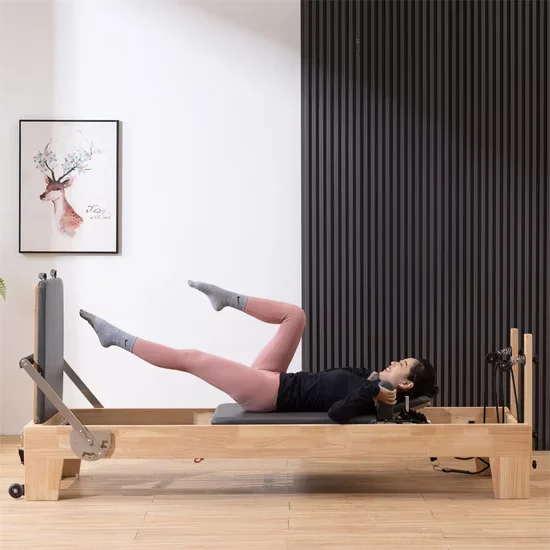
A Pilates reformer occupies a different lane than treadmills or bikes: it covers controlled eccentric strength, core stabilization and low-impact plyometric work through the jump board. In a studio layout this unit pairs with mat zones and tower apparatus, filling the gap between bodyweight mobility and loaded strength training. The 2400 mm bed length accommodates tall adult users across full range of motion, and the 100 kg net weight keeps the frame planted during jump board rebounds. The commercial Pilates reformer maple wood frame is positioned for moderate to high-frequency group class rotation, where accessory swaps between long box and platform need to happen in seconds between sessions.
Continuous Class Schedules and What the Floor Must Tolerate
A studio running four to six reformer classes daily puts each unit through repeated spring tension cycles and carriage transitions with minimal cool-down between bookings. Maple rails expand and contract with seasonal humidity shifts, so the deployment environment needs stable climate control to preserve rail straightness and carriage glide tolerance [NEED_CITE: wood dimensional stability under commercial HVAC cycles]. The 2400 × 600 mm footprint demands a level subfloor — any twist transfers directly into lateral carriage play. Adequate lateral clearance is also critical when the jump board is mounted, since users extend well beyond the bed length during plyometric sequences.
Reading the Rail, Frame and Accessory Specs That Actually Matter
The choice between maple and aluminum for the carriage rail is fundamentally about material damping. Aluminum extrusion is dimensionally stable but transmits vibration almost entirely into the frame and floor. Solid maple, being a dense hardwood, converts a portion of that vibrational energy into internal friction, which is why wood-frame reformers feel noticeably smoother under hand contact during slow controlled movements. The steel-reinforced frame beneath the maple shell carries the static and dynamic loads — 100 kg of net weight suggests substantial steel cross-section rather than thin-wall tubing. Accessory fitment matters equally: the long box extends the carriage surface for seated and supine work, the jump board converts the foot bar end into a rebound platform, and the platform adds standing and kneeling exercise capacity. Quick-release mechanisms on these accessories must hold firm under repetitive loading without developing play.
What Spec Compromise Costs a Studio Over Twelve Months
Studios that source the cheapest wood-frame reformers often discover within months that the carriage develops lateral wobble as the rail surface wears unevenly. Instructors start avoiding transition movements that expose the play, quietly shrinking the exercise library [NEED_CITE: premature rail wear in light-commercial Pilates equipment]. Jump board work gets dropped entirely because the frame flex makes rebound landings feel unstable. Members notice the degraded experience before they can name the cause, and class fill rates drift downward. Replacing a full fleet of under-specified reformers costs far more than sourcing commercial-grade units from the start.
Why This Product Line Covers the Deployment Gap
The SRY-20B is engineered and tested for 10,000 hours of continuous high-frequency operation, matching the durability standard applied across the full cardio range. The maple rail glide tolerance is verified on the test rig before any unit ships. OEM customization covers logo placement and solid-color finish matching, so studio chains can integrate the reformer into branded environments without post-delivery respray work. The 3D cardio zone layout service accounts for this unit’s 2400 × 600 mm footprint plus the lateral and longitudinal clearance needed for jump board and platform exercises, ensuring the reformer does not become a bottleneck in member flow. Technical support covers accessory fitment troubleshooting and rail maintenance scheduling around class timetables.
Documentation & Test Records
- CE declaration of conformity for the SRY-20B Pilates reformer
- EN 957 test report covering frame load-bearing and fatigue cycles
- ISO 9001 certificate for manufacturing and quality management
- Rail straightness and carriage glide tolerance test record
- Accessory quick-release mechanism durability confirmation
- OEM color and logo artwork approval documentation
Installation, Commissioning & Maintenance
- Verify 2400 × 600 mm footprint clearance plus lateral jump board swing zone before anchoring
- Level the subfloor to prevent lateral carriage drift across the maple rail surface
- Confirm spring tension calibration and carriage glide smoothness on first commissioning
- Inspect accessory quick-release locks monthly under high-frequency class rotation
- Wipe maple rail surface after each class to prevent sweat residue buildup and grain swelling
- Recheck carriage wheel bearing play quarterly and adjust to manufacturer tolerance
Before You Request a Quote
Provide your studio floor area and planned reformer count so the 3D layout can verify clearance for jump board and platform movements around each SRY-20B. Specify the expected daily class schedule to confirm the unit matches your usage density. Indicate the deployment floor level and adjacent room types so noise transmission expectations are aligned. State whether OEM logo and color customization is required for brand integration.
Frequently Asked Questions
Q: How does a maple wood rail compare to aluminum for noise and long-term maintenance?
A: Maple absorbs carriage vibration internally, reducing transmitted noise into the floor structure compared to rigid aluminum extrusion. Maintenance differs: maple requires periodic surface inspection for humidity-related expansion and occasional re-waxing, while aluminum needs none but transmits more resonance. For upper-floor studios and shared tenancies, maple is the quieter deployment choice.
Q: Which accessories ship with the SRY-20B and can they be ordered separately later?
A: The unit includes the long box, jump board and platform as standard accessories. Each accessory uses the same quick-release mounting system, so additional units or replacements can be ordered separately to match your class programming needs. Contact the project team with your production batch reference to confirm accessory compatibility.
Q: What does the OEM customization process cover for studio branding?
A: OEM scope includes logo placement on the frame, solid-color finish matching to your studio palette, and artwork approval before production. Custom color requires a physical sample sign-off to ensure consistency across fleet orders. The production lead accommodates up to 80 pieces per month, so phased fleet rollouts are manageable.
Q: How much floor clearance does the reformer need when using the jump board?
A: The 2400 mm bed length extends further with the jump board mounted and user in motion. Allow a minimum longitudinal clearance beyond the foot-bar end for full leg extension during rebound exercises, plus lateral space for arm movement. The 3D layout service maps exact clearance zones based on your room dimensions.

![Commercial Folding Pilates Reformer Machines SRY-20 for Studio [WARN] draft identifier mismatch](https://bicksport.com/wp-content/uploads/2026/08/commercial-folding-pilates-reformer-machines-sry-20-for-studio-warn-draft-identifier-mismatch-bb2073.webp)