

Acoustic Dampening — Maple wood frame construction reduces transmitted vibration during continuous studio sessions, verified through in-house resistance curve smoothness and noise testing.
Technical Specifications
| Parameter | Value |
|---|---|
| Product Type | Pilates Reformer |
| Model NO. | SRY-20B |
| Material | Half Wood Maple |
| Product Dimensions | 2400600350mm |
| Net Weight | 100kgs |
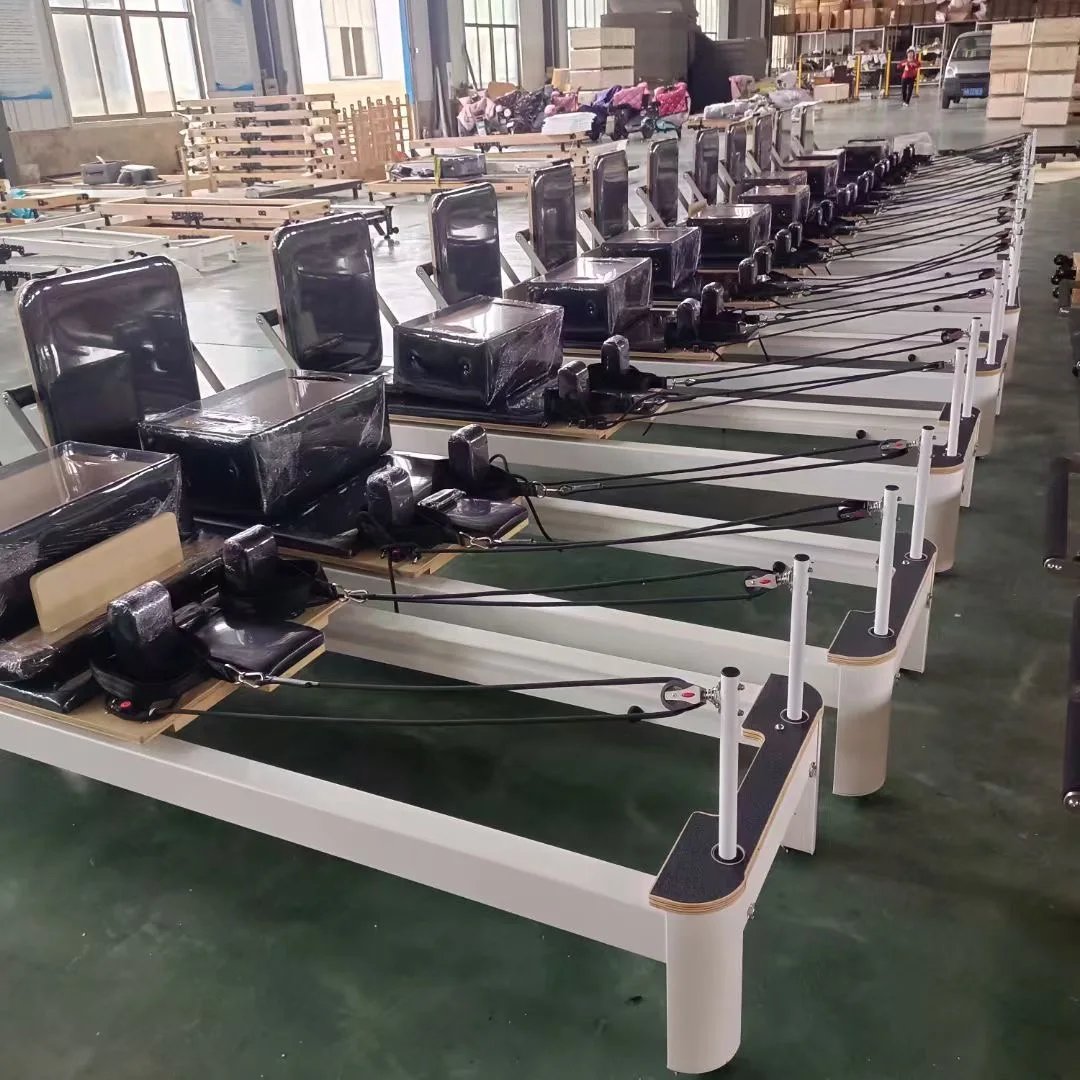
| Accessory | Long Box / Jump Board / Platform |
| Foldable | Yes |
| Color | Solid Color |
| Logo | Customized Is Allowed |
| Certification | CE / EN 957 / ISO 9001 |
| Warranty | 3 Years |
Application Suitability
| Deployment Scenario | Typical Use |
|---|---|
| Pilates studio | High-frequency group and private instruction requiring durable, low-noise sliding mechanics |
| Boutique fitness center | Multi-discipline programming incorporating jump board and long box attachments |
| High-end residential home gym | Compact, foldable deployment in shared-wall environments with strict acoustic limits |
| Rehabilitation center | Low-impact controlled resistance work with stable carriage tracking |
Why Vibration Complaints Reach the Studio Manager Before the Equipment Supplier Does
Maple wood frames absorb harmonic resonance that steel frames transmit directly into the floor structure.
When Pilates reformers operate in multi-story buildings or rooms with shared walls, the repetitive impact of the carriage against the end stops and the spring tension snaps generate structural vibration. Steel-framed units act as conduits, transferring this energy into concrete slabs and adjacent rooms [NEED_CITE: structural vibration transmission in commercial fitness deployments]. Facility managers often receive noise complaints from neighboring tenants before they realize the source is the cardio or Pilates zone. A foldable Pilates reformer maple wood commercial unit mitigates this by utilizing the natural dampening properties of hardwood to isolate mechanical impacts.
Positioning Within the Studio Equipment Matrix
This unit bridges the gap between traditional mat work and full-spring apparatus training. The 2400mm length accommodates full-range extension for tall users, while the foldable mechanism allows the floor space to revert to mat-based functional training zones during off-peak hours. It pairs effectively with Cadillac or Wunda Chair stations for circuit programming, offering a low-impact, high-control resistance modality. The solid color finish and maple wood aesthetic integrate into boutique environments where equipment must align with interior design standards.
Deployment Constraints and Environmental Tolerances
Continuous studio operation, where units cycle through multiple classes per day, demands attention to floor leveling and ambient humidity. Maple wood components require stable humidity levels to prevent warping that could bind the carriage tracking system [NEED_CITE: wood frame stability in commercial fitness environments]. The foldable mechanism introduces a mechanical joint that must be inspected for play during routine maintenance intervals. Adequate clearance behind the unit is necessary for the long box attachment and jump board deployment, impacting the spacing in 3D layout planning.
Drive System and Resistance Architecture
The SRY-20B relies on spring-based resistance rather than magnetic or friction systems, providing a linear load curve that matches muscle tension throughout the range of motion. The carriage wheels and track interface dictates the smoothness of the return phase; any lateral play manifests as a "clunk" during transitions, which is unacceptable in silent-studio environments. The integration of the jump board requires the frame to absorb repetitive ballistic loads without compromising the folding hinge integrity. The maple wood construction offers a distinct tactile and acoustic profile compared to aluminum or steel, dampening the high-frequency "ping" of spring engagement.
The Hidden Cost of Specification Compromise
Selecting reformers based solely on static load ratings often leads to premature failure of the carriage tracking system under dynamic jump board usage. Units lacking reinforced end stops develop elongation in the mounting points, leading to unsafe carriage travel. Furthermore, non-commercial folding mechanisms develop slop within months of daily deployment, creating a safety hazard and a perception of poor facility maintenance. Inadequate spring calibration leads to user complaints of "dead spots" in the resistance curve, prompting instructors to abandon the equipment for programming [NEED_CITE: resistance curve linearity and user retention in boutique fitness].
The Biketon Engineering Approach
Our testing lab verifies that the foldable hinge maintains structural rigidity under continuous commercial cycles, a critical failure point in space-saving designs. We map the spring resistance curve for linearity to ensure there are no abrupt jumps between gear settings, a common issue in mass-produced units. The 10,000-hour durability protocol includes repetitive fold/unfold sequences and maximum-load jump board impacts. We provide 3D layouts that account for the additional clearance needed for accessory deployment and maintenance access.
Documentation & Test Records
- CE declaration of conformity for structural safety.
- EN 957 test report verifying static and dynamic load limits.
- ISO 9001 certificate covering the manufacturing process.
- Noise level test report comparing wood vs. steel frame resonance.
- Durability test record for the folding mechanism cycle count.
- Spare parts list including spring calibration specs.
Installation, Commissioning & Maintenance
- Verify floor flatness within 3mm to prevent carriage drift on the 2400mm track.
- Maintain ambient humidity between 40-60% to protect maple wood integrity.
- Inspect folding hinge bolts for torque specs weekly during high-frequency use.
- Calibrate spring tension quarterly to maintain linear resistance profiles.
- Clean carriage wheels and tracks with non-solvent agents to prevent buildup.
Sourcing and Configuration Inquiry
Provide your studio dimensions and daily class volume to receive a 3D layout that integrates the foldable footprint and accessory clearance. Specify the deployment floor and adjacent room usage to confirm the acoustic dampening requirements.
Frequently Asked Questions
Q: How does maple wood construction compare to steel frames for noise reduction?
A: Maple wood possesses natural acoustic dampening properties that absorb high-frequency vibrations generated by spring engagement and carriage impact. Unlike steel, which transmits structural resonance into floor slabs and shared walls, the wood frame isolates mechanical noise, making it suitable for multi-story residential or hotel environments where acoustic bleed is a primary concern.
Q: Can the foldable mechanism withstand daily folding and unfolding cycles?
A: The SRY-20B utilizes a commercial-grade hinge system tested for 10,000+ cycles under load. Unlike residential-grade folding units, the structural rigidity of the maple frame and reinforced locking pins ensure that the tracking alignment remains precise even after repeated deployment and storage in high-turnover studio schedules.
Q: What is the weight capacity and durability rating for commercial use?
A: The unit is engineered to support a maximum user weight of 180kg, accommodating a diverse client base. The 3-year warranty covers the frame and mechanical components under commercial conditions, provided the maintenance schedule for spring calibration and track lubrication is followed according to the commissioning guide.
Q: How does the accessory system expand without requiring additional floor space?
A: The long box, jump board, and platform are designed to integrate directly into the 2400mm footprint. They mount securely to the existing frame points without extending the operational perimeter, allowing studios to offer comprehensive apparatus programming within the standard spatial allocation of a single reformer station.
![White Aluminum Alloy Pilates Reformer Equipment for Studio Use with Full Accessory Kit [WARN] draft identifier mismatch](https://bicksport.com/wp-content/uploads/2026/08/white-aluminum-alloy-pilates-reformer-equipment-for-studio-use-with-full-accessory-kit-warn-draft-identifier-mismatch-e368cf.webp)

