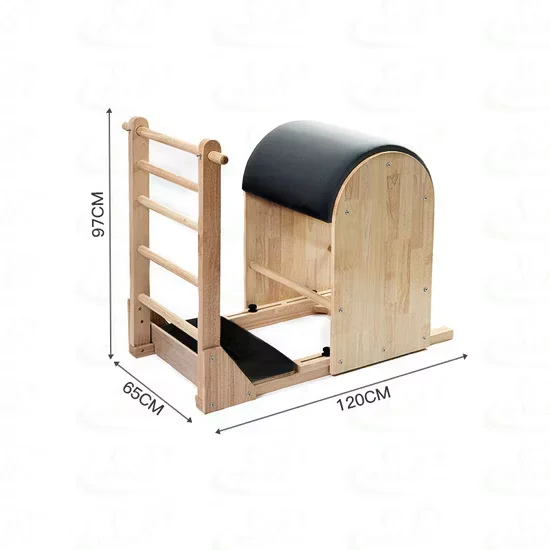
Solid Wood Acoustic Damping — Solid oak frame absorbs carriage resonance before vibration reaches the floor slab, solving noise transmission in multi-story wellness spaces.
Technical Specifications
| Parameter | Value |
|---|---|
| Designation | SRY-20B |
| Product Type | Pilates Reformer |
| Material | Solid Wood |
| Color | Solid Color (customizable finish available) |
| Specification | 2400 × 600 × 350 mm |
| Net Weight | 100 kg |
| Foldable | Yes |
| Accessories | Long Box / Jump Board / Platform |
| Age Group | Adult |
| Gender | Unisex |
| Customization | Logo, color, accessory configuration available |
| Warranty | 3 Years |
| Production Capacity | 80 Pieces/Month |
Application Suitability
| Deployment Scenario | Typical Use |
|---|---|
| Boutique Pilates studio in shared commercial buildings | Daily group and private reformer classes requiring acoustic discretion |
| High-end residential wellness suite | Private training where equipment must store compactly between sessions |
| Hotel fitness center on guest room floors | 24-hour access reformer sessions with minimal floor-borne vibration |
| Corporate wellness room with multi-use scheduling | Rapid reconfiguration between Pilates and other movement formats |
| Private rehabilitation and sports recovery clinic | Controlled resistance work for injury recovery and mobility programming |
Why Vibration Complaints Surface Before the Studio Owner Notices
Solid wood mass and internal damping characteristics stop carriage resonance at the frame level, not after it has already entered the building structure.
Metal-frame reformers transmit carriage oscillation directly through rigid steel legs into concrete or timber floor slabs. In multi-story deployments — particularly studios above occupied office floors or hotel guest rooms — that structural transmission becomes audible as a rhythmic low-frequency thud. Facility operators often learn about the problem only when tenants or guests file formal complaints, by which point the acoustic issue has already damaged the business relationship [NEED_CITE: structural vibration transmission standards for fitness equipment in mixed-use buildings]. A foldable wood Pilates reformer commercial addresses this at the source: the timber frame itself acts as a damping layer, absorbing and dissipating carriage energy before it couples with the floor.
Positioning Within a Dedicated Reformer Studio Layout
This reformer covers the full classical and contemporary Pilates movement vocabulary at beginner through advanced intensity levels. The long box, jump board, and platform accessory set enables supine, seated, kneeling, and standing work without requiring additional standalone apparatus. In a studio configuration, units pair naturally with Cadillac towers and Wunda chairs to create progressive circuit programming. The 2400 × 600 mm footprint fits standard commercial studio grid spacing, while the foldable wood Pilates reformer commercial design allows wall-side storage between class blocks, keeping the floor clear for mat work or group movement sessions. The solid wood construction and 100 kg net weight provide stable grounding for dynamic jump board sequences across a broad user weight range.
Continuous Studio Scheduling and Deployment Environment
Back-to-back class scheduling in boutique studios means individual reformer units may see six or more sessions per day with brief turnover windows. The wood frame and carriage rail system must sustain repeated loading cycles without joint loosening or rail surface degradation [NEED_CITE: commercial Pilates equipment duty cycle expectations in high-traffic studio environments]. Floor-borne vibration remains a concern when studios occupy upper floors of mixed-use buildings, making the inherent damping of solid timber relevant for lease compliance and neighbor relations. Adequate ventilation around each unit prevents humidity accumulation that could affect wood dimensional stability over time. Ground-level deployment requires a flat, sealed surface to prevent moisture wicking into the frame base, while upper-floor installations benefit from acoustic isolation pads beneath the footplate.
Wood Species, Rail Engineering, and Accessory Load Paths
Solid hardwood — typically oak or comparable dense species — provides mass and internal fiber structure that dissipate vibrational energy rather than transmitting it. This is a fundamentally different approach to noise control than adding aftermarket damping pads to a metal frame. The carriage rail surface must balance low-friction glide with long-term wear resistance; wheel material and rail hardness work together to determine smoothness and maintenance intervals [NEED_CITE: wood species dimensional stability and load-bearing capacity for fitness apparatus]. The foldable joint mechanism must maintain frame rigidity during high-load exercises such as jump board plyometrics, where dynamic forces significantly exceed static user weight. Accessory attachment points — long box rails, jump board sockets, platform mounting hardware — carry concentrated loads that demand robust joinery and verified load ratings at each connection.
What Happens When Specification Compromises Surface Mid-Deployment
Light-duty reformer frames built from softwood or engineered board may appear adequate during showroom testing but deteriorate under sustained commercial use. Rail surfaces score and develop friction points, carriage wheels flat-spot, and foldable joints work loose within months of daily studio scheduling. The resulting noise increase and movement inconsistency drive member complaints and class cancellations — problems that compound quickly in subscription-based studio models where retention depends on session quality [NEED_CITE: equipment failure patterns in commercial Pilates studio operations]. Sourcing reformers without verified accessory load ratings creates safety exposure during jump board and platform exercises, where dynamic forces test every joint and fastener in the frame.
Why This Product Line Earns Studio Operator Confidence
Every unit undergoes dimensional and load verification before shipping, ensuring the solid wood frame meets structural requirements for commercial scheduling. The three-year warranty covers frame integrity and carriage mechanism function across continuous studio deployment. Full OEM customization — logo engraving, finish color matching, and accessory configuration — enables franchise networks to maintain brand consistency across locations. Each deployment includes 3D floor layout planning that accounts for the 2400 × 600 mm footprint, foldable storage positioning, and safe clearance zones around each reformer for instructor circulation. The complete accessory ecosystem ships integrated, eliminating separate procurement and compatibility issues. Technical support remains available around the clock for commissioning questions and maintenance scheduling.
Documentation & Test Records
- CE declaration of conformity for SRY-20B Pilates reformer
- EN 957 test report covering structural load and safety requirements
- ISO 9001 certificate for manufacturing quality management
- Wood treatment and dimensional stability specification sheet
- Accessory load rating records for long box, jump board, and platform
- Foldable mechanism cycle test documentation
Installation, Commissioning & Maintenance
- Confirm 2400 × 600 mm clearance plus instructor walkway on all sides
- Level the floor surface and install moisture barrier pads beneath footplates
- Inspect all foldable joint fasteners after initial 30-day break-in period
- Lubricate carriage wheels and inspect rail surfaces per maintenance schedule
- Verify accessory attachment points for long box and jump board security
- Apply wood-safe finish treatment per humidity conditions in your facility
Equipment Selection and Deployment Planning
Provide your studio floor dimensions and planned unit count to receive a 3D layout covering reformer spacing, foldable storage zones, and instructor circulation paths. Specify your daily class schedule and expected sessions per unit so we can confirm frame and rail durability alignment. Indicate your deployment floor level and adjacent occupied spaces to verify acoustic suitability. State your destination market for finish treatment recommendations matching local humidity conditions. Confirm whether OEM logo engraving or custom finish color is required for brand alignment.
Frequently Asked Questions
Q: What wood species and treatment process ensures long-term dimensional stability?
A: The frame uses dense hardwood selected for structural load capacity and natural vibration damping. Timber undergoes kiln drying to a target moisture content matched to the deployment environment, followed by sealed finish treatment that resists humidity fluctuation. This process prevents warping, splitting, and joint loosening across seasonal climate changes typical in both temperate and tropical installation regions.
Q: How does the foldable mechanism maintain rigidity during high-load exercises?
A: The folding joint uses reinforced metal hardware that locks the frame into a rigid operational geometry when deployed. During use, load paths bypass the hinge entirely, transferring forces through the primary wood structure. The mechanism is cycle-tested to verify that repeated folding and unfolding does not introduce play or compromise structural alignment over the equipment service life.
Q: Can the reformer accommodate commercial-duty daily usage in a studio environment?
A: The solid wood frame and carriage system are specified for repeated daily sessions typical in boutique studio scheduling. Rail surface hardness and wheel material are matched to sustain smooth glide under continuous use. The three-year warranty covers structural and mechanical function, reflecting confidence in long-term durability under commercial operating conditions.
Q: What accessory options are available and how do they integrate with the base frame?
A: The long box, jump board, and platform each attach to dedicated mounting points engineered into the frame structure. These connection points are load-rated for the dynamic forces generated during plyometric and standing exercises. Accessories integrate without tools for rapid configuration changes between class formats, and all three ship as a matched set calibrated to the specific frame dimensions.
Q: What OEM customization options exist for branding and finish matching?
A: Logo engraving or plate mounting is available on the frame. Finish color can be specified to match studio interior design palettes across franchise networks. Accessory configuration can be adjusted per order, allowing operators to select the combination that matches their class programming. Custom specifications are confirmed during the quotation phase before production begins.
![Fitness Equipment Maple Wood Pilates Bed Reformer for Yoga Studio [WARN] draft identifier mismatch](https://bicksport.com/wp-content/uploads/2026/08/fitness-equipment-maple-wood-pilates-bed-reformer-for-yoga-studio-warn-draft-identifier-mismatch-6090a0.webp)
![Commercial Aluminum Alloy Pilates Reformer Bed for Studio [WARN] draft identifier mismatch](https://bicksport.com/wp-content/uploads/2026/08/commercial-aluminum-alloy-pilates-reformer-bed-for-studio-warn-draft-identifier-mismatch-c372fc.webp)