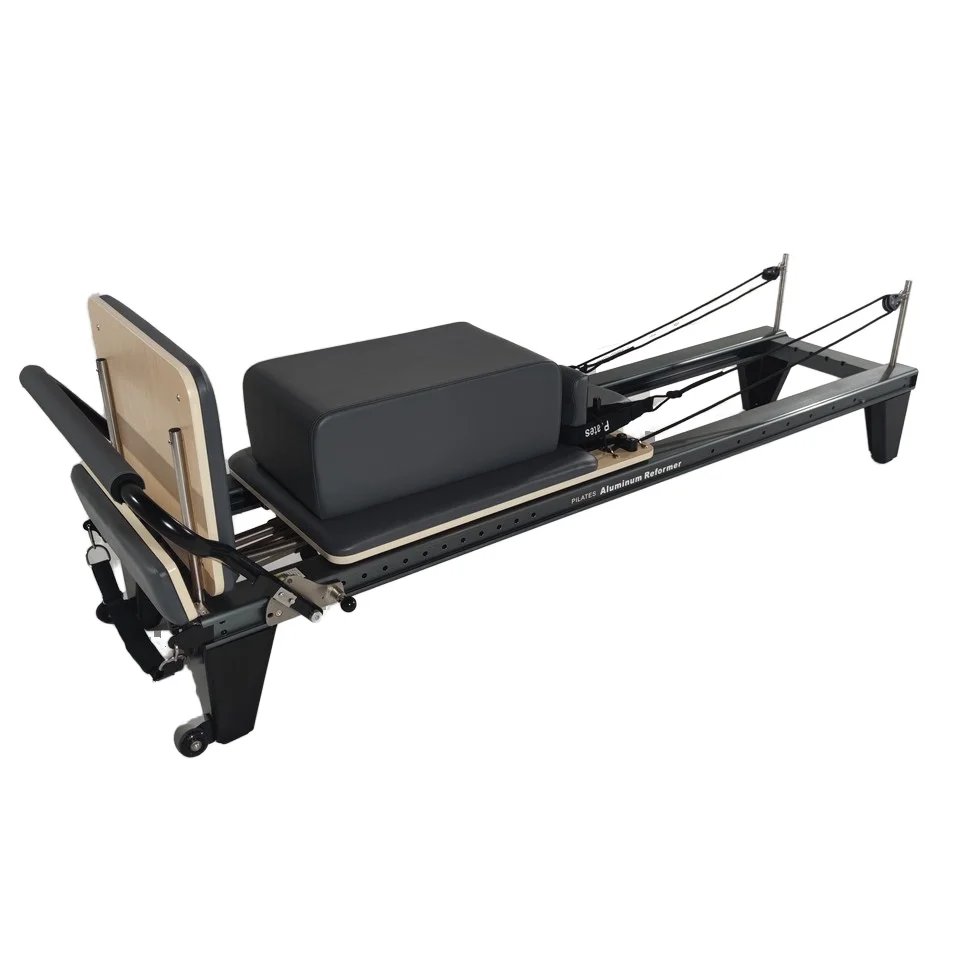
Acoustic-Optimized Frame Geometry — aluminum extrusion profiles and damped carriage wheels engineered to limit structure-borne vibration in multi-use wellness spaces.
Technical Specifications
| Parameter | Value |
|---|---|
| Designation | SRY-12A |
| Product Type | Pilates Reformer |
| Frame Material | Aluminum |
| Foldable | Yes |
| Product Dimensions | 2570 × 730 × 270 mm |
| Net Weight | 90 kg |
| Accessory | Long Box / Jump Board / Platform |
| Warranty | 3 Years |
Application Suitability
| Deployment Scenario | Typical Use |
|---|---|
| Boutique Pilates studio | Group reformer classes with multi-exercise programming across spring-resistance levels |
| Hotel wellness floor | Compact mind-body sessions in limited-footprint spa-adjacent rooms |
| High-end residential home gym | Daily low-impact training with foldable storage between sessions |
| Corporate wellness room | Employee recovery and mobility work during midday breaks |
| Sports performance training center | Athlete rehabilitation and core-stabilization protocols |
Why Vibration Travels Through Floor Joists Before Anyone Notices
Carriage track tolerances and frame resonance determine whether a reformer stays quiet or becomes a structural complaint.
Deploying a foldable aluminum Pilates reformer machine on upper hotel floors or shared residential ceilings often reveals a problem too late: carriage wheels transmitting low-frequency vibration through joist cavities into occupied rooms below. Steel frames tend to dampen some frequencies internally, but aluminum extrusions conduct vibration differently, requiring deliberate isolation at the carriage-track interface and the foldable hinge joints. Facilities that overlook this during spec review end up relocating entire rooms after the first guest complaint [NEED_CITE: structure-borne vibration transmission through floor assemblies in commercial wellness spaces].
Positioning This Reformer Within a Mixed-Discipline Wellness Floor
The SRY-12A covers full-spectrum reformer programming — supine, prone, seated, and standing spring-resistance work — within a single footprint. In a studio layout, it pairs with mat zones and cadillac units to absorb peak class scheduling without requiring dedicated apparatus per station. The 2570 × 730 mm footprint fits standard three-unit studio rows with adequate lateral clearance, while the foldable design allows conversion between group-class and open-floor configurations. User weight capacity accommodates a broad participant range across commercial group sessions.
Continuous Session Scheduling and Floor-Loading Realities
Back-to-back studio classes mean the carriage track and spring anchors face sustained loading with minimal rest cycles. Aluminum’s fatigue characteristics differ from welded steel, so hinge points on a foldable frame require verified cycle ratings before deployment in high-throughput environments. Upper-floor installations demand attention to subfloor rigidity — flexible timber joists amplify carriage travel vibration more than concrete slabs. Voltage is not a factor here, but ambient humidity in spa-adjacent rooms can affect aluminum surface treatment longevity [NEED_CITE: aluminum alloy corrosion resistance in high-humidity wellness environments]. Ground-level placement on screeded concrete with isolation pads reduces transmitted vibration substantially.
Reading the Aluminum Frame and Spring Specification Sheet
Aluminum extrusion frames offer corrosion resistance and lighter transport weight compared to steel, but the alloy grade and wall thickness determine long-term rigidity under dynamic jump-board loading. Spring-resistance calibration is the core mechanical variable: progression levels must match user advancement without requiring full spring-set replacement within months. Carriage wheel material — typically sealed polyurethane bearings — directly influences track noise and rolling smoothness across thousands of repetitions. The foldable hinge mechanism introduces a secondary wear point absent in fixed-frame reformers, so pin tolerances and bushing material warrant inspection during commissioning. Accessory mounting interfaces for the long box, jump board, and platform must remain secure under lateral forces without drift.
What Happens When Foldable Hinges Are Underspecified
Facilities that select reformers on weight savings alone often discover hinge play developing after several hundred fold-unfold cycles in staff training rooms or hotel suites. Carriage rattle emerges when track alignment shifts from frame flex, degrading exercise precision and generating audible disturbance in adjacent occupied spaces. Spring anchors that lack hardened mounting points deform under jump-board impact, causing resistance drift that instructors notice before maintenance staff do. Units returned under warranty for these issues typically show no manufacturing defect — only loading conditions that exceeded the hinge rating [NEED_CITE: mechanical fatigue thresholds in foldable fitness equipment under commercial duty cycles].
Why This Product Line Holds Up Across Deployments
Sub-35dB acoustic standards developed for our cardio range informed the carriage-track and wheel-bearing tolerances on this reformer series. Components undergo 10,000-hour continuous-cycle testing adapted to reciprocating carriage loads rather than rotary motor loads. The foldable mechanism is rated for repeated deployment in hotel wellness suites where staff fold units daily between guest sessions. Full OEM customization extends to frame finish color and accessory branding. Free 3D layout planning covers reformer spacing, airflow clearance, and sightline requirements for studio configurations. 24/7 technical support addresses spring-tension calibration and carriage-track alignment queries as they arise on-site.
Documentation & Test Records
- CE declaration of conformity covering the SRY-12A frame and accessory assemblies
- EN 957 test report for structural loading and spring-resistance safety margins
- ISO 9001 certificate for manufacturing quality management systems
- Noise level test record documenting carriage-track acoustic output
- Durability test record for foldable hinge cycle rating and spring-anchor fatigue
- Installation and commissioning guide with spring-calibration procedures and spare parts list
Installation, Commissioning & Maintenance
- Verify 2570 × 730 mm footprint with minimum 600 mm lateral clearance for carriage access and instructor circulation
- Level the aluminum frame on isolation pads to prevent track misalignment and carriage drift during spring-loaded exercises
- Inspect foldable hinge pins and bushings at commissioning and re-torque after the first 200 fold cycles
- Calibrate spring-resistance progression levels using the included specification sheet before opening to member sessions
- Clean aluminum surfaces with pH-neutral solution to protect surface treatment from sweat and humidity accumulation
- Verify long box, jump board, and platform mounting interfaces for secure engagement before each class session
Scoping Your Reformer Deployment
Provide studio dimensions and intended unit count to receive a 3D layout covering equipment spacing, airflow, and instructor sightlines. Specify deployment floor level and adjacent occupied rooms to confirm acoustic isolation requirements. Indicate whether units will be folded daily between sessions so the hinge duty cycle can be matched to actual use patterns. Clarify spring-resistance levels needed for your target participant progression to ensure the included set covers your programming scope.
Frequently Asked Questions
Q: How does an aluminum frame compare to steel for long-term reformer durability?
A: Aluminum resists corrosion in humid wellness environments and reduces transport weight, but alloy grade and wall thickness determine rigidity under dynamic loading. High-grade extrusions with reinforced cross-sections perform comparably to steel for studio use. The critical difference lies in fatigue behavior at welded or bolted joints, which must be validated through cycle testing specific to reciprocating carriage loads.
Q: Does a foldable reformer sacrifice structural rigidity during exercises?
A: A properly engineered foldable mechanism maintains rigidity when locked in the open position, with hinge play remaining within track-tolerance limits. The concern is long-term wear at the fold joint after repeated cycling. Procurement should verify the hinge cycle rating against expected daily fold frequency in your deployment scenario to ensure alignment holds over the warranty period.
Q: How should spring resistance be matched to user progression levels?
A: Spring sets are calibrated to specific tension ranges, and instructors need a clear progression map from beginner to advanced loads. Request the manufacturer’s spring specification sheet detailing force curves for each spring color or gauge. Mismatched tension causes users to compensate with improper form, and replacement intervals depend on cycle count rather than calendar time.
Q: Is the jump board stable enough for dynamic plyometric exercises on a foldable frame?
A: Jump-board stability depends on mounting interface rigidity and the frame’s ability to absorb repetitive impact without resonance buildup. Verify that the platform mounting points are reinforced and that the foldable hinge does not introduce flex under vertical loading. Testing should confirm no audible rattle or carriage displacement during sustained jump sequences.
Q: What floor and acoustic considerations apply when installing reformers above occupied rooms?
A: Carriage wheels transmit low-frequency vibration through the frame into the floor structure. Isolation pads beneath each foot reduce transmission, and subfloor rigidity affects how much vibration reaches rooms below. Upper-floor deployments should include an acoustic assessment of the floor assembly, with particular attention to timber joist spans that amplify reciprocating loads more than concrete slabs.
![Beech Wood Pilates Reformer Bed for Commercial Studio Equipment [WARN] draft identifier mismatch](https://bicksport.com/wp-content/uploads/2026/08/beech-wood-pilates-reformer-bed-for-commercial-studio-equipment-warn-draft-identifier-mismatch-32d5bd.webp)