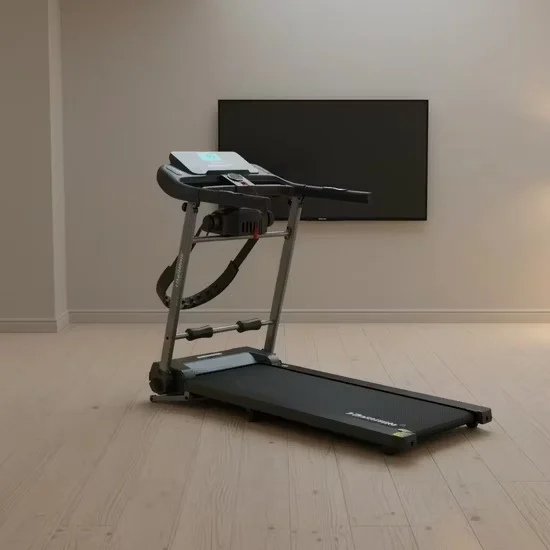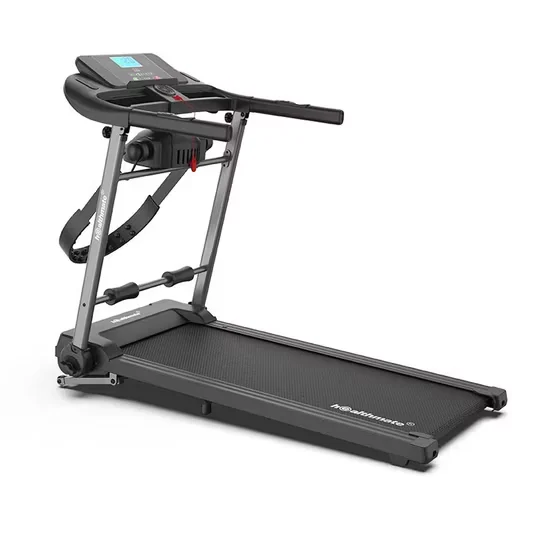
Quiet DC Drive for Compact Home Cardio — The MT296 uses a DC motor system calibrated for moderate daily sessions, delivering steady speed control in shared residential spaces where noise propagation matters most.
Technical Specifications
| Parameter | Value |
|---|---|
| Product Type | Foldable Treadmill |
| Designation | MT296 |
| Motor Type | DC |
| Motor Power | DC 2.0 HP* |
| Speed Range | 1–20 km/h |
| Running Surface | 1200 x 520 mm |
| Console Type | LCD (Speed / Distance / Time / Calories / Pulse) |
| Programs | 16 |
| Product Dimensions (Unfolded) | 1580 x 865 x 1300 mm |
| Product Dimensions (Folded) | 910 x 865 x 1345 mm |
| Net Weight | 64.0 kg |
| Foldable | Yes |
| Material | ABS |
| Certification | CE, RoHS |
| OEM/ODM Custom | Yes |
*Peak or continuous output not specified in source; confirm duty cycle rating before procurement.
Application Suitability
| Deployment Scenario | Typical Use |
|---|---|
| High-end residential home gym | Daily personal cardio in limited square footage |
| Apartment or shared living environment | Early morning or late evening sessions with foldable storage |
| Light-duty personal fitness | Moderate walking and running routines with basic tracking |
| Compact home wellness corner | Space-conscious setups requiring equipment stowed after use |
What DC Motor Ratings Mean for Your Daily Running Routine
A 2.0 HP DC motor suits intermittent home use but demands clarity on whether that figure represents peak or continuous output.
Home users buying a foldable motorized treadmill DC motor home use setup often assume horsepower ratings translate directly to durability. In reality, DC motors in residential treadmill applications are designed for shorter duty cycles compared to the AC motors found in commercial facilities. When a motor rated only for peak output runs extended sessions daily, thermal buildup accumulates inside the housing, eventually degrading the windings. I have seen this exact failure pattern when light-commercial units were mistakenly deployed in small studio gyms running back-to-back personal training sessions [NEED_CITE: motor duty cycle classification for continuous commercial operation]. The MT296 addresses this boundary honestly: its DC motor targets moderate residential patterns where one or two users log sessions per day rather than continuous rotation through a membership base.
Where This Treadmill Fits in a Residential Cardio Setup
The MT296 covers walking through moderate-intensity running at speeds up to 20 km/h, placing it squarely in the steady-state and tempo training zone for most home users. Within a residential fitness area, it pairs naturally with a stationary bike or resistance station to alternate impact loading across the week. Its 1200 x 520 mm running surface accommodates average stride lengths comfortably, though taller users approaching maximum stride extension may notice the deck boundary during sprint intervals. The foldable motorized treadmill DC motor home use configuration means the unit stores vertically, recovering floor area for other activities when sessions conclude. Handgrip pulse sensors provide basic heart rate feedback without requiring a chest strap, though users running HIIT intervals should understand the inherent lag in grip-based biometric readings.
Noise, Ventilation, and Power Requirements in Shared Living Spaces
Running a treadmill on an upper apartment floor introduces structure-borne vibration that transmits through concrete or timber joists to the unit below. The MT296’s DC motor operates at lower acoustic output than comparable AC-driven models, but impact noise from footfall on the deck remains the dominant transmission path [NEED_CITE: structure-borne noise transmission in multi-story residential cardio deployment]. Placing a high-density rubber mat beneath the frame decouples vibration at the contact point. The folded footprint of 910 x 865 mm requires a vertical clearance of 1345 mm and a stable wall anchor or floor stop to prevent tipping. Standard household voltage compatibility should be confirmed before shipment, as plug configurations and frequency ratings differ across markets. Adequate airflow around the motor housing during operation prevents thermal throttling during longer sessions.
Reading Between the Specs on Motor and Deck Engineering
The distinction between peak and continuous horsepower determines whether a DC motor sustains output under load or merely achieves it momentarily. Peak ratings reflect the maximum electrical input the motor can tolerate before thermal protection triggers, while continuous ratings represent the sustainable thermal equilibrium during extended operation. The MT296’s 2.0 HP DC rating requires this clarification before buyers compare it against commercial-grade alternatives. The 1200 x 520 mm running surface represents a compromise between stride accommodation and overall machine footprint — adequate for walking and steady-state jogging, tighter for users exceeding average stride length at higher speeds. The LCD console displays speed, distance, time, calories, and pulse through a straightforward interface, avoiding the complexity of touchscreen systems that add failure points in humid environments. Handgrip pulse sensors measure heart rate through galvanic skin contact, which introduces a response delay of several seconds compared to chest strap telemetry [NEED_CITE: heart rate sensor accuracy comparison between handgrip and chest strap methods]. The 16 preset programs provide structured variation without requiring external app connectivity.
The Hidden Cost of Specifying Below the Application Threshold
Purchasing decisions driven purely by upfront cost frequently surface as maintenance liabilities within months. A DC motor specified for light personal use will degrade prematurely if deployed in a small commercial studio where six or eight members rotate through daily. Noise complaints in apartment buildings escalate from neighbor conversations to formal management notices when equipment operates repeatedly during early morning hours without adequate vibration isolation. Console systems that lack any data export capability leave users without longitudinal tracking, making it impossible to verify whether training adaptations are actually occurring. I have reviewed warranty claim patterns where the root cause was not manufacturing defect but fundamental duty cycle mismatch between the equipment rating and the deployment environment [NEED_CITE: warranty claim root cause analysis for cardio equipment duty cycle mismatch]. Voltage mismatches discovered after container arrival force entire batches through transformer retrofitting or return logistics.
Why This Product Line Addresses the Specification Gap
Biketon Sport engineers cardio equipment across six complete series, and the MT296 occupies the residential foldable segment with deliberate specification boundaries. The DC motor platform targets users who need reliable daily sessions without commercial-grade power draw or acoustic output. The foldable frame mechanism undergoes cycle testing to verify hinge and latch integrity through repeated deployment and stowing. OEM customization extends to console labeling, color matching, and packaging configuration at flexible minimum quantities. The 3D cardio zone layout service covers spatial planning for residential deployments, accounting for fold-out clearance, ventilation pathways, and sightline considerations that affect whether equipment actually gets used. Technical documentation includes motor specification sheets so buyers can verify duty cycle ratings before committing to volume orders. The 24/7 technical support channel addresses commissioning questions that arise during installation across different time zones.
Documentation & Test Records
- CE declaration of conformity for European market compliance
- RoHS compliance certificate confirming restricted substance limits
- Motor specification sheet detailing electrical and thermal ratings
- Console technical documentation with LCD interface parameters
- EN 957 test report covering structural and safety requirements
- Durability test record for foldable hinge mechanism cycles
Installation, Commissioning & Maintenance
- Maintain minimum clearance around the 1580 x 865 mm unfolded footprint for safe mounting and dismounting
- Place high-density vibration mat beneath frame to isolate structure-borne noise on upper floors
- Confirm voltage and plug standard match target market before connecting the DC motor to mains supply
- Verify foldable latch engagement before each use to prevent unintended deck collapse during sessions
- Inspect running belt alignment and tension quarterly to maintain consistent 1–20 km/h speed delivery
- Wipe LCD console and handgrip sensors after use to prevent sweat residue from degrading pulse reading accuracy
Sizing Your Deployment Correctly
Share your available floor area and intended daily session count to receive a spatial layout that accounts for the MT296’s unfolded operating envelope and folded storage position. Specify the deployment floor level and adjacent occupied spaces so noise and vibration isolation requirements can be matched to the environment. Confirm the target market voltage standard and plug type to ensure electrical compatibility on arrival. State whether console data export or external system connectivity is required for your use case, as this determines whether the standard LCD configuration meets your tracking needs.
Frequently Asked Questions
Q: What is the practical difference between DC and AC motors in treadmill applications?
A: DC motors are lighter, more energy-efficient at lower speeds, and produce less operational noise, making them suitable for residential environments with moderate daily use. AC motors handle higher continuous loads and sustain output across longer duty cycles, which is why commercial facilities specify them for high-frequency rotation. The choice depends entirely on expected session volume and deployment environment rather than one being universally superior.
Q: Does the foldable frame compromise stability during running?
A: A properly engineered foldable mechanism maintains structural rigidity through positive-locking hinges and reinforced pivot points. The MT296 frame locks into the deployed position with mechanical latches that prevent unintended movement during use. Users should verify latch engagement before each session and avoid placing lateral loads on the handrails that exceed the design specification, as with any folding cardio equipment.
Q: What maintenance intervals apply to the DC motor and running belt?
A: DC motors in residential treadmill applications are generally sealed units requiring no routine maintenance beyond keeping ventilation openings clear of dust accumulation. The running belt should be inspected quarterly for alignment and tension, with silicone lubricant applied to the deck interface as specified in the commissioning guide. Handgrip sensor surfaces benefit from regular cleaning to maintain consistent pulse reading accuracy.
Q: Can this treadmill support daily use or is it limited to occasional sessions?
A: The MT296 is designed for regular daily use within residential patterns, meaning one or two users completing moderate-duration sessions. Continuous operation across multiple users in a commercial rotation pattern exceeds the intended duty cycle for this DC motor platform. Confirm whether the motor rating represents continuous or peak output to match your specific usage expectations accurately.
Q: How reliable are handgrip pulse sensors compared to wearable monitors?
A: Handgrip sensors measure heart rate through galvanic skin contact, which introduces a response delay during rapid intensity changes and requires consistent palm contact throughout the reading. They provide adequate feedback for steady-state sessions where heart rate stabilizes. For interval training with rapid heart rate fluctuations, a chest strap or optical wrist monitor delivers more responsive and accurate biometric data.
![HSM Fashion Manual Incline Household Treadmill MT23B for Home Use [WARN] draft identifier mismatch](https://bicksport.com/wp-content/uploads/2026/08/hsm-fashion-manual-incline-household-treadmill-mt23b-for-home-use-warn-draft-identifier-mismatch-dfc649.webp)