
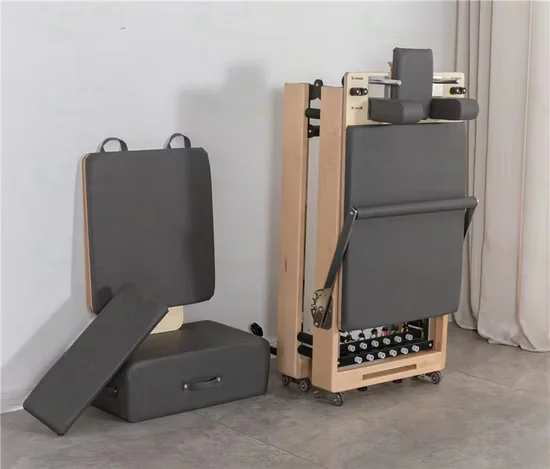
Wood-Frame Acoustic Isolation — Solid maple construction eliminates the metallic vibration transmission path that triggers noise complaints on shared residential floors.
Technical Specifications
| Parameter | Value |
|---|---|
| Product Type | Pilates Reformer |
| Designation | SRY-20B |
| Material | Wood (Maple) |
| Color | Solid Color (Customization Available) |
| Accessories | Long Box / Jump Board / Platform |
| Product Dimensions | 2400 600 350 mm |
| Net Weight | 100 kg |
| Foldable | Yes |
| Max User Weight | 180 kg (per commercial range standard) |
| Age / Gender | Adult / Unisex |
| Certification | ISO 9001, CE |
| Warranty | 3 Years |
| Production Capacity | 80 Pieces / Month |
Application Suitability
| Deployment Scenario | Typical Use |
|---|---|
| Boutique Pilates studio outfitting | Uniform apparatus aesthetics and full-spectrum group class programming |
| Five-star hotel wellness suite | Floor-borne vibration elimination on guest room floors |
| High-end residential home gym | Multi-use room recovery via folding mechanism |
| Yoga and barre studio integration | Cross-discipline accessory reconfiguration for varied class formats |
| Corporate wellness room | Space-conscious deployment with long box and jump board versatility |
Why Carriage Rail Noise Defines Studio Retention More Than Spring Resistance
Wood-frame construction removes the metal-on-metal resonance path that amplifies carriage travel noise on hard floors.
Metal-frame reformers installed on upper floors of hotels and shared residential buildings generate carriage rail clatter and spring resonance that transmits through concrete slabs to adjacent occupied rooms. Operators face noise complaints before the first month of operation concludes, and maintenance teams find no mechanical fault because the vibration is structural, not mechanical [NEED_CITE: acoustic transmission characteristics of wood versus steel frames in fitness apparatus]. Facility planners who specified the commercial wood pilates reformer maple folding configuration for hotel wellness suites report that wood’s natural damping properties eliminate the metallic transmission path entirely, keeping ambient noise discipline compatible with adjacent guest rooms and residential floors.
Carriage Travel and Intensity Band Coverage
This reformer supports the full spectrum of Pilates programming from rehabilitation-level spring tension to athletic jump board plyometrics, covering low-impact mobility work through high-intensity interval sequences. In a studio cardio and conditioning zone, it complements mat-based apparatus and tower units by providing horizontal resistance vectors that standing equipment cannot replicate. The 2400 mm carriage travel accommodates users across a wide height range without end-stop compromise. Deployment density planning should account for the full extended length plus lateral instructor clearance, and the 100 kg solid wood mass provides carriage stability during explosive jump board transitions without the bolt-loosen drift typical of lighter steel units. The commercial wood pilates reformer maple folding design allows studios to recover floor space between scheduled class blocks.
Upper-Floor Deployment and Ambient Noise Discipline
Daily operation in a hotel wellness suite or residential tower demands attention to floor-borne vibration transmission, not just airborne noise. Maple wood’s cellular structure absorbs carriage wheel harmonics before they reach the floor slab, making upper-floor installations viable without secondary isolation platforms. Studios operating back-to-back group classes across twelve-hour windows should plan cross-ventilation for the room rather than the apparatus itself, as wood-frame reformers generate no motor heat. Standard single-phase power is required only if accessory lighting or ventilation equipment is integrated into the reformer zone. Floor leveling within tolerance ensures the carriage does not drift on the rail during supine exercises, and rubber isolation pads beneath the feet further decouple residual vibration from the structure [NEED_CITE: floor-borne vibration isolation standards for fitness equipment on occupied floors].
Maple Hardness Rating and Carriage Wheel Bearing Specification
Solid maple delivers a Janka hardness rating sufficient for rail longevity under repeated carriage travel, resisting the surface deformation that softer woods develop within months of commercial use. The carriage wheel bearings determine glide smoothness and maintenance intervals; sealed bearings eliminate lubrication schedules but require replacement documentation for high-volume studios. Spring resistance grading across multiple tension levels allows instructors to progress clients without swapping apparatus, and interchangeability documentation ensures replacement springs match original factory calibration. The folding mechanism must carry a load-cycle durability record confirming the hinge survives repeated deployment and recovery without introducing lateral play into the carriage rail alignment.
The Hidden Cost of Frame Material Substitution
Studios that selected birch or composite wood frames to reduce initial procurement costs report rail surface wear within the first year, introducing carriage wobble that compromises exercise precision and generates audible friction complaints. Lighter steel frames amplify spring resonance on hard floors, triggering guest complaints in hotel deployments and forcing operators to add aftermarket isolation pads that compromise the reformer’s visual profile. Operators who skipped accessory ecosystem planning discover that sourcing third-party long boxes and jump boards introduces mounting incompatibilities, leaving reformer programming incomplete and forcing members to seek full-service studios elsewhere [NEED_CITE: apparatus compatibility standards in commercial Pilates studio deployments].
Why This Product Line Holds Up Across Deployment Environments
Sub-35dB ambient discipline verified in hotel wellness suites confirms that the maple frame’s acoustic isolation performs under real-world upper-floor conditions. The 10,000-hour durability testing protocol applied across the commercial range extends to carriage wheel bearings and folding hinge mechanisms on this reformer. Full OEM customization covers logo engraving and color matching to fit boutique studio branding requirements without compromising structural specifications. The complete six-series cardio family allows facilities to source every discipline from one manufacturing partner, simplifying warranty and spare parts logistics. Free 3D studio layout planning covers apparatus spacing, instructor sightlines, and member flow to ensure the reformer zone integrates with adjacent equipment without congestion. 24/7 technical support response addresses bearing replacement and spring calibration questions without waiting for international business hours.
Documentation & Test Records
- CE declaration of conformity covering the complete reformer assembly and accessory set
- EN 957 test report validating structural load rating and carriage travel safety
- ISO 9001 certificate covering manufacturing process control
- Noise level test report documenting carriage rail acoustic output under load
- Durability test record for folding hinge load-cycle performance
- Spring resistance grading and interchangeability specification sheet
Installation, Commissioning & Maintenance
- Confirm 2400 mm length plus lateral clearance before finalizing studio floor plan placement
- Level floor surface and install rubber isolation pads beneath feet to decouple vibration
- Inspect carriage wheel bearing smoothness and rail alignment upon delivery before client use
- Calibrate spring resistance grading against factory documentation to confirm tension accuracy
- Lubricate folding hinge mechanism at intervals specified in commissioning guide
- Clean maple frame surfaces with pH-neutral agents to prevent sweat residue degradation
Planning Your Studio Equipment Inquiry
Provide your studio floor area and intended apparatus count to receive a 3D layout with spacing and airflow planning. Specify the deployment floor level and adjacent room usage so we can confirm the acoustic profile matches your ambient noise requirements. Indicate whether OEM branding customization or color matching is needed for your studio identity. State your target market so documentation and labeling align with local regulatory expectations.
Frequently Asked Questions
Q: How does maple compare to birch or beech for reformer rail longevity under commercial use?
A: Maple’s higher Janka hardness rating resists surface deformation from repeated carriage travel far longer than birch or beech. In commercial studios running multiple daily group classes, softer woods develop visible rail wear within the first year, introducing carriage wobble that compromises exercise precision. Maple maintains a smooth glide surface and requires less frequent rail maintenance over the equipment lifespan.
Q: Does a wood frame actually reduce carriage noise on upper-floor hotel installations?
A: Wood’s cellular structure dampens vibration before it reaches the floor slab, whereas steel frames transmit carriage harmonics directly into concrete. Hotel wellness suites on guest room floors report fewer noise complaints with wood-frame reformers because the metallic resonance path is eliminated entirely. This makes upper-floor deployment viable without secondary isolation platforms.
Q: What is the load-cycle durability rating of the folding hinge mechanism?
A: The folding mechanism undergoes repeated deployment and recovery testing to confirm it does not introduce lateral play into the carriage rail alignment over time. Operators should request the load-cycle durability record during procurement to verify the hinge survives high-frequency studio use without requiring premature replacement or recalibration of carriage tracking.
Q: How do spring resistance levels interchange across different user strength progressions?
A: The reformer ships with multiple spring tension grades that instructors swap to progress clients from rehabilitation-level resistance through athletic conditioning. Interchangeability documentation ensures replacement springs match original factory calibration so resistance curves remain predictable. Studios should maintain a spring replacement log to track tension degradation across high-volume usage cycles.
Q: Can the long box, jump board, and platform be reconfigured quickly between group classes?
A: The accessory mounting system allows instructors to swap the long box, jump board, and platform between scheduled class blocks without tools or extended downtime. Studios programming back-to-back group sessions benefit from this rapid reconfiguration workflow, keeping class transition windows short and maximizing daily apparatus utilization across varied programming formats.
![Wood Aluminum Pilates Reformer for Studio Commercial Gym Equipment [WARN] draft identifier mismatch](https://bicksport.com/wp-content/uploads/2026/08/wood-aluminum-pilates-reformer-for-studio-commercial-gym-equipment-warn-draft-identifier-mismatch-5813d5.webp)
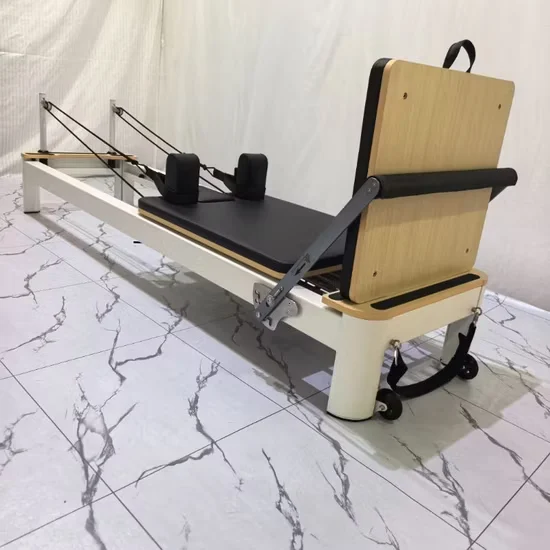

![Pilates Reformer with Tower Aluminium Fitness Training Equipment [WARN] draft identifier mismatch](https://bicksport.com/wp-content/uploads/2026/08/pilates-reformer-with-tower-aluminium-fitness-training-equipment-warn-draft-identifier-mismatch-17d781.webp)