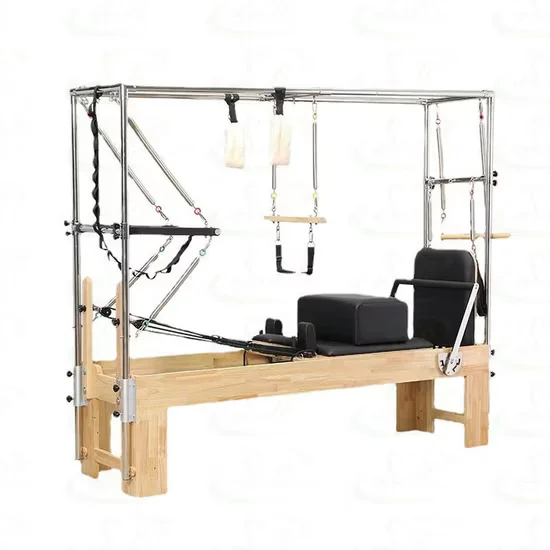
Naturally Silent Mechanics — Solid wood frame eliminates motor, belt, and cable noise entirely, making the Pilates ladder barrel deployable on hotel wellness floors and shared studio spaces without acoustic complaints.
Technical Specifications
| Parameter | Value |
|---|---|
| Product Type | Pilates Ladder Barrel |
| Model NO. | SRY-03 |
| Product Dimensions | 1100770980mm |
| Net Weight | 50kgs |
| Color | Solid Color |
| Age Group | Adult |
| Gender | Unisex |
| Logo | Customized Is Allowed |
| Warranty | 3 Years |
| Certification | ISO 9001, CE, EN 957 |
| Production Capacity | 800 Pieces/Month |
| HS Code | 9506911900 |
Application Suitability
| Deployment Scenario | Typical Use |
|---|---|
| Boutique Pilates and yoga studios | Spinal articulation, back extension, and core stabilization in group or semi-private sessions |
| Five-star hotel wellness centers on guest floors | Low-noise flexibility and rehabilitation apparatus accessible around the clock |
| Rehabilitation centers and physical therapy clinics | Controlled range-of-motion work for spinal and hip recovery protocols |
| Corporate wellness rooms | Versatile bodyweight training station requiring zero electronic maintenance |
| High-end residential home gyms | Aesthetic solid wood apparatus complementing interior design without mechanical noise |
Why Studios Replace Metal-Frame Apparatus After the First Noise Complaint
Solid wood construction removes the noise source rather than masking it.
When a boutique Pilates studio occupies a shared commercial building, every repetition on a metal-frame reformer transmits vibration through the floor slab into the office or hotel room below. We have watched facility managers receive noise complaints within the first week of operation, long before any maintenance issue surfaces. A commercial Pilates ladder barrel wood eco-friendly design sidesteps this problem because there is no motor, no spring tower, and no pulley cable to generate acoustic energy. The resistance comes entirely from the practitioner’s bodyweight interacting with the barrel’s curved surface and ladder rungs [NEED_CITE: acoustic transmission class requirements for fitness equipment in mixed-use commercial buildings].
I remember an installation in a European boutique wellness center where the studio sat directly above a conference suite. The metal reformers created a rhythmic thudding during group classes that bled through the ceiling. The client replaced the entire floor’s apparatus lineup within six months. Equipment that relies on mechanical simplicity avoids this failure mode from day one.
Where the Ladder Barrel Fits in a Studio Equipment Roster
The ladder barrel covers the extension, flexion, and lateral bending spectrum that reformers and Cadillacs cannot isolate effectively. In a group class rotation, practitioners move from reformer spring work to the barrel for spinal decompression and hip flexor stretching, creating a natural intensity transition. This commercial Pilates ladder barrel wood eco-friendly apparatus pairs with Wunda chairs and spine correctors to fill the bodyweight training gap in a twelve-station studio layout. It accommodates users across a broad height range because the ladder rung spacing allows hand and foot placement adjustments. The equipment collects no electronic data — it is a pure mechanical tool — so placement does not depend on power outlet proximity or cable routing.
Continuous Operation and Spatial Deployment Requirements
A ladder barrel in a busy studio may see eight to twelve consecutive class sessions per day, each placing sustained bodyweight loads on the barrel apex and ladder joints. Solid wood handles this duty cycle differently than bonded composite or tubular steel: the grain structure distributes compressive stress along the fiber rather than concentrating it at weld points [NEED_CITE: structural load testing standards for static Pilates apparatus in commercial use]. Noise transmission is essentially zero, so the apparatus can sit on upper floors or beside treatment rooms without acoustic isolation. Ventilation requirements are minimal because there is no motor generating heat. The unit requires a level floor surface with adequate clearance on all sides for practitioner movement — typically one meter of free space around the perimeter. No dedicated electrical circuit or data connection is needed, simplifying deployment in retrofit spaces where adding outlets would require contractor work.
Reading the Material and Joinery Specifications
The solid wood frame bears all structural load through mortise-and-tenon or doweled joints rather than welded connections, which means the frame absorbs and dissipates force along continuous grain lines. Wood species selection determines surface hardness and sweat resistance — denser hardwoods resist denting from repeated foot placement on the ladder rungs while maintaining a warm tactile surface that does not chill the skin like powder-coated steel. The barrel curvature radius determines the range of spinal articulation: a tighter curve produces deeper extension but requires greater practitioner control, so studios serving rehabilitation populations typically select a gentler arc. The ladder rung diameter and spacing affect grip security during hanging and stretching movements. Surface finish must withstand repeated skin contact and cleaning chemicals without degrading or releasing volatile compounds [NEED_CITE: finish safety requirements for skin-contact surfaces on fitness equipment].
The Hidden Cost of Specifying Below Commercial Grade
Apparatus built with laminated particleboard or thin-gauge steel tubing may hold up under home use frequencies but degrades rapidly when eight practitioners per hour cycle through spinal extensions and weighted stretches. The barrel surface sags, the ladder rungs loosen at their anchor points, and the padding compresses permanently within months. Studios that purchased budget-tier barrels report replacing them before the second year, absorbing both the replacement cost and the member complaints about equipment that looks and feels worn. A facility outfitting twelve stations cannot absorb that churn without disrupting class scheduling and damaging client retention [NEED_CITE: duty cycle classification for Pilates apparatus in multi-session commercial studios].
What Sets This Product Line Apart for Facility Buyers
Every unit undergoes structural load verification that simulates continuous commercial-frequency use across the barrel apex and ladder joints. The solid wood selection process prioritizes grain density and finish durability for high-touch studio environments. Customization covers logo engraving, color matching, and surface finish so multi-location chains maintain brand consistency without managing separate SKUs per site. Our engineering team provides 3D studio layouts that account for ladder barrel placement relative to reformers, ensuring practitioner flow and instructor sightlines work during peak class capacity. Full documentation — from material certifications to structural test records — ships with each order. Technical support remains available around the clock for installation questions and maintenance guidance, and the three-year warranty covers commercial-frequency use rather than restricting coverage to residential duty cycles.
Documentation & Test Records
- CE declaration of conformity covering Pilates apparatus mechanical safety
- EN 957 test report validating structural load capacity for commercial use
- ISO 9001 certificate confirming manufacturing quality management system
- Wood material sourcing and finish safety documentation for skin-contact compliance
- Structural durability test record simulating high-frequency studio deployment
- Installation guide with floor leveling and clearance specifications
Installation, Commissioning & Maintenance
- Position the 1100770980mm unit with one-meter perimeter clearance for practitioner movement safety
- Verify floor levelness before placement; use shims under the base if the surface deviates beyond tolerance
- Inspect all ladder rung joints and barrel-to-frame connections upon delivery and retighten after the first thirty days
- Clean the solid wood surface daily with pH-neutral cleaner; avoid ammonia-based products that degrade the finish
- Check ladder rung anchor integrity quarterly under commercial-frequency use and reseat any loosened joints immediately
- Apply recommended wood conditioner to the barrel surface semi-annually to maintain sweat and moisture resistance
Planning Your Studio Equipment Inquiry
Provide your studio floor plan and total apparatus count so our team can generate a 3D layout showing ladder barrel placement within the class rotation flow. Specify your daily session volume to confirm the three-year warranty aligns with your duty cycle expectations. Identify the deployment floor and adjacent room types so we can verify that the zero-noise mechanical design meets your building’s acoustic environment. Confirm your target market’s wood finish and safety compliance requirements if the equipment is destined for regions with specific material import regulations. Indicate whether logo engraving or custom color matching is needed so we can scope the customization timeline into the production schedule.
Frequently Asked Questions
Q: What wood species and finish are used, and are they safe for direct skin contact?
A: The solid wood selection prioritizes dense hardwoods with closed grain structure to resist sweat absorption and surface denting. All finishes are tested for skin-contact safety and comply with applicable material standards for fitness equipment surfaces. We provide finish specification sheets and safety documentation with each shipment so facility operators can verify compliance with local regulations.
Q: How does solid wood construction compare to metal-frame apparatus in noise and maintenance?
A: Solid wood generates zero operational noise because there is no motor, spring, or pulley mechanism involved. Metal-frame apparatus transmits vibration through the floor structure, which becomes problematic in shared commercial buildings. Maintenance on wood apparatus focuses on surface cleaning and periodic joint inspection, eliminating the cable replacement and spring tension calibration that metal equipment requires.
Q: Can the ladder barrel be customized with studio branding and color matching?
A: Yes, logo engraving and custom color options are available to match studio branding across multiple locations. This allows chain operators to maintain visual consistency without managing separate product SKUs. Customization details including logo placement, engraving depth, and finish color are confirmed during the scoping phase before production begins.
Q: What is the recommended placement and spacing in a studio layout for group classes?
A: Each unit requires approximately one meter of clearance on all sides for safe practitioner movement during extension and flexion exercises. Our 3D layout service maps ladder barrel positions relative to reformers and other apparatus, ensuring instructor sightlines and participant flow work during peak class capacity without congestion.
Q: How does the 3-year warranty cover commercial-frequency use versus home use?
A: The warranty explicitly covers commercial deployment including multi-session daily use in studios, hotels, and rehabilitation centers. It is not restricted to residential duty cycles. Coverage includes structural frame integrity, ladder rung joints, and barrel surface adhesion under normal commercial operating conditions as defined in the warranty documentation.

![Commercial Aluminum Alloy Pilates Reformer Bed for Studio [WARN] draft identifier mismatch](https://bicksport.com/wp-content/uploads/2026/08/commercial-aluminum-alloy-pilates-reformer-bed-for-studio-warn-draft-identifier-mismatch-c372fc.webp)
![White Aluminum Pilates Reformer Machine for Home Use [WARN] draft identifier mismatch](https://bicksport.com/wp-content/uploads/2026/08/white-aluminum-pilates-reformer-machine-for-home-use-warn-draft-identifier-mismatch-1f1dec.webp)