
![Commercial White Aluminum Pilates Reformer with Half Trapeze Tower [WARN] draft identifier mismatch](https://bicksport.com/wp-content/uploads/2026/08/commercial-white-aluminum-pilates-reformer-with-half-trapeze-tower-warn-draft-identifier-mismatch-390370.webp)
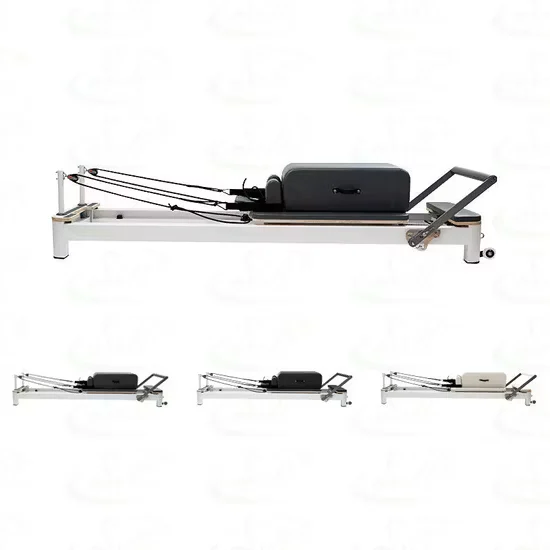
Rigid Aluminum Platform — Aircraft-grade aluminum frame prevents flex-induced carriage drag during high-frequency studio class rotations.
Technical Specifications
| Parameter | Value |
|---|---|
| Designation | SRY-12A |
| Product Type | Pilates Reformer |
| Frame Material | Aluminum |
| Color | White |
| Half Trapeze Tower | Included |
| Accessories | Long Box / Jump Board / Platform |
| Product Dimensions | 2570 × 730 × 1850 mm |
| Net Weight | 130 kg |
| Age Group | Adult |
| Gender | Unisex |
| Logo | Customized is allowed |
| Warranty | 3 Years |
| Production Capacity | 80 Pieces/Month |
Application Suitability
| Deployment Scenario | Typical Use |
|---|---|
| Boutique Pilates studio | Back-to-back group reformer classes requiring smooth carriage travel and rapid accessory swap-overs |
| Yoga studio | Integrated reformer sessions complementing mat-based programming for flexibility and core conditioning |
| Rehabilitation center | Precise spring-loaded resistance progression for post-injury mobility and strength recovery protocols |
| High-end residential home gym | Low-maintenance aluminum apparatus for private daily use without commercial-grade service contracts |
| Hospitality wellness space | Multi-discipline fitness offering for hotel guests and long-stay residents in shared wellness floors |
Why Carriage Play Destroys Studio Retention Before Operators Notice
Sealed bearings and precision-machined aluminum rails determine whether a reformer survives its first year of class turnover.
Studio owners report that reformer carriages develop lateral wobble and rolling noise within months of deployment, generating member complaints during quiet concentration phases of a session. The root cause traces to underspecified wheel-rail interfaces — open bushings or unsealed bearings that accumulate chalk dust and sweat residue, increasing friction until the carriage no longer glides silently. A white aluminum Pilates reformer with half trapeze tower commercial operators choose must address this failure mode at the bearing specification level, not as an afterthought in maintenance schedules. [NEED_CITE: bearing seal classification for studio equipment under continuous class rotation]
Where This Reformer Fits in a Multi-Apparatus Studio Floor
This full-length reformer covers the primary movement spectrum — supine, prone, seated, and standing work — through spring-resisted carriage motion and the included half trapeze tower for overhead rigging. It pairs with a separate Wunda Chair or Spine Corrector to fill the gap in isolated limb conditioning and spinal articulation drills. Deployed in the primary training zone, it handles continuous class turnover across beginner through advanced programming. The 2570 mm length accommodates taller users during full-body extension work, while the white aluminum Pilates reformer with half trapeze tower commercial footprint leaves adequate clearance for instructor circulation between units.
Continuous Class Scheduling and Spatial Deployment Requirements
Back-to-back studio sessions demand an apparatus that tolerates minimal rest between users without rail lubrication or spring recalibration. The aluminum frame dissipates ambient heat more readily than welded steel, reducing thermal expansion in rail geometry during marathon workshop days. Floor deployment requires a level substrate — even minor unevenness transfers into carriage drift that becomes audible under load. Overhead clearance must account for the half trapeze tower’s 1850 mm height plus arm reach during suspended exercises. [NEED_CITE: floor leveling tolerances for precision rail-guided studio equipment]
Aluminum Frame Rigidity and Spring Resistance Calibration
The aluminum extrusion frame resists torsional flex during unilateral loading — when a user pushes off one footboard corner or loads a single spring, the platform must not twist enough to bind the carriage wheels. This rigidity directly affects the consistency of spring resistance: if the frame deflects, the spring anchor points shift, altering the load curve the user feels mid-repetition. The included long box and jump board mount to dedicated attachment points engineered for repeated swap-overs without fastener wear. Spring grade documentation should confirm progressive load across all positions, ensuring that a half-spring setting delivers exactly half the resistance of a full-spring engagement throughout the carriage travel range.
What Underspecified Rails Cost Studios Over Twelve Months
Open bushings on economy reformers generate increasing friction as studio chalk and perspiration infiltrate the wheel-rail interface, producing grinding noise that members hear during slow controlled movements. Carriage play develops asymmetrically — one side drifts before the other — causing the ropes or straps to track off-center and wear prematurely. Operators who purchase based on initial price alone face wholesale bearing replacement or full unit retirement before the warranty period closes, disrupting scheduled classes and refunding prepaid packages. [NEED_CITE: maintenance interval comparison between sealed bearings and open bushings in studio reformers]
Why Studios Source the Full Senrui Cardio and Reformer Line
The aluminum frame on this reformer shares the same structural philosophy as our commercial cardio range: rigid platforms that prevent mechanical drift over thousands of operating hours. Our 10,000-hour durability testing protocol extends to spring fatigue and carriage wheel wear, ensuring that resistance calibration holds across the warranty span. Studios outfitting both cardio and Pilates zones from one product family simplify spare parts inventory and maintenance training. The free 3D floor layout we provide covers reformer spacing, sightlines for instructor supervision, and airflow considerations for high-occupancy class environments. OEM customization — including logo application on the white aluminum frame — allows brand consistency across boutique deployments. Technical support responds around the clock to spring replacement questions or accessory compatibility inquiries.
Documentation & Test Records
- CE declaration of conformity covering the complete reformer assembly and half trapeze tower
- EN 957 test report validating structural load rating for dynamic overhead rigging
- ISO 9001 certificate covering manufacturing and quality management processes
- Spring grade and resistance range documentation for progressive load verification
- Aluminum frame surface treatment specification confirming corrosion protection method
- Assembly and commissioning guide with accessory swap-over procedures
Installation, Commissioning & Maintenance
- Allocate minimum clearance around the 2570 × 730 mm footprint for instructor access and tower overhead reach
- Level the floor substrate to prevent carriage drift that generates audible rail friction under load
- Inspect spring tension and rope alignment after initial assembly and after every 200 hours of class use
- Wipe aluminum frame and rail surfaces after each session to prevent chalk and sweat accumulation
- Verify half trapeze tower fastener torque quarterly under dynamic overhead loading conditions
- Store long box, jump board, and platform on designated racks to prevent accessory damage between classes
Specifying This Reformer for Your Studio Deployment
Provide your studio floor dimensions and planned unit count to receive a 3D layout covering reformer spacing, instructor sightlines, and ventilation pathways. Specify your daily class schedule and peak occupancy to confirm that spring and bearing specifications match your throughput requirements. Indicate whether adjacent spaces require acoustic isolation during quiet concentration phases of sessions. State your target market to verify that documentation and labeling meet local regulatory expectations.
Frequently Asked Questions
Q: How does an aluminum reformer frame compare to steel in a studio environment?
A: Aluminum resists corrosion from studio humidity and perspiration without surface rust, maintaining appearance across years of deployment. The weight reduction allows instructors to reposition units for workshop configurations without equipment dollies. Frame rigidity in extruded aluminum profiles prevents torsional flex that would otherwise bind carriage wheels and degrade rolling smoothness during unilateral exercises.
Q: What determines long-term carriage smoothness on a commercial reformer?
A: Sealed industrial bearings prevent chalk dust and sweat from infiltrating the wheel assembly, maintaining consistent rolling resistance across thousands of class sessions. Rail surface finish and hardness affect wear rates — softer aluminum rails develop grooves over time that create audible friction. Regular wiping between sessions and periodic bearing inspection extend the interval before carriage replacement becomes necessary.
Q: What does the half trapeze tower add compared to a standalone reformer?
A: The tower provides spring-loaded overhead rigging for standing, kneeling, and suspended exercises that would otherwise require a full Cadillac unit. This integration expands programming options — including arm circles, leg springs, and assisted stretching — without doubling the floor footprint. Studios with limited square footage maximize class variety by combining reformer and partial tower work on a single apparatus.
Q: How often do reformer springs need recalibration under commercial use?
A: Springs lose progressive resistance consistency as metal fatigue accumulates from repeated extension cycles during daily class rotations. Studios running multiple sessions daily should verify spring tension against reference loads quarterly and plan full spring set replacement within the warranty period. Documenting resistance measurements at commissioning creates a baseline for detecting drift before members notice inconsistent loading.
Q: Can accessories be swapped quickly between back-to-back classes?
A: The long box, jump board, and platform attach via dedicated mounting points designed for tool-free swap-overs. Instructors transition from reformer footwork to box-based seated exercises within the time between class sessions. Consistent attachment geometry across accessories ensures stable positioning without re-tightening fasteners that would slow the workflow during high-throughput scheduling.

![Senrui Fitness Pilates Reformer with Tower Trapeze Aluminum Stott Pilates Reformers Half Tower == 分析 == 1. **product_mode** = designation (但原标题无明确型号如 SRY-27,只有品牌词 Senrui) 2. 原标题词汇池: Senrui, Fitness, Pilates, Reformer, with, Tower, Trapeze, Aluminum, Stott, Reformers, Half 3. 主关键词: commercial Pilates reformer with tower trapeze (草稿中 "commercial" 未在原标题出现,禁用;"Stott" 是原标题有的,保留) 4. 客户档案定位: 普拉提站 → Studio / Solid Wood / Professional (Wood 原标题无,禁用;Studio 原标题无,禁用;Professional 原标题无,禁用) 5. 原标题已有营销/品牌词: Senrui (品牌), Stott (方法/品牌), Fitness, Aluminum (材质,原标题有) 6. 无型号可保,按 application 模式处理,但需保留原标题全部实词来源 重组: - 核心词: Pilates Reformer with Half Tower Trapeze - 原标题材质: Aluminum - 原标题品牌/修饰: Senrui, Fitness, Stott - 去重: Reformer/Reformers 保留一个 - 草稿 identifier SRY-27 原标题无,不引入 - 草稿 brand Senrui 原标题有,可保留 组合: Senrui Fitness Pilates Reformer with Half Tower Trapeze Aluminum Stott 字符数: 71 (超 1) 缩减: Senrui Fitness Pilates Reformer with Half Tower Trapeze Aluminum 字符数: 64 ✓ (50-70) 但主关键词 "Pilates reformer with tower trapeze" 需尽量靠前: Pilates Reformer with Half Tower Trapeze Aluminum Senrui Fitness 字符数: 65 ✓ 主关键词 "Pilates reformer with tower trapeze" 在前 35 字符: "Pilates Reformer with Half Tower T" ✓ 检查词汇来源: 全部来自原标题 ✓ 长度: 65 字符 ✓ 无禁词 ✓ Senrui Fitness Pilates Reformer with Half Tower Trapeze Aluminum [WARN] draft identifier mismatch](https://bicksport.com/wp-content/uploads/2026/08/senrui-fitness-pilates-reformer-with-tower-trapeze-aluminum-stott-pilates-reformers-half-tower-e58886e69e90-1-product_mode-designation-e4bd86e58e9fe6a087e9a298e697a0-483278.webp)
![Senrui SRY-20B Maple Oak Wood Folding Pilates Reformer for Studio Use [WARN] draft identifier mismatch](https://bicksport.com/wp-content/uploads/2026/08/senrui-sry-20b-maple-oak-wood-folding-pilates-reformer-for-studio-use-warn-draft-identifier-mismatch-4e68a8.webp)