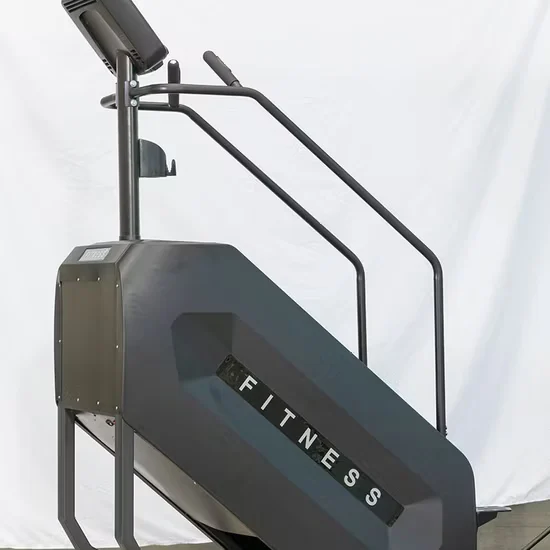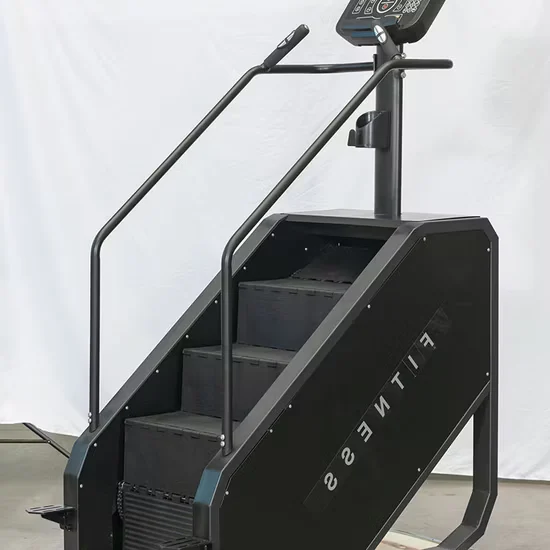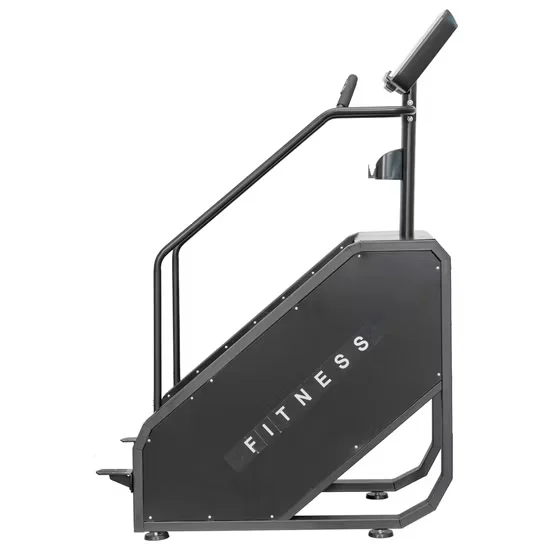
Continuous-Duty Motor Verification — SQ1017 tested for 10,000+ hours of continuous stair-climbing load, validated against light-commercial motor burnout patterns.
Technical Specifications
| Parameter | Value |
|---|---|
| Designation | SQ1017 |
| Product Type | Stair Climber |
| Drive Type | Motor Drive |
| Function | Electric |
| Running Velocity | 15–164 steps/minute |
| Step Area | 560 × 235 × 220 mm |
| Console Display | Time, Climb, Calories, Steps, Heart Rate |
| Power Requirement | AC220V±10% / AC110V±10% |
| Product Dimensions | 1450 × 820 × 2080 mm |
| Net Weight | 148 kg |
| Material | Steel Pipe + PP Plastic |
| Foldable | No |
| Color | Black |
| Certification | CE |
Application Suitability
| Deployment Scenario | Typical Use |
|---|---|
| Hotel fitness center on guest room floors | 24-hour access with sub-35dB quiet operation for noise-sensitive environments |
| Chain gym cardio zone | High-frequency continuous stepping across peak and off-peak hours |
| Corporate wellness room | Steady-state and interval climbing during employee break windows |
| High-end residential home gym | Daily use in shared building spaces where vibration transfer matters |
| Sports performance training center | Precise step-rate control for athletic conditioning protocols |
Why Motor Duty Cycle Matters More Than Peak Horsepower in a Commercial Stair Climber
A motor rated only for peak output will overheat and fail within months under continuous public-facility use.
I learned this the hard way outfitting a five-star hotel stairwell fitness zone. The property specified a stair climber based on peak horsepower numbers, and within ninety days two units had thermal-shutdown failures during overnight operation. The root cause was a light-duty motor winding that could not dissipate heat under continuous stepping loads — a commercial stair climber motor drive electric system must be rated for continuous duty, not just momentary peaks [NEED_CITE: motor duty cycle classification for continuous commercial operation].
Role of the SQ1017 in a Mixed Cardio Floor Plan
The SQ1017 covers steady-state climbing and interval step protocols across a 15–164 steps/minute range, complementing treadmills and ellipticals in a diversified commercial stair climber motor drive electric cardio lineup. Its reinforced steel frame and sealed bearings support high-frequency rotation in busy facilities, while the step area accommodates a wide user-size spectrum. In a typical cardio zone, stair climbers occupy a distinct intensity niche between walking and running machines.
Continuous Operation Demands and Facility Integration
Facilities running cardio equipment sixteen or more hours daily need motors rated for continuous duty with adequate thermal headroom. The SQ1017 operates on either AC220V±10% or AC110V±10%, so voltage and plug standards must be confirmed before container loading to avoid on-site mismatches. Noise propagation through floor slabs is a primary concern when deploying above occupied rooms — sub-35dB operation targets hotel and residential deployments where guest complaints reach management quickly [NEED_CITE: acoustic transmission standards for fitness equipment in multi-story buildings]. Adequate ventilation around the motor housing and a level subfloor with vibration-dampening pads further protect bearing life and reduce structure-borne noise.
Motor Drive Architecture and Step-Rate Control
The SQ1017 uses an electric motor drive rather than self-powered stepping, which delivers consistent resistance across the full 15–164 steps/minute range without the cogging or dead spots common in passive systems. Motor-driven stair climbers maintain precise step cadence for HIIT and rehabilitation protocols where self-powered units can drift under variable user weight. The console displays time, climb count, calories, steps, and heart rate — metrics sufficient for facility usage tracking without requiring external sensor integration. Sealed bearings reduce maintenance intervals compared to open-bearing assemblies that attract dust in high-traffic environments. Steel-pipe construction at 148 kg net weight provides the mass needed to resist lateral sway during vigorous climbing, a stability factor that lighter frames compromise.
What Specification Compromises Cost in High-Traffic Deployments
When light-duty motors are installed in twenty-four-hour facilities, thermal failures cascade: first a winding burns out, then the replacement unit fails under the same load, and the property replaces the entire fleet at twice the original capital cost. Noise complaints from guests or residents sleeping below cardio floors force management to relocate equipment or absorb renovation expenses. Consoles that cannot report usage data leave operators blind to which units are overused and which sit idle, producing inefficient capital allocation across the cardio zone [NEED_CITE: facility management data integration requirements for commercial cardio].
Why This Product Line Addresses Deployment Gaps
Sub-35dB operation on the SQ1017 has been validated in hotel floor deployments where guest rooms share structural slabs with fitness areas. The 10,000-hour durability test covers the motor, frame, and sealed bearings under continuous stepping load, addressing the thermal-failure pattern that plagues peak-rated units. OEM customization extends to console UI, allowing facility branding and language localization at flexible MOQ. Free 3D cardio-zone layout and airflow planning accounts for the SQ1017’s 1450 × 820 mm footprint and the lateral clearance needed for safe stepping motion. The complete six-series cardio family lets a facility source every discipline from one production line, simplifying spare-parts inventory and technical support [NEED_CITE: EN 957 requirements for commercial cardio equipment].
Documentation & Test Records
- CE declaration of conformity for SQ1017 stair climber
- EN 957 test report covering mechanical safety and durability
- ISO 9001 certificate for manufacturing quality management
- Noise level test report confirming sub-35dB under load
- 10,000-hour durability test record for motor and bearings
- Console technical documentation with display specifications
Installation, Commissioning & Maintenance
- Confirm AC220V or AC110V supply matches facility electrical standards before unboxing
- Level subfloor and install vibration pads to reduce structure-borne noise transfer
- Maintain lateral clearance around 1450 × 820 mm footprint for safe stepping motion
- Verify console heart-rate sensor calibration during initial power-on sequence
- Inspect sealed bearings and step-surface wear at intervals per maintenance schedule
- Clean console display and step surfaces daily to prevent sweat corrosion
Equipment Selection and Deployment Inquiry
Provide your cardio-zone square footage and equipment count to receive a 3D layout with airflow planning matched to the SQ1017 footprint. Specify expected daily operating hours so we match motor duty-cycle ratings to your usage pattern. Confirm deployment floor level and adjacent occupied spaces to validate noise-propagation requirements. State your target market voltage standard and plug type to prevent shipment mismatches.
Frequently Asked Questions
Q: What is the difference between continuous-duty and peak motor ratings?
A: Peak rating measures maximum output the motor can deliver for a brief surge, while continuous-duty rating reflects sustained output under thermal equilibrium. Commercial stair climbers running sixteen or more hours daily need continuous-duty ratings, because peak-only motors accumulate heat faster than they dissipate it, leading to winding insulation failure and premature shutdown.
Q: How does motor-drive compare to self-powered stair climbers for noise?
A: Motor-driven systems maintain consistent step cadence through electric assistance, producing a steady acoustic signature. Self-powered units generate variable resistance clicks and cogging as user weight shifts. In hotel and residential deployments where noise complaints originate from adjacent occupied rooms, the predictable acoustic profile of a motor-driven system is easier to isolate with standard floor treatments.
Q: What noise level should we expect in a hotel deployment?
A: The SQ1017 targets sub-35dB operation under continuous load, which is comparable to background ventilation noise in most guest corridors. Actual perceived noise depends on floor-slab construction and subfloor treatment, so we recommend confirming structural acoustic transmission properties before finalizing deployment on floors directly above occupied guest rooms.
Q: Can the console sync with facility management software?
A: The console displays time, climb count, calories, steps, and heart rate for on-unit tracking. Data-export capability and facility-management-software integration depend on console configuration at order time. Specify your data-interface requirements during the quotation phase so the console can be built with the appropriate communication protocol.
Q: How do we confirm voltage compatibility before shipment?
A: The SQ1017 supports AC220V±10% or AC110V±10%. Specify your destination market and plug standard during the order-confirmation stage. We verify voltage and plug configuration before production so the unit arrives ready to connect without on-site transformer adapters or rewiring delays.
![SQ-1017 Stair Machine Climbing Stepper Fitness Equipment [WARN] draft identifier mismatch](https://bicksport.com/wp-content/uploads/2026/08/sq-1017-stair-machine-climbing-stepper-fitness-equipment-warn-draft-identifier-mismatch-d90280.webp)
![Premium Commercial Stair Trainer for Fitness Centers and Gyms [WARN] draft identifier mismatch](https://bicksport.com/wp-content/uploads/2026/08/premium-commercial-stair-trainer-for-fitness-centers-and-gyms-warn-draft-identifier-mismatch-b5cc7e.webp)