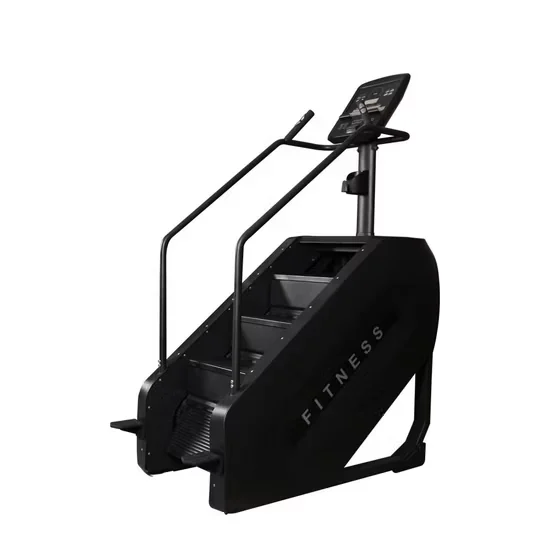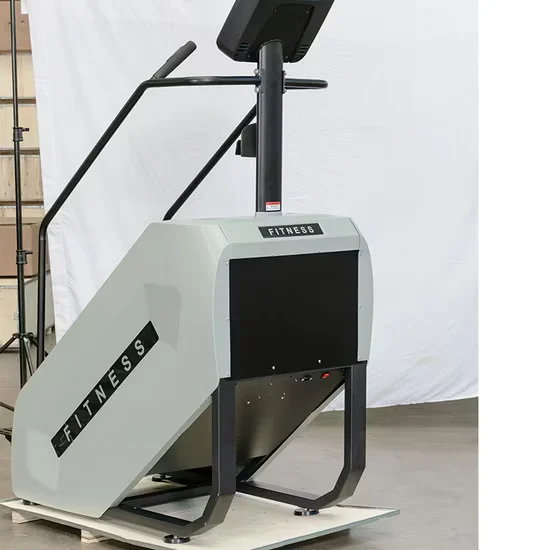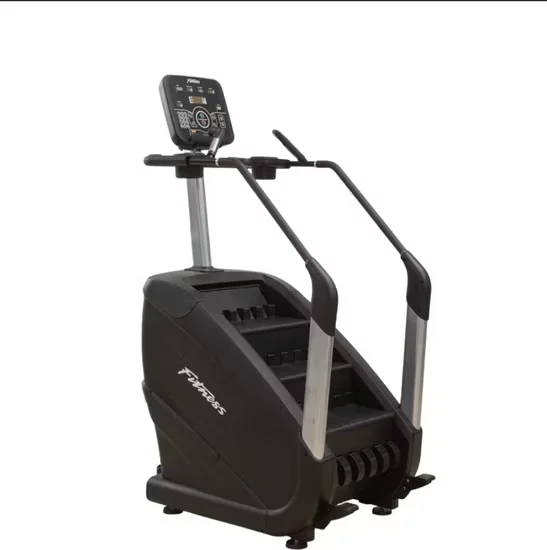
Whisper-Quiet Operation — Sub-35dB motor-driven stair climber verified in hotel guest floor deployments with magnetic resistance tuning and acoustic isolation.
Technical Specifications
| Parameter | Value |
|---|---|
| Product Type | Stair Climber |
| Drive Type | Motor Drive |
| Running Velocity | 15 steps/min – 164 steps/min |
| Step Area | 560 × 240 × 200 mm |
| Power Requirement | AC220V±10% / AC110V±10% |
| Console Type | LED (Time, Climb, Calories, Steps, Heart Rate) |
| Heart Rate | Handgrip |
| Product Dimensions | 1400 × 700 × 2000 mm |
| Net Weight | 148 kg |
| Foldable | Unfolded |
| Material | Steel Pipe + PP Plastic |
| Color | Black |
| Certification | CE |
| Customization | Available with logo, color, console UI, and specification options |
Application Suitability
| Deployment Scenario | Typical Use |
|---|---|
| Hotel fitness center on guest room floors | 24-hour cardio access with minimal noise transfer to adjacent rooms |
| Chain gym cardio zone | High-frequency climbing sessions during peak morning and evening hours |
| Corporate wellness room | Midday interval sessions for employees in shared office environments |
| High-end residential home gym | Daily lower-body conditioning without disturbing shared building spaces |
| Sports performance training center | Athlete stair climbing protocols with controlled step velocity progression |
Why Noise Complaints Reach the Front Desk Before Maintenance Does
Motor-driven stair climbers transmit low-frequency vibration through structural floors when magnetic gaps are not calibrated.
A boutique hotel project in Latin America installed stair climbers directly below occupied guest suites. The magnetic control module arrived with an uncalibrated gap, causing resistance surges at low step velocities and audible vibration penetrating the floor slab. Guests escalated complaints before the maintenance team even flagged the unit [NEED_CITE: acoustic transmission through concrete floor assemblies in hospitality environments]. Every unit in that shipment was pulled back, the drive assemblies were re-tuned, and operating noise was brought below 35dB. This commercial stair climber motor drive ships with pre-calibrated magnetic modules and sealed bearing assemblies tested for continuous operation.
Positioning Within the Cardio Floor Layout
This commercial stair climber occupies the high-intensity lower-body training position in a facility’s cardio zone, complementing treadmills for steady-state work and ellipticals for low-impact recovery sessions. The 15–164 steps/min velocity range covers warm-up cadences through aggressive interval climbing, accommodating users from rehabilitation contexts to athletic conditioning programs. The 1400 × 700 mm footprint allows deployment in corridors and compact cardio bays where lateral clearance is limited. LED console output provides real-time step count, climb duration, calorie estimates, and handgrip heart rate, giving users immediate performance feedback without requiring external device pairing.
Continuous Duty Cycles and Deployment Environment Constraints
Facilities running cardio equipment 16+ hours daily need motors rated for sustained thermal loads rather than peak output claims. This unit’s motor drive system maintains consistent torque delivery across the full step velocity range without thermal throttling during extended sessions. The 148 kg net weight and steel pipe frame construction resist lateral sway during high-cadence climbing, but floor leveling and vibration isolation pads remain necessary on upper floors to prevent structure-borne noise transmission [NEED_CITE: structure-borne vibration limits for fitness equipment on suspended floor slabs]. AC220V and AC110V power configurations must be confirmed before shipment, as voltage mismatches discovered after container arrival cause costly rewiring and commissioning delays. Facilities planning to integrate usage data with management systems should verify LED console data output protocols during the specification phase.
Interpreting Motor Drive and Step Velocity Specifications
Motor-driven stair climbers eliminate the inconsistent resistance feel that manual friction systems produce at varying step cadences. The motor maintains uniform step resistance whether the user is climbing at 15 steps/min during a controlled warm-up or pushing 164 steps/min in a high-intensity interval. Steel pipe and PP plastic construction in the step area provides a rigid platform that resists flex under dynamic loading, while the 560 × 240 mm step surface accommodates users across a wide foot-size range. Handgrip heart rate sensors offer stable readings during climbing motion, where wrist movement is more controlled than during running or rowing. The LED console displays time, climb distance, calorie estimates, step count, and heart rate simultaneously, avoiding the menu-navigation delays that interrupt workout flow on more complex interfaces.
The Hidden Cost of Specification Shortcuts
Light-commercial motors installed in 24-hour hotel fitness centers frequently fail within months because they were never designed for the thermal accumulation of back-to-back user sessions. When a motor burns out on a guest floor, the replacement logistics involve not just parts shipping but also guest compensation and reputational damage [NEED_CITE: equipment downtime cost in hospitality fitness operations]. Stair climbers with uncalibrated magnetic modules generate noise that migrates through building structures, producing complaints that facility managers trace to multiple sources before identifying the equipment. Voltage specification errors compound the problem — a unit wired for AC220V deployed on an AC110V circuit will underperform and overheat, while the reverse creates an immediate safety hazard.
Why This Product Line for Your Facility
Sub-35dB operation has been verified in actual hotel deployments where the unit operates on guest room floors without generating noise complaints. Motors, reinforced steel frames, and sealed bearings undergo 10,000-hour continuous operation testing that simulates years of high-frequency commercial use. The LED console can be customized with facility branding and UI layouts through OEM/ODM scoping, matching the visual identity of hotel chains and gym networks. When you provide your cardio zone dimensions, a 3D layout plan covers equipment spacing, airflow patterns, and member traffic flow specific to stair climber placement requirements. Six complete cardio series allow sourcing treadmills, bikes, ellipticals, rowing machines, and spinning bikes from one product line, simplifying procurement and maintenance coordination. Technical support responds around the clock with spare parts and troubleshooting guidance.
Documentation & Test Records
- CE declaration of conformity for commercial stair climber compliance
- EN 957 test report covering structural integrity and safety requirements
- ISO 9001 certificate for manufacturing quality management systems
- Noise level test report verifying sub-35dB operation under load
- 10,000-hour durability test record for motor and bearing assemblies
- LED console technical documentation with data output specifications
Installation, Commissioning & Maintenance
- Maintain minimum clearance around the 1400 × 700 mm footprint for safe user mounting and dismounting
- Level the steel pipe frame on vibration isolation pads to prevent structure-borne noise on upper floors
- Verify AC220V or AC110V power supply matches unit configuration before connecting to dedicated circuit
- Calibrate magnetic control module resistance response during initial commissioning across full step velocity range
- Inspect motor drive belt tension and step assembly bearings at intervals specified in the maintenance guide
- Clean LED console surface and handgrip heart rate sensors regularly to prevent sweat corrosion
Equipment Selection and Quotation Process
Share your cardio zone square footage and target equipment count to receive a 3D layout plan with airflow and member flow analysis specific to stair climber deployment. Specify average daily operating hours so the motor duty cycle matches your facility’s usage pattern. Confirm the deployment floor level and adjacent occupied spaces to validate acoustic requirements before shipment. State your target market voltage and plug standard to eliminate electrical mismatches at delivery. Indicate whether console data integration with facility management software is required for the LED configuration.
Frequently Asked Questions
Q: Motor drive versus manual stair climbers — which performs better in high-traffic commercial environments?
A: Motor-driven systems maintain consistent step resistance regardless of user cadence, eliminating the uneven feel that manual friction systems produce when step speed varies. For facilities with continuous back-to-back usage throughout operating hours, motor drive delivers predictable performance and reduces maintenance interventions associated with mechanical wear components.
Q: How do I verify continuous duty rating versus peak output on motor specifications?
A: Peak output indicates maximum short-burst capacity, while continuous duty rating reflects sustained thermal performance under ongoing load. Request the motor specification sheet showing continuous duty classification, and compare it against your facility’s average session duration and daily operating hours to confirm the motor handles your actual usage pattern.
Q: What deployment considerations apply when installing stair climbers on hotel guest floors?
A: Structure-borne vibration transmits through floor slabs more readily than airborne noise, so vibration isolation pads and proper frame leveling are essential. Confirm sub-35dB operation with a noise level test report, and verify that the unit’s acoustic profile was validated in an actual guest floor environment rather than a ground-level test lab.
Q: Can the LED console data integrate with facility management software?
A: LED consoles provide standard workout metric displays including step count, climb duration, and heart rate. Facilities requiring data sync with member apps or management systems should request console technical documentation detailing available data output protocols and confirm compatibility during the specification phase before production begins.

![Commercial Stair Machine SQ1017 for Daily Gym Workouts [WARN] draft identifier mismatch](https://bicksport.com/wp-content/uploads/2026/08/commercial-stair-machine-sq1017-for-daily-gym-workouts-warn-draft-identifier-mismatch-6b0378.webp)