
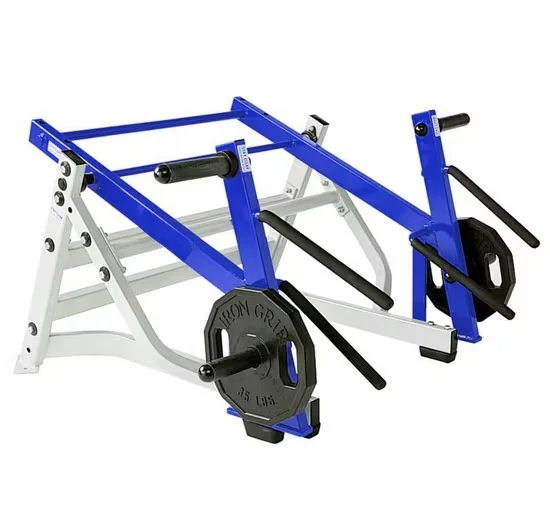
Structural Rigor Proven — 122kg steel frame with sealed bearings engineered for high-frequency squat and lunge cycles under loads up to 180kg.
Technical Specifications
| Parameter | Value |
|---|---|
| Designation | 5044 |
| Product Type | Squat Lunge Machine |
| Exercise Target | Waist, Leg |
| Frame Material | Steel |
| Product Dimensions | 1623 × 1691 × 872 mm |
| Net Weight | 122 kg |
| Max User Weight | 180 kg |
| Resistance Type | Available with plate-loaded or selectorized pin stack |
| Age Group | Adult |
| Gender | Unisex |
| Fit Area | Professional Gym and Club |
| Certification | ISO 9001, CE |
| OEM/ODM | Available (color, logo, upholstery) |
Application Suitability
| Deployment Scenario | Typical Use |
|---|---|
| Chain gym strength zone | Daily high-repetition squat and lunge programming across peak member hours |
| Corporate wellness room | Compact lower-body station for time-constrained employee sessions |
| Professional sports training center | Loaded compound movements for athlete lower-body development |
| Community fitness center | Durable shared-use station accommodating varied user sizes and experience levels |
| High-end residential home gym | Dedicated lower-body compound movement station for serious training |
Why Frame Deflection Matters More Than Plate Weight
A rigid frame keeps the lifter’s force path consistent under load.
Strength equipment in commercial facilities often develops micro-deflections at weld joints after months of repeated loading. Members notice the wobble before maintenance logs it, and confidence in the movement pattern erodes. On a commercial squat lunge machine gym equipment, that instability forces the user to compensate with stabilizer muscles that should not be bearing the primary load, altering the intended biomechanics of the exercise [NEED_CITE: structural deflection thresholds in commercial strength equipment under cyclic loading].
I once audited a chain club’s leg press zone where three units had been pulled from the floor within a single quarter. The frames had not cracked — they had flexed enough under heavy use to throw the guide rods out of alignment, creating binding that members felt as grinding. The root cause was undersized tubing that saved weight in shipping but cost far more in replacement labor and member churn.
Where the 5044 Sits in a Strength Zone Layout
This commercial squat lunge machine gym equipment targets compound lower-body movements — squats and lunges — across moderate to high intensity ranges. It complements isolation machines like leg extensions and hamstring curls by handling the multi-joint loading those units cannot replicate. The 1623 × 1691 mm footprint positions it as a mid-zone anchor piece, requiring standard clearance on all sides for safe loading and unloading. The 180 kg max user weight and wide stance platform accommodate the full range of adult body types found in open-membership facilities. Data capture is limited to the mechanical domain; resistance is set by the user through plate or pin selection rather than electronic control.
Continuous Use and Floor Loading Considerations
A commercial squat lunge machine gym equipment in a chain gym or hotel fitness center may see dozens of loading cycles per day across peak hours. The 122 kg net weight provides inherent stability against lateral shift during heavy lunges, but the floor must be level to prevent frame racking over time [NEED_CITE: floor load distribution requirements for heavy static fitness equipment]. Deployment on upper floors requires verifying that the structural slab can handle the concentrated point loads from the four foot pads. Vibration transmission to adjacent occupied spaces is a factor with dropped plates, so rubber matting under and around the unit serves both acoustic and structural purposes. No electrical circuit is required for the base mechanical configuration, simplifying placement flexibility.
Decoding the Steel Frame and Bearing Specifications
The frame uses welded steel construction with reinforced tubing at the primary stress junctions where the lever arms connect to the upright. Thicker wall thickness at these joints resists the cyclic bending moments that occur during loaded squats, where force peaks at the bottom of the movement and tapers toward extension. Sealed bearings at the pivot points keep lubricant contained and contaminant ingress out, which matters in facilities where chalk dust and sweat accumulate around strength stations. The platform surface uses a textured anti-slip finish to maintain foot grip under heavy axial loads, and the widened stance area lets users position their feet to match individual hip anatomy rather than forcing a single track width. These are the mechanical details that separate a unit lasting years under commercial frequency from one developing play and rattle within months.
The Hidden Cost of Underspecified Structural Components
Cutting steel thickness to reduce shipping weight produces a unit that feels solid on day one but develops joint play as weld zones fatigue under cyclic loading. Members sense the looseness as instability during heavy sets, and the compensation patterns shift load away from the target musculature. Bearings without proper seals ingest chalk and moisture, accelerating wear until the pivot develops lateral play that makes the movement feel uncontrolled [NEED_CITE: bearing failure modes in commercial strength equipment]. When a facility replaces a station early because of structural degradation, the cost extends beyond the new unit — it includes floor downtime, member complaints about missing equipment, and the labor of removing the old frame.
Why This Product Line Earns Its Floor Space
Sub-35dB whisper-quiet operation matters less for a purely mechanical strength station, but the engineering discipline behind that standard carries through to the sealed bearings and precision pivot alignment on the 5044 — smooth, silent articulation under load. Components are tested through 10,000-hour continuous high-frequency operation cycles, which for a commercial squat lunge machine gym equipment translates to years of daily use before bearing or bushing replacement enters the maintenance conversation. Full OEM and ODM customization covers frame color, logo placement, and upholstery material, letting operators match the unit to their brand environment. The complete six-series cardio and strength family means a facility can consolidate sourcing across disciplines. Free 3D layout planning covers the spacing and sightline requirements specific to this footprint so the unit integrates into the strength zone without creating traffic bottlenecks.
Documentation & Test Records
- CE declaration of conformity covering the full assembled unit
- EN 957 test report validating structural integrity and safety clearances
- ISO 9001 certificate for the manufacturing quality management system
- Frame weld inspection and steel thickness verification records
- Bearing and bushing cycle durability test documentation
- OEM customization specification sheet with material swatches
Installation, Commissioning & Maintenance
- Verify 1623 × 1691 mm footprint with clearance on all sides for safe plate loading
- Level the floor or use shims under foot pads to prevent frame racking
- Assemble with torque verification on all structural bolts per the installation guide
- Inspect sealed bearings quarterly for smooth pivot action without lateral play
- Clean platform surface and frame joints weekly to remove chalk and sweat buildup
- Confirm upholstery condition and re-tension mounting hardware biannually
Requesting the Right Configuration
Provide your strength zone dimensions and current equipment list to receive a 3D layout showing how the 5044 integrates with your existing stations. Specify average daily user volume so we can confirm the bearing and bushing specification matches your frequency. Indicate deployment floor level and adjacent room usage so we can advise on vibration isolation requirements. State your target market for any labeling or language requirements on the OEM configuration. Note whether you need color matching to an existing equipment palette or custom logo application.
Frequently Asked Questions
Q: What structural differences separate commercial squat lunge machines from residential-grade units?
A: Commercial frames use thicker-walled steel tubing and reinforced weld junctions designed for hundreds of loading cycles per week rather than occasional home use. Bearings are sealed against chalk dust and moisture ingress that accelerate wear in shared facilities. The platform dimensions and stance width accommodate the full adult population, and the frame must pass EN 957 structural testing for commercial load ratings.
Q: How does the movement path on this machine protect the knees during loaded lunges?
A: The lever arm geometry constrains the knee and hip joints to travel within a controlled sagittal plane, reducing the lateral deviation that occurs with free-weight lunges. The guided path does not eliminate the need for proper form, but it limits the range of compensatory movement that places shear force on the knee under heavy loads.
Q: What is the bearing maintenance schedule under heavy commercial use?
A: Sealed bearings in the pivot assembly are designed to run without routine lubrication under high-frequency operation. Quarterly inspections should check for lateral play or roughness in articulation. Replacement intervals depend on actual cycle volume and environmental conditions like chalk dust exposure, but the sealed design extends service intervals significantly compared to open bushings.
Q: What OEM customization options are available and what are the minimum order requirements?
A: Customization covers frame color, logo placement, and upholstery material selection. MOQ varies by customization scope — color changes on standard frames require smaller batches than full upholstery specification changes. Contact the sales team with your specific requirements to confirm minimum quantities and production lead times for your configuration.
Q: How should the strength zone layout account for this machine’s footprint and user clearance?
A: The 1623 × 1691 mm footprint requires clearance on all four sides for safe plate loading and user movement during lunges. Position the unit with adequate lateral space so adjacent users are not within the movement envelope. Sightline planning should ensure the station is visible from the facility entrance to encourage utilization across the strength zone.
![Hammer Strength ISO-Lateral D.Y. Row Commercial Gym Equipment [WARN] draft identifier mismatch](https://bicksport.com/wp-content/uploads/2026/08/hammer-strength-iso-lateral-d-y-row-commercial-gym-equipment-warn-draft-identifier-mismatch-bc5ba5.webp)
![H016 Plate-Loaded Seated Biceps Curl Machine for Commercial Gyms [WARN] draft identifier mismatch](https://bicksport.com/wp-content/uploads/2026/08/h016-plate-loaded-seated-biceps-curl-machine-for-commercial-gyms-warn-draft-identifier-mismatch-5fb5d1.webp)

