
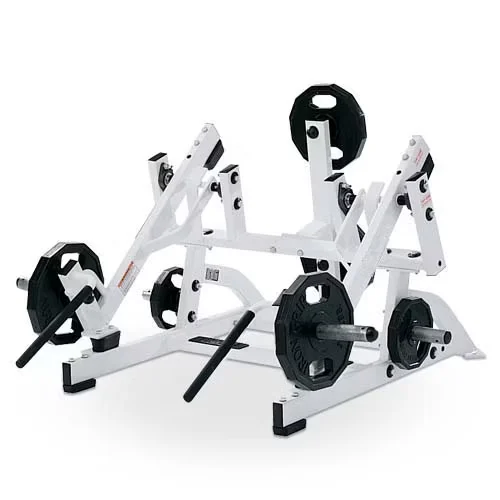
Heavy-Duty Steel Frame — Engineered for continuous high-load squat and high pull training in professional facilities without structural flex or wobble.
Technical Specifications
| Parameter | Value |
|---|---|
| Product Type | Strength Training Machine (Squat High Pull) |
| Model NO. | 5043 |
| Exercise Part | Arm |
| Material | Steel |
| Product Dimensions | 1650×1150×1050 mm |
| Net Weight | 99 kg |
| Max User Weight | 180 kg |
| Resistance Type | Plate-loaded or pin-selected (configurable) |
| Drive Type | Cable and pulley with sealed bearings |
| Age Group | Adult |
| Gender | Unisex |
| Certification | ISO 9001, CE |
| OEM/ODM | Available |
Application Suitability
| Deployment Scenario | Typical Use |
|---|---|
| Professional gym and club strength zone | High-frequency squat and high pull circuits during peak hours |
| Corporate wellness room | Employee strength conditioning with minimal supervision |
| Community fitness center | Multi-user daily rotation across varying fitness levels |
| Sports performance training center | Athlete power development with precise load progression |
| High-end residential home gym | Dedicated compound movement station for serious lifters |
Why Cable Wear and Frame Flex End Up on the Incident Report
A commercial squat high pull machine lives or dies by its pulley alignment and frame rigidity under repeated heavy loading.
I have walked into gym weight rooms where the cable on a high pull station was already fraying after six months of daily use. The pulleys were misaligned just enough to create a grinding contact point, shaving the outer sheath off the wire rope strand by strand [NEED_CITE: cable wear patterns in high-frequency commercial strength equipment]. Meanwhile, the frame would visibly sway when an athlete loaded the stack beyond a moderate threshold. That is not a training tool — it is a liability waiting for a witness statement. A commercial squat high pull machine strength training setup in a busy facility needs a frame that does not negotiate with load and a cable path that stays true through thousands of reps per week.
Where This Squat High Pull Fits in a Commercial Strength Floor
This unit targets compound pulling and lower-body explosive movements — squat-to-high-pull progressions, upright rows, and shrug variations — filling the gap between free-weight racks and isolation cable towers. In a commercial strength zone, it sits naturally between the power rack row and the functional trainer bank, catching members who need guided movement patterns without sacrificing load. The 1650×1150 mm footprint allows placement against a wall or as an island unit with clearance on two sides. The 180 kg max user weight rating accommodates the full range of athletic builds encountered in a commercial squat high pull machine strength training environment. Resistance is adjustable through the plate-loaded or pin-selected system, allowing facility managers to standardize loading protocols across a mixed-member population.
Continuous Throughput and Facility Environment Requirements
A machine in a busy gym strength zone can see 40 or more working sets per day across multiple users, which means every bearing and cable anchor point accumulates cycles fast [NEED_CITE: cycle count expectations for commercial strength equipment in high-traffic facilities]. The sealed bearing pulleys on this unit reduce the need for weekly lubrication passes that unsealed systems demand, keeping maintenance visits to a monthly interval. Floor leveling matters here — at 99 kg net weight, the base must sit flat on a rubber-matted concrete subfloor to prevent lateral drift during explosive pulls. The 1050 mm height clearance means this unit fits under standard commercial ceiling heights without interference. For facilities running HVAC at minimum airflow in the weight room, the open-frame design avoids trapping heat around the cable housing, which matters when rubber grips and cable sheaths soften under sustained ambient temperatures above 30°C.
Cable Path, Bearing Grade, and Frame Gauge Explained
The sealed bearing pulley system is the first thing I check on any cable-driven strength unit. Sealed bearings keep particulate out of the race, which directly determines how long the pulley spins freely before developing play. On a commercial squat high pull machine, the cable redirects through multiple pulley points from the weight stack to the handle — each redirect is a potential friction and wear site. If the bearings are unsealed, chalk dust and sweat residue migrate into the race within weeks, creating a gritty rotation that members notice immediately. The steel frame construction at this unit’s gauge provides torsional rigidity so that lateral forces during off-axis pulls do not translate into visible sway. Plate-loaded and pin-selected resistance options give operators flexibility: pin-selected for unsupervised community gyms where load standardization matters, plate-loaded for performance centers where athletes increment in small jumps.
What Spec Sheet Compromises Cost in the Weight Room
A frame that saves weight on steel thickness will show its weakness the first time a 100 kg athlete performs explosive high pulls — the lateral oscillation transfers directly into the cable path, creating uneven wear and a wobbling handle that ruins movement quality [NEED_CITE: frame deflection thresholds for commercial cable machines under dynamic loading]. Pulleys with bushings instead of sealed bearings may save cost at the factory but generate replacement orders every quarter as the rotation degrades. Cable wire rope rated below the machine’s maximum load capacity will develop broken strands silently, visible only when a maintenance tech pulls back the sheath during a scheduled inspection. On a commercial squat high pull machine strength training deployment, these are not theoretical failures — they are the reason a facility manager ends up replacing the entire cable assembly before the warranty period ends.
Why This Product Line Carries Our Recommendation
The 10,000-hour durability testing protocol applied across this product family extends to the pulley bearings and cable anchor points on this unit, not just the frame welds. Every commercial squat high pull machine we ship undergoes EN 957 structural verification before crating. The full six-series cardio and strength family means a facility can source its entire floor from one engineering and QC system — when we lay out a 3D strength zone plan, we account for the 1650×1150 mm footprint of this unit alongside rack spacing and member flow lines. OEM customization covers frame color and logo placement so the unit matches the facility’s visual identity. The 24/7 technical support line covers cable tensioning guidance and bearing replacement scheduling for any deployment time zone.
Documentation & Test Records
- CE declaration of conformity for commercial strength equipment
- EN 957 test report covering structural integrity and cable load rating
- ISO 9001 certificate for manufacturing quality management
- Noise level test record for pulley and cable operation
- Durability test log for sealed bearing lifecycle validation
- Steel wire rope specification sheet with tensile strength data
- Installation and commissioning guide with floor plan templates
Installation, Commissioning & Maintenance
- Maintain 800 mm clearance on all sides of the 1650×1150 mm frame for safe user passage
- Level the steel base on rubber flooring using adjustable foot pads before loading
- Inspect cable wire rope sheath monthly for strand separation at pulley contact points
- Lubricate cable guide rods with dry PTFE spray quarterly to prevent chalk buildup
- Verify pulley bearing rotation monthly — any gritty feel indicates seal compromise
- Wipe down steel frame and cable housing weekly with pH-neutral cleaner to prevent sweat corrosion
Getting the Right Configuration for Your Facility
Share your strength zone square footage and adjacent equipment list so we can generate a 3D layout that accounts for this unit’s footprint and member circulation paths. Specify your expected daily user count so we can confirm the cable and bearing specification matches the duty cycle. Let us know your deployment country’s voltage standards if any electronic counters or displays are included in your configuration. Indicate whether you need pin-selected or plate-loaded resistance to align with your facility’s supervision model.
Frequently Asked Questions
Q: What separates a commercial cable machine from a home-grade unit?
A: Commercial units use thicker steel gauges in the frame, sealed bearings in every pulley, and wire rope rated for continuous multi-user loading. Home-grade machines typically use bushings that degrade under daily use and frames that flex under heavier athletes. The difference shows within the first six months of gym-floor deployment.
Q: How do you assess frame stability before purchasing?
A: Request the frame steel thickness specification and weld inspection report. A stable frame should show no lateral deflection when loaded near maximum user weight during dynamic movements. Ask for the EN 957 structural test record, which documents load testing protocols specific to commercial strength equipment.
Q: What role do sealed bearings play in cable machine performance?
A: Sealed bearings prevent chalk dust, sweat, and debris from entering the pulley race. This maintains smooth cable travel and consistent resistance feel over thousands of cycles. Unsealed bearings or bushings develop play and grinding within months in high-traffic facilities, requiring frequent replacement and generating member complaints.
Q: What is the typical maintenance schedule for a cable-driven strength machine?
A: Monthly inspections should cover cable sheath condition, pulley bearing smoothness, and frame bolt torque. Quarterly maintenance includes cable guide rod lubrication and full cable tension verification. Annual service involves replacing the wire rope assembly as a preventive measure regardless of visible wear, based on facility usage volume.
Q: How should strength zone layout account for cable machine placement?
A: Cable machines need clearance on at least two sides for user approach and plate loading. Place them along walls or between rack stations where member flow naturally passes through. Avoid positioning near entry points where foot traffic interrupts working sets. A 3D layout plan helps visualize sightlines and spacing before equipment arrives.


![Commercial 2019 Hammer Strength ISO-Lateral Front Lat Pulldown [WARN] draft identifier mismatch](https://bicksport.com/wp-content/uploads/2026/08/commercial-2019-hammer-strength-iso-lateral-front-lat-pulldown-warn-draft-identifier-mismatch-48edae.webp)
