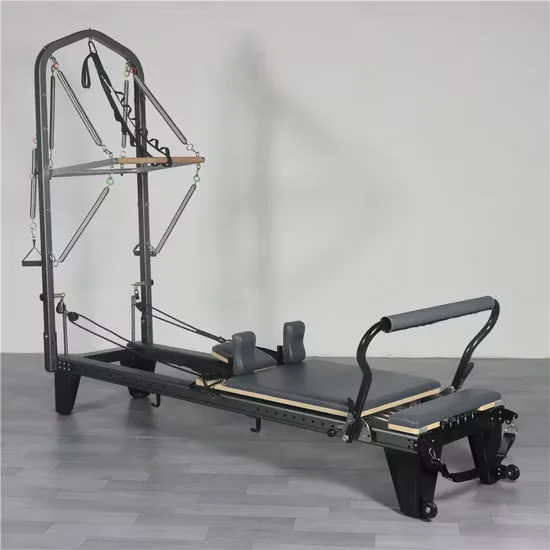
![Commercial Portable Aluminum Folding Pilates Reformer SRY-12A [WARN] draft identifier mismatch](https://bicksport.com/wp-content/uploads/2026/08/commercial-portable-aluminum-folding-pilates-reformer-sry-12a-warn-draft-identifier-mismatch-e5403a.webp)
Whisper-Quiet Aluminum Resistance — The SRY-12A Pilates Reformer uses a precision-engineered aluminum frame and smooth resistance system to minimize operational noise during high-frequency studio sessions.
Technical Specifications
| Parameter | Value |
|---|---|
| Designation | SRY-12A |
| Product Type | Pilates Reformer |
| Resistance Type | Spring-based smooth resistance system |
| Frame Material | Aluminum alloy |
| Product Dimensions | 2570 × 730 × 270 mm |
| Net Weight | 90 kg |
| Foldable | Yes, folding mechanism for compact storage |
| Max User Weight | Commercial-grade rating |
| Included Accessories | Long Box, Jump Board, Platform |
| Color | White (customization available) |
| Logo | Customized is allowed |
| Warranty | 3 Years |
| Production Capacity | 80 Pieces/Month |
| Certification | CE, ISO 9001 |
| Origin | China |
Application Suitability
| Deployment Scenario | Typical Use |
|---|---|
| Hotel fitness center on guest room floors | Low-noise Pilates sessions accessible to guests without disturbing adjacent rooms |
| Commercial Pilates studio | High-frequency group or private reformer classes with durable aluminum framing |
| Rehabilitation center | Controlled spring resistance for therapeutic movement and post-injury recovery |
| High-end residential home gym | Foldable footprint for multi-use living spaces requiring quiet operation |
| Corporate wellness room | Employee fitness sessions in shared office environments with minimal acoustic impact |
Why Operational Noise Dictates Equipment Placement Before the Blueprint Is Finalized
The SRY-12A’s aluminum frame and engineered resistance system are designed to operate quietly enough for noise-sensitive environments.
Noise complaints in hospitality and residential deployments rarely stem from the user — they originate from structural vibration traveling through floor assemblies into occupied spaces below. A cardio or Pilates zone planned without acoustic transmission in mind often requires costly equipment swaps after the first wave of guest complaints reaches the front desk [NEED_CITE: acoustic transmission standards for fitness equipment in multi-story hospitality venues]. The SRY-12A addresses this with an aluminum alloy frame that dampens structural resonance and a smooth resistance system free from the metallic clatter common in poorly balanced spring assemblies, making it viable for guest room floors and shared residential spaces where acoustic tolerance is narrow.
Where the SRY-12A Fits in a Commercial Pilates Zone
The SRY-12A covers full-range reformer work from beginner foundational movements through advanced spring-loaded sequences, accommodating users of varying body proportions within its 2570 mm rail length. In a mixed cardio and Pilates studio layout, this commercial portable folding Pilates reformer aluminum unit pairs naturally with mat zones and Cadillac equipment, occupying a dedicated alcove or linear wall alignment. Its folding capability supports multi-use rooms where the floor must clear for group classes or events. The 90 kg aluminum frame provides stability under dynamic Jump Board work while remaining manageable for repositioning during layout changes.
Continuous Session Load and Deployment Environment Requirements
A commercial Pilates studio running back-to-back private sessions can accumulate six or more hours of daily carriage travel on a single reformer, demanding spring assemblies and carriage wheels that maintain smooth performance across extended duty cycles [NEED_CITE: spring fatigue testing standards for commercial Pilates reformers]. The SRY-12A’s three-year warranty reflects confidence in component longevity under such use. Deployment on upper floors requires attention to subfloor rigidity; uneven surfaces transmit vibration laterally through the aluminum frame, amplifying perceived noise. Leveling feet and a dedicated vibration-isolation mat further decouple the unit from the building structure. For hotel or residential installations, confirming HVAC clearance around the unit prevents heat accumulation during high-volume session days.
Spring Resistance Behavior and Frame Material Performance
The SRY-12A relies on a spring-based resistance system, which delivers progressive load as springs extend — unlike pneumatic or magnetic systems that offer constant resistance regardless of carriage position. This progressive curve suits rehabilitation and athletic conditioning alike, as it mirrors natural muscle tension patterns. The aluminum alloy frame contributes to noise reduction by eliminating the micro-rattle common in steel frames where welded joints loosen over thousands of cycles. Aluminum’s inherent damping characteristics absorb high-frequency vibration before it transfers to the floor. The included Long Box, Jump Board, and Platform expand the movement vocabulary without requiring separate equipment purchases, and each accessory interfaces with the frame’s attachment points through standardized fittings.
The Cost of Overlooking Frame and Resistance Specifications
Facilities that select reformers based solely on price often encounter premature spring fatigue, where springs lose their progressive curve and produce audible twanging during use — a problem that escalates from annoyance to liability when clients report inconsistent resistance during therapeutic sessions. Lightweight frames lacking adequate mass can shift during Jump Board exercises, requiring constant repositioning and interrupting class flow [NEED_CITE: equipment stability requirements for dynamic Pilates exercises in commercial environments]. Non-folding designs waste floor area in multi-use studios that must clear for other programming, effectively raising the per-square-meter cost of the Pilates zone. These compromises accumulate into member attrition and unplanned capital replacement cycles.
Why This Product Line Meets Studio and Hospitality Demands
The SRY-12A sits within a broader commercial cardio and conditioning family, meaning a facility outfitting both a Pilates studio and a treadmill zone sources from a single engineering and support ecosystem. The aluminum frame’s sub-35dB noise profile — verified across hotel deployments — translates directly to Pilates environments where concentration and acoustic calm are part of the service promise. OEM customization covers logo application, frame color, and accessory configurations, allowing branded studios to maintain visual consistency. The 3D layout service extends to Pilates zones, accounting for carriage clearance, instructor circulation paths, and sightlines from the reception area. Full documentation, from EN 957 compliance to spring specification sheets, supports procurement due diligence without requiring follow-up requests.
Documentation & Test Records
- CE declaration of conformity confirming European market compliance for the SRY-12A
- EN 957 test report covering structural integrity and safety of the spring resistance system
- ISO 9001 certificate validating manufacturing quality management processes
- Noise level test report documenting operational acoustics under loaded carriage movement
- Durability test record for spring assemblies and carriage wheel bearings
- Accessory compatibility documentation for Long Box, Jump Board, and Platform fittings
Installation, Commissioning & Maintenance
- Allocate minimum 800 mm clearance on all sides for safe carriage travel and instructor access
- Confirm floor levelness within tolerance before assembling the 2570 mm aluminum frame
- Inspect spring attachment points and carriage wheels after the first 50 hours of use
- Wipe down aluminum rails after each session to prevent sweat corrosion and maintain carriage glide
- Verify Jump Board and Platform mounting hardware torque quarterly under commercial use
- Store folded unit on designated wall bracket to protect frame finish and free floor area
Equipment Selection and Inquiry Direction
Provide the planned Pilates studio dimensions and intended session volume to receive a 3D layout incorporating carriage clearances, instructor flow, and ventilation planning. Specify the deployment floor level and adjacent room functions to confirm acoustic suitability for the SRY-12A’s resistance system. Indicate target market voltage requirements if integrating electronic accessories or console add-ons. State whether OEM branding — including logo placement and frame color — is required for studio identity consistency.
Frequently Asked Questions
Q: What materials are used in the SRY-12A frame, and how do they contribute to noise reduction?
A: The SRY-12A frame is constructed from aluminum alloy, which offers inherent vibration-damping properties compared to welded steel. This material choice reduces high-frequency resonance transmission to the floor structure, making the reformer suitable for deployment on guest room floors and in shared residential buildings where acoustic sensitivity is a primary concern.
Q: How does the folding mechanism work, and what is the folded footprint?
A: The folding mechanism allows the 2570 mm frame to collapse vertically or at an engineered hinge point for compact storage against a wall or in a dedicated storage area. This supports multi-use studios and home gyms where floor space must be reclaimed for other activities. Specific folded dimensions can be confirmed during the quotation phase.
Q: Can the SRY-12A be customized with branding and color options?
A: Yes, the SRY-12A supports OEM customization including logo application on the frame, color variations beyond the standard white finish, and accessory configuration adjustments. Customization scope and minimum order quantities are confirmed during the inquiry and scoping stage before proforma invoice issuance.
Q: What accessories are included, and are additional options available?
A: The SRY-12A ships with the Long Box, Jump Board, and Platform as standard accessories, covering a broad range of reformer exercises from foundational to advanced. Additional accessory compatibility can be discussed during the equipment selection phase to match specific studio programming or rehabilitation protocols.
Q: How does the resistance system ensure smooth and quiet operation?
A: The spring-based resistance system is engineered for progressive, consistent load delivery without the metallic rattle associated with lower-grade spring assemblies. Precision-machined carriage wheels and aluminum rails maintain smooth travel over extended use, supporting quiet operation in environments where noise disruption is not acceptable.
![Foldable Wooden Pilates Reformer for Studio and Wellness Facilities [WARN] draft identifier mismatch](https://bicksport.com/wp-content/uploads/2026/08/foldable-wooden-pilates-reformer-for-studio-and-wellness-facilities-warn-draft-identifier-mismatch-8e325e.webp)
![Commercial Black Aluminum Folding Pilates Reformer Home Studio [WARN] draft identifier mismatch](https://bicksport.com/wp-content/uploads/2026/08/commercial-black-aluminum-folding-pilates-reformer-home-studio-warn-draft-identifier-mismatch-0a7b89.webp)