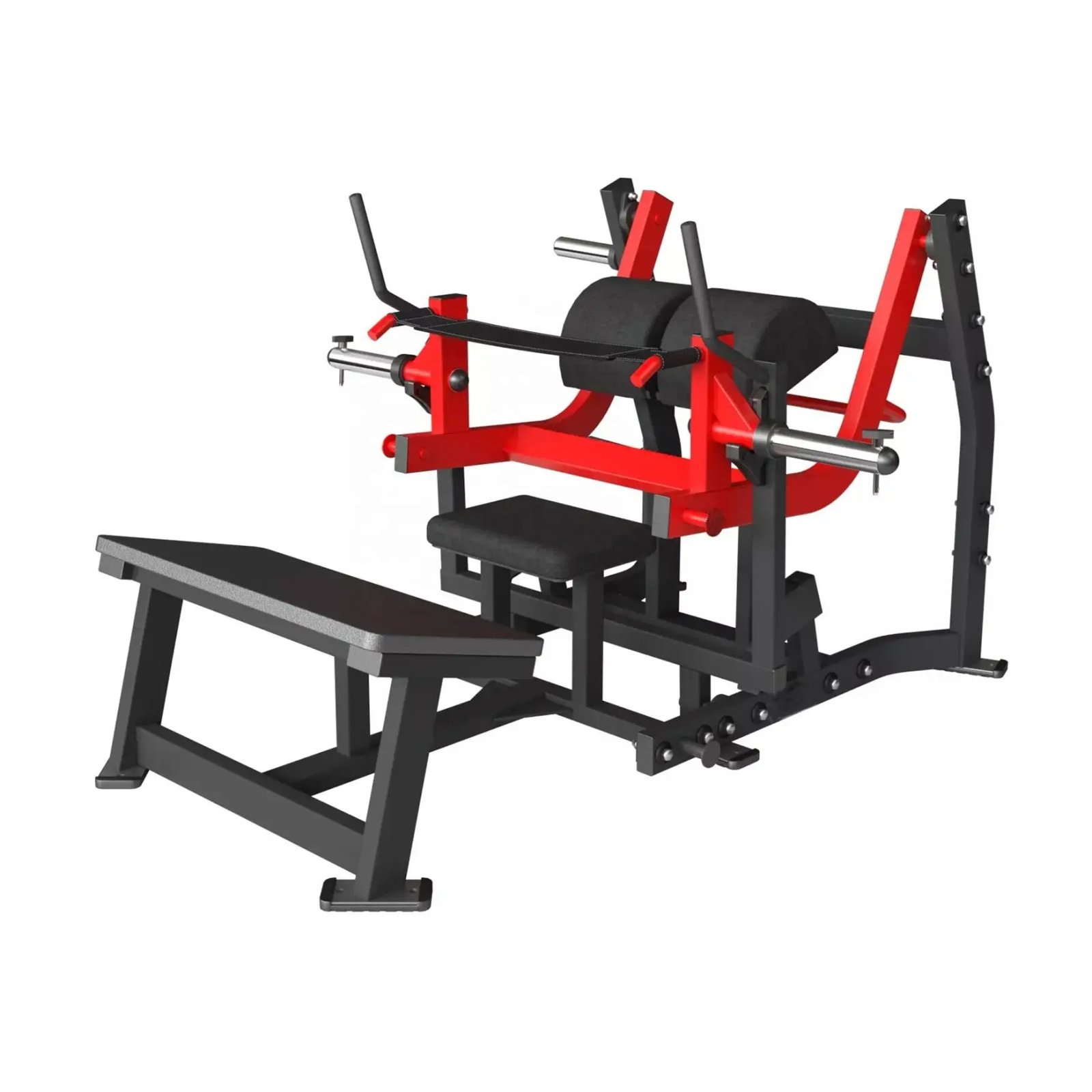
Reinforced Steel Rigidity — Manual plate-loaded resistance eliminates motor burnout risk, delivering 24/7 uptime in high-traffic commercial strength zones.
Technical Specifications
| Parameter | Value |
|---|---|
| Product Type | Strength Equipment — Hammer Strength Lateral Horizontal Bench Press |
| Exercise Part | Chest |
| Power Source | Manual (Plate-Loaded) |
| Resistance Type | Manual Plate-Loaded |
| Frame Material | Reinforced Steel |
| Foldable | Unfolded (Fixed Frame) |
| Product Dimensions | 1700 × 1400 × 1200 mm |
| Net Weight | 112 kg |
| Color | Optional |
| OEM/Customization | Available |
| Application | Fitness Center / Gymnasium |
| Certification | ISO 9001, CE |
Application Suitability
| Deployment Scenario | Typical Use |
|---|---|
| Hotel fitness center on guest room floors | Low-vibration chest training minimizing structural noise to rooms below |
| Chain gym cardio and strength zones | High-frequency plate-loaded deployment without motor duty-cycle limits |
| Corporate wellness room | Durable, maintenance-free strength anchor for mixed-use layouts |
| High-end residential home gym | Commercial-grade frame rigidity for heavy daily loading |
| Sports performance training center | Plate-loaded progressive overload for athletic chest development |
Why Metallic Clanking Reaches Adjacent Studios Before Maintenance Does
Sealed pivot bearings and reinforced steel tubing prevent structural resonance under heavy loading.
In mixed-use commercial floors, strength machines with thin-gauge frames and unsealed pivots generate metallic clanking that travels through shared flooring. Adjacent yoga studios, recovery zones, and hotel guest rooms below register every plate drop as structural vibration. We have seen facilities replace entire strength zones after noise complaints escalated to management before the maintenance team even logged the first ticket [NEED_CITE: structural noise transmission standards for mixed-use fitness floors]. The commercial plate-loaded lateral horizontal bench press avoids these failure points by relying on manual resistance and heavy-gauge welded steel, removing the motor and electronic components that typically introduce vibration harmonics.
Positioning Within the Strength Zone Layout
The Lateral Horizontal Bench Press targets the chest through a converging plate-loaded pressing path, fitting into the moderate-to-high intensity strength category. It complements isolation machines and cable systems in a commercial layout, serving as a primary compound movement anchor. Because it requires no electrical connection, operators can deploy it in high-density free-weight areas away from power drops. The fixed-frame footprint suits users of varying body sizes, and the manual plate-loaded resistance allows incremental loading without the electronic step-limitations found on selectorized machines. This commercial plate-loaded lateral horizontal bench press fits naturally alongside squat racks and plate-loaded leg presses.
Continuous Loading Cycles and Deployment Environment
This plate-loaded unit operates without motor duty-cycle constraints, meaning it can endure continuous back-to-back use throughout peak hours without thermal shutdown. Since there is no motor or electronic console, heat dissipation and dedicated cooling ventilation are not concerns for facility planners. Deployment requires a level floor with adequate overhead clearance for loading plates, and operators should consider placing vibration-dampening rubber mats beneath the frame to isolate transmitted force from adjacent flooring systems [NEED_CITE: flooring vibration isolation for commercial plate-loaded equipment]. No dedicated electrical circuit is needed, simplifying placement in retrofitted spaces where adding power drops is cost-prohibitive.
Manual Resistance Mechanics and Frame Engineering
Plate-loaded resistance delivers a direct mechanical connection between the user and the weight, bypassing the belt-and-pulley friction losses found in selectorized machines. The reinforced steel frame provides structural rigidity that minimizes flex during heavy pressing sets, maintaining consistent movement geometry. Sealed pivot bearings at the arm axis reduce metallic wear over thousands of loading cycles, preventing the grinding noise that develops in units with open bushings. The unfolded fixed-frame design eliminates folding joint wear points entirely, ensuring long-term stability without periodic bolt retightening. Color and pad upholstery remain available as customization options to match existing facility branding.
The Hidden Cost of Specifying Light-Duty Frames
Facilities that select light-duty strength machines for commercial floors often face premature weld fatigue and bearing failure under high-frequency public use. Thin-gauge tubing flexes under heavy loads, transmitting vibration through the floor and generating complaints from adjacent spaces. We have witnessed operators pull entire machine rows after members reported inconsistent resistance feel caused by worn pivot bushings [NEED_CITE: pivot bearing failure modes in commercial strength equipment]. Units lacking sealed bearings require frequent lubrication schedules that maintenance teams struggle to sustain, accelerating wear and generating metallic noise that degrades the facility experience.
Why This Product Line Fits the Deployment
Biketon’s engineering approach prioritizes verified structural data over marketing claims, and this plate-loaded press benefits from the same rigorous frame testing applied across the cardio range. The reinforced steel construction undergoes continuous loading validation consistent with 10,000-hour durability protocols. The Biketon team provides 3D strength-zone layout planning that accounts for this unit’s 1700 × 1400 mm footprint, ensuring proper spacing for plate loading and member circulation. OEM customization covers frame color, pad upholstery, and branding, allowing visual consistency across mixed cardio and strength zones. The Biketon technical support team remains available around the clock for installation and commissioning questions.
Documentation & Test Records
- CE declaration of conformity for EU market import compliance
- EN 957 test report validating structural integrity and safety requirements
- ISO 9001 certificate confirming quality management system standards
- Durability test record documenting continuous loading cycle performance
- Frame steel gauge and weld inspection report for structural verification
- Installation and commissioning guide with spare parts list
Installation, Commissioning & Maintenance
- Confirm 1700 × 1400 mm footprint with clearance for plate loading on both sides
- Place vibration-dampening rubber mats beneath the 112 kg steel frame to isolate floor resonance
- Verify floor levelness before anchoring to prevent frame twist under asymmetric loading
- Inspect sealed pivot bearings quarterly and check for play or grinding during articulation
- Wipe down steel frame and upholstery after each use to prevent sweat corrosion
- Confirm plate horn locking mechanisms and inspect welds for stress fractures annually
Equipment Selection and Deployment Inquiry
Provide your strength zone square footage and target unit count to receive a 3D layout plan that accounts for plate-loading clearance and member circulation paths. Specify the deployment floor and adjacent room types so we can confirm vibration isolation requirements for the steel frame. Indicate whether frame color and pad upholstery customization is needed to match your existing branding scheme.
Frequently Asked Questions
Q: How does plate-loaded resistance compare to selectorized machines for high-traffic commercial deployment?
A: Plate-loaded machines eliminate cable, pulley, and weight-stack wear points that require frequent maintenance in high-traffic environments. The direct mechanical connection delivers consistent resistance feel without friction degradation over time. Operators benefit from lower long-term service costs and simpler maintenance schedules since there are no internal selector mechanisms to repair or replace.
Q: How does manual resistance eliminate motor-related failure points in 24/7 facilities?
A: Manual plate-loaded machines contain no motor, electronics, or thermal sensors, removing the components most prone to failure under continuous commercial use. Without duty-cycle limitations, the unit can handle back-to-back users throughout peak hours without risk of overheating or electronic shutdown, making it ideal for high-volume strength zones.
Q: What frame and bearing specifications minimize noise transmission to adjacent spaces?
A: Reinforced steel tubing with adequate gauge thickness reduces frame flex under load, preventing structural resonance that travels through shared flooring. Sealed pivot bearings at articulation points eliminate metal-on-metal grinding that develops over time in units with open bushings. Pairing the frame with rubber vibration mats further isolates transmitted force from the building structure.
Q: Can frame color and upholstery be customized to match existing facility branding?
A: OEM customization covers frame color, pad upholstery material, and logo placement at flexible minimum order quantities. This allows facility operators to maintain visual consistency across mixed cardio and strength zones without compromising on the commercial-grade structural specifications required for high-frequency deployment.