
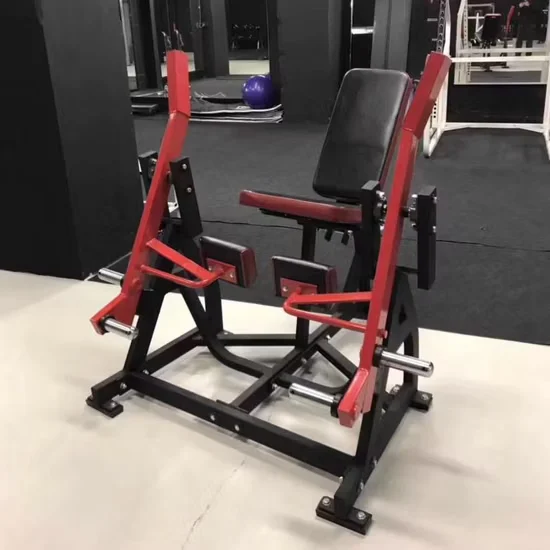
Continuous Duty Tested — Every commercial plate loaded hack squat unit undergoes 10,000-hour structural fatigue verification on reinforced steel frames before leaving the production line.
Technical Specifications
| Parameter | Value |
|---|---|
| Designation | SRH-27 |
| Product Type | Plate Loaded Hack Squat |
| Tube Size | 501003mm |
| Frame Material | Iron |
| Machine Weight | 200kgs |
| Product Dimensions | 23001300800mm |
| Color | Customized options available |
| Age Group | Adult |
| Gender | Unisex |
| Certification | RoHS, ISO 9001, CE |
Application Suitability
| Deployment Scenario | Typical Use |
|---|---|
| International gym chain strength zones | Heavy compound lower body training during peak membership hours |
| Corporate wellness fitness rooms | Progressive resistance leg work for employees across fitness levels |
| Community fitness center weight areas | High-frequency squat pattern loading with plate flexibility |
| Professional sports training centers | Athlete-grade lower body power development with controlled loading angles |
| High-end residential home gyms | Space-conscious strength training with adjustable plate resistance |
Why Frame Gauge Matters More Than Marketing Photos Suggest
A 501003mm tube section tells you what happens when a 180kg user pushes through a maximal set at 2 AM in an unsupervised gym.
Commercial facilities deploy plate loaded hack squat machines that endure unpredictable load cycles — members stack plates unevenly, drop carriages from height, and push near-maximal loads repeatedly throughout operating hours. Light-gauge tubing develops weld fatigue and frame flex within the first year of continuous public use, creating structural play that compromises exercise mechanics and generates noise complaints from adjacent spaces. The SRH-27 addresses this through reinforced steel construction with tube dimensions sized for the dynamic forces inherent to plate loaded leg training [NEED_CITE: structural load testing standards for commercial plate loaded equipment].
Positioning Within a Commercial Strength Training Floor
This commercial plate loaded hack squat machine covers controlled lower body compound movement through a fixed movement path, complementing free weight squat racks and leg press stations already on the floor. It occupies a position between beginner-friendly selectorized leg machines and advanced barbell squat platforms — members who need guided mechanics but prefer progressive plate resistance gravitate toward this design. The fixed carriage angle and back pad support accommodate users across a wide height range, and the plate loaded system allows incremental loading adjustments without the maintenance burden of cable and pulley assemblies found in pin-loaded alternatives.
Facility Throughput and Deployment Environment Requirements
Plate loaded equipment operates without motors or electronic components, which eliminates electrical load calculations and dedicated circuit requirements during facility planning. However, the 2300*1300mm footprint demands careful spacing consideration — sufficient clearance on all sides allows safe plate loading and unloading without interfering with adjacent equipment traffic flow. Ground leveling beneath the unit prevents frame twist under asymmetric plate loads, and rubber flooring beneath the carriage drop zone absorbs impact noise transmitted to floors below. Facilities on upper levels should assess structural loading capacity given the 200kg machine weight plus maximum stacked plate loads [NEED_CITE: floor load capacity requirements for commercial plate loaded strength equipment].
Frame and Bearing Specifications Decoded
The 501003mm rectangular tube specification indicates wall thickness and cross-sectional dimensions that directly affect torsional rigidity under off-center plate loads. Thinner gauge tubing deflects visibly when plates are stacked on one side only, creating uneven carriage travel and accelerated wear on guide rod bushings. The iron frame construction paired with reinforced weld points at stress concentration areas — particularly where the carriage meets the guide rod assembly and where the back pad mounts to the main frame — determines long-term structural integrity. Plate loaded sleeves must maintain precise diameter tolerance to accept standard Olympic plates without excessive play, and the carriage bearing system requires sealed construction to prevent gym dust and chalk contamination from increasing friction over time.
What Underspecified Frames Cost Facilities in Year Two
Strength machines built with residential-grade tubing specifications enter commercial environments every day, and the failure pattern follows a predictable timeline. Weld cracks appear first at high-stress junctions within six to twelve months of continuous member use, followed by carriage wobble as guide rod bushings wear unevenly from frame flex. Facilities then face a decision between welding repairs that compromise heat-treated steel properties or full equipment replacement — both options create member disruption and lost training revenue [NEED_CITE: commercial equipment failure modes under continuous high-frequency loading].
Why This Product Line Holds Up Where Others Fail
Every unit undergoes 10,000-hour durability testing that simulates continuous commercial loading cycles, catching weld and bearing weaknesses before they reach your facility. The SRH-27 belongs to a complete strength equipment family, so facilities can source multiple disciplines from one manufacturing partner with consistent frame aesthetics and color matching. Full OEM customization extends to frame color and branding, allowing gym chains to maintain visual identity across locations. The 23001300800mm footprint integrates into 3D strength zone layouts that account for plate loading clearance, member flow between stations, and ceiling height requirements for full carriage travel. Documentation includes EN 957 compliance verification specific to plate loaded equipment safety requirements, and 24/7 technical support covers bearing replacement procedures and maintenance scheduling.
Documentation & Test Records
- CE declaration of conformity covering plate loaded strength equipment safety requirements
- EN 957 test report verifying structural integrity and user safety compliance
- ISO 9001 certificate confirming manufacturing process control standards
- RoHS compliance documentation for material composition verification
- Frame durability test record from 10,000-hour continuous loading simulation
- Complete spare parts list with bearing and bushing replacement specifications
Installation, Commissioning & Maintenance
- Maintain 1000mm clearance on plate loading sides for safe plate handling and member passage
- Level floor surface beneath all four feet before securing frame anchors to prevent twist
- Inspect carriage guide rod bushings quarterly and replace when lateral play exceeds tolerance
- Lubricate guide rods with manufacturer-specified grease at six-month intervals
- Verify all structural bolts at weld junctions after first 500 hours of member use
- Clean plate loading sleeves monthly to remove chalk buildup and maintain plate fit
Equipment Selection and Deployment Planning
Provide your strength zone square footage and equipment list to receive a 3D layout addressing member flow, plate loading clearance, and sightline planning for trainer supervision. Specify expected daily member volume so we can confirm structural specifications match your usage patterns. Indicate deployment floor level so we can advise on structural loading requirements and noise transmission mitigation for occupied spaces below. Communicate any facility branding requirements early so color customization integrates with your existing equipment palette.
Frequently Asked Questions
Q: What advantages does plate loaded design offer over selectorized machines for commercial facilities?
A: Plate loaded machines eliminate cable, pulley, and weight stack maintenance entirely — there are no cables to snap, no selector pins to bend, and no weight stack alignment issues. Facilities with members who train at high intensities often prefer the progressive loading flexibility of adding individual plates beyond fixed weight stack limits. The simpler mechanical design also means fewer specialized replacement parts to stock.
Q: How does the 501003mm tube specification compare to lighter commercial frames?
A: The 3mm wall thickness provides substantially greater torsional rigidity than thinner gauge alternatives, which matters when plates are loaded asymmetrically or when members drop the carriage repeatedly. Thinner tubing develops visible flex under heavy loads, accelerating bushing wear and creating carriage travel inconsistencies. The rectangular 50*100mm cross section resists bending in both planes during squat pattern movements.
Q: What floor preparation does this equipment require before installation?
A: The surface must be level within tolerance specifications to prevent frame twist that causes uneven carriage wear over time. Rubber flooring beneath the carriage drop zone absorbs impact and reduces noise transmission to floors below. Upper-level installations require structural engineering assessment to confirm the floor can support combined machine weight and maximum loaded plate weight during use.
Q: How often do carriage bearings require maintenance under heavy commercial use?
A: Sealed bearings in plate loaded equipment resist contamination from gym dust and chalk, but quarterly inspection is recommended for high-traffic facilities. Signs that replacement is approaching include increased carriage friction, lateral play in the guide rod assembly, or audible grinding during movement. Keeping guide rods lubricated per the maintenance schedule extends bearing service intervals substantially.
Q: Can the frame color be matched to existing equipment from other manufacturers?
A: Full OEM color customization is available, allowing facilities to match existing branding palettes or create consistent visual identity across a new equipment order. Powder coat finishing provides durable coverage that withstands gym environment exposure to sweat, cleaning chemicals, and plate contact. Color samples can be reviewed before production to confirm exact shade matching requirements.

![Hammer Strength Squat Lunge Machine for Commercial Gym Use [WARN] draft identifier mismatch](https://bicksport.com/wp-content/uploads/2026/08/hammer-strength-squat-lunge-machine-for-commercial-gym-use-warn-draft-identifier-mismatch-8ca3cf.webp)