
![Commercial Pilates Core Bed White Aluminum Alloy Reformer for Studio [WARN] draft identifier mismatch](https://bicksport.com/wp-content/uploads/2026/08/commercial-pilates-core-bed-white-aluminum-alloy-reformer-for-studio-warn-draft-identifier-mismatch-c80ae9.webp)
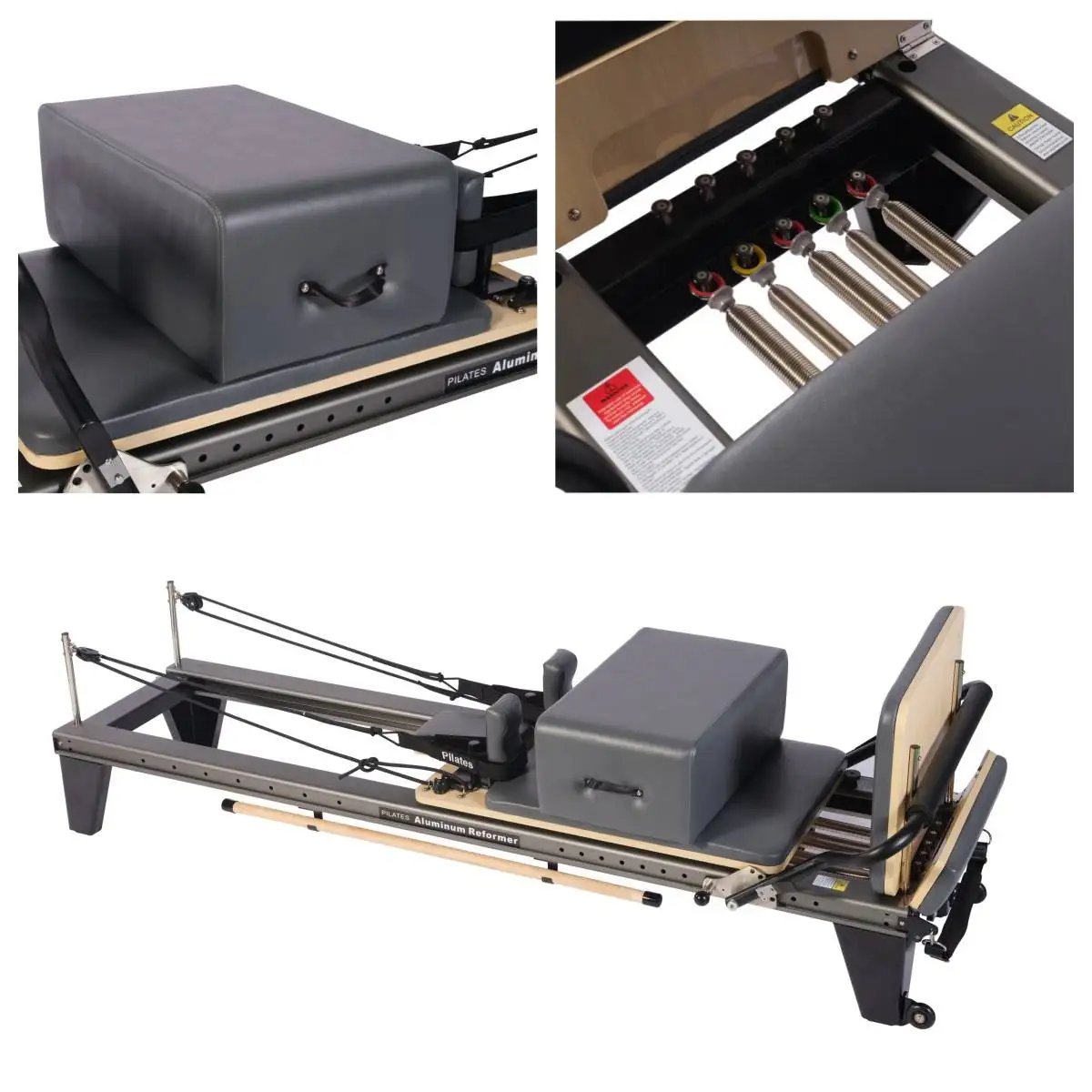
Whisper-Quiet Carriage Motion — Sealed wheel bearings and aluminum alloy rails deliver rattle-free reformer operation across back-to-back studio classes.
Technical Specifications
| Parameter | Value |
|---|---|
| Designation | SRY-12 |
| Product Type | Pilates Reformer |
| Frame Material | Aluminum Alloy |
| Color | White |
| Product Dimensions | 2570 x 730 x 270 mm |
| Net Weight | 90 kg |
| Accessories Included | Long Box, Jump Board, Platform |
| Logo Customization | Available on request |
| User Demographic | Adult, Unisex |
| Warranty | 3 Years |
| Production Capacity | 80 Pieces/Month |
Application Suitability
| Deployment Scenario | Typical Use |
|---|---|
| Boutique Pilates studio | Group reformer classes requiring uniform equipment appearance and smooth carriage travel |
| High-end residential home gym | Private sessions with accessory versatility for full-body programming |
| Corporate wellness center | Employee fitness rooms offering low-impact resistance training |
| Rehabilitation or physiotherapy clinic | Adjustable-resistance apparatus for post-injury movement recovery |
Why Studio Operators Trace Member Complaints to Frame Material and Assembly Tolerance
Aluminum alloy construction eliminates the creak and carriage play that drives member attrition in group reformer classes.
When a reformer carriage develops lateral wobble or spring anchors lose seating precision, the noise and feel degradation show up in class feedback long before maintenance logs catch the problem. In humid studio environments, steel frames can develop surface corrosion at rail contact points, accelerating wheel bearing wear and introducing the kind of rattle that disrupts concentration during controlled movement sequences. A commercial Pilates reformer white aluminum alloy studio deployment avoids this degradation path because the alloy resists oxidation and maintains rail straightness under repeated loading cycles [NEED_CITE: aluminum alloy fatigue performance under cyclic loading in fitness equipment].
Positioning Within the Studio Equipment Mix
This reformer covers the full spectrum of classical and contemporary Pilates programming, from footwork series through advanced jump board plyometrics. In a group class layout, the 2570 mm length and 730 mm width allow standard spacing between units while leaving adequate instructor walkway clearance. The 90 kg net weight provides enough mass to resist carriage shift during standing work and jump board landings without making floor-plan reconfiguration between class formats impractical. It pairs naturally with cadillac and chair apparatus for studios building a complete equipment ecosystem. The commercial Pilates reformer white aluminum alloy studio configuration suits facilities targeting adult practitioners across fitness levels, with accessory modularity handling beginner through advanced programming from a single unit.
Continuous Class Scheduling and Floor Transmission
Studios running four to six group classes daily place cumulative stress on carriage bearings and spring anchors that far exceeds home-use duty cycles. The aluminum alloy frame inherently dampens vibration transmission compared to welded steel, which matters when reformer rooms occupy upper floors above occupied spaces. Adequate ventilation around the equipment footprint prevents moisture accumulation that could compromise rail lubrication over time. Standard single-phase power is not a concern for this manually resisted apparatus, but studios should confirm floor levelness before installation because even minor unevenness introduces carriage drift during slow controlled movements [NEED_CITE: floor flatness tolerances for precision fitness equipment installation].
Rail Geometry and Bearing Selection Explained
The aluminum alloy extrusion profile determines rail straightness and surface finish, both of which govern carriage travel smoothness. Extruded alloy maintains tighter dimensional tolerance than formed steel channel, reducing the lateral play that causes rattling during rapid direction changes. Sealed wheel bearings prevent sweat and studio humidity from contaminating the rolling surfaces, extending service intervals in high-frequency class scheduling. The 90 kg frame mass provides inertial stability during jump board exercises where lighter reformers can shift on smooth flooring. Spring resistance progression depends on anchor geometry and coil specification rather than user-adjustable mechanisms, making initial factory calibration critical for consistent feel across multiple units in a group class setting.
The Hidden Cost of Specifying Below Commercial Duty
Reformers built for home use enter studio environments and develop carriage play within months because their wheel bearings and rail surfaces were never rated for continuous multi-user scheduling. Springs lose tension uniformity across units in a group class room, creating inconsistent resistance that instructors must constantly compensate for during choreography. Frame joints that tolerate occasional home use begin to creak under the cumulative loading of sequential classes, and the noise migrates through floor structures to adjacent treatment rooms or guest spaces. Studios that procure based on unit price rather than duty-cycle specification often face full-room replacement within two years [NEED_CITE: commercial versus residential equipment duty cycle classification standards].
Why This Product Line Fits Studio Procurement
The aluminum alloy frame and sealed bearing specification targets the specific failure modes that emerge in group class environments. Units are tested for continuous high-frequency carriage travel, validating bearing life and spring fatigue performance under studio scheduling loads. The accessory ecosystem ships with long box, jump board, and platform included, eliminating separate procurement cycles for progressive programming needs. Custom logo placement is available for studios building a branded equipment identity. The manufacturer provides 3D floor layout planning that accounts for reformer footprint, instructor circulation paths, and ventilation clearances specific to this 2570 x 730 mm platform. Technical support covers bearing replacement intervals and spring tension verification procedures for ongoing maintenance scheduling.
Documentation & Test Records
- CE declaration of conformity covering mechanical safety requirements
- EN 957 test report validating structural integrity under cyclic loading
- ISO 9001 certificate for manufacturing quality management systems
- Frame material certification confirming aluminum alloy grade and temper
- Bearing and spring fatigue test records for commercial duty-cycle validation
- Assembly and calibration guide with torque specifications for frame joints
Installation, Commissioning & Maintenance
- Confirm floor levelness within tolerance before positioning the 2570 x 730 mm frame to prevent carriage drift
- Allow minimum clearance at head and foot ends for jump board and long box accessory deployment
- Verify spring anchor seating and carriage wheel bearing smoothness during initial commissioning
- Establish spring tension verification schedule based on weekly class frequency to maintain uniform resistance
- Clean aluminum alloy rails with non-abrasive solution to preserve surface finish and bearing contact quality
- Inspect frame joint fasteners at quarterly intervals for torque retention under vibration loading
Equipment Selection and Deployment Inquiry
Provide studio floor dimensions and planned class capacity to receive a 3D layout addressing reformer spacing, instructor sightlines, and ventilation requirements. Specify average daily class count to confirm bearing and spring duty-cycle adequacy for your scheduling density. Indicate deployment floor level and adjacent room occupancy to evaluate whether acoustic underlayment is necessary beneath the reformer footprint. Confirm whether custom logo application is required and any target delivery timeline for studio opening schedules.
Frequently Asked Questions
Q: How does an aluminum alloy frame compare to steel for studio reformer deployment?
A: Aluminum alloy resists corrosion in humid studio environments and dampens vibration transmission to floors below, which matters in multi-story buildings. The lighter weight simplifies repositioning between class formats while the 90 kg net mass still provides adequate stability during jump board exercises. Extruded alloy maintains tighter rail straightness tolerance, reducing carriage play over time.
Q: What determines spring replacement intervals in a commercial class schedule?
A: Spring fatigue life depends on coil wire diameter, material grade, and the number of full extension cycles accumulated. Studios running multiple daily classes should verify tension uniformity across all units monthly, replacing springs when resistance feel diverges from baseline. Request the manufacturer’s fatigue cycle test data to build a preventive replacement schedule aligned with your class volume.
Q: Can third-party accessories fit this reformer carriage rail?
A: Accessory compatibility depends on carriage rail width, mounting hole spacing, and attachment mechanism geometry. The included long box, jump board, and platform are engineered for this specific rail profile. Third-party components may require adapter brackets or may not seat securely, introducing movement play during use that compromises exercise precision and safety.
Q: Does this reformer require acoustic underlayment in upper-floor studios?
A: The aluminum alloy frame dampens vibration transmission compared to steel, but floor construction and adjacent room sensitivity determine whether additional isolation is necessary. Studios above occupied guest rooms or treatment spaces should evaluate impact noise from jump board exercises specifically. Providing floor construction details during inquiry enables a targeted acoustic recommendation.

![Wood Foldable Pilates Reformer Bed for Home Use and Yoga Studio [WARN] draft identifier mismatch](https://bicksport.com/wp-content/uploads/2026/08/wood-foldable-pilates-reformer-bed-for-home-use-and-yoga-studio-warn-draft-identifier-mismatch-9d916e.webp)
