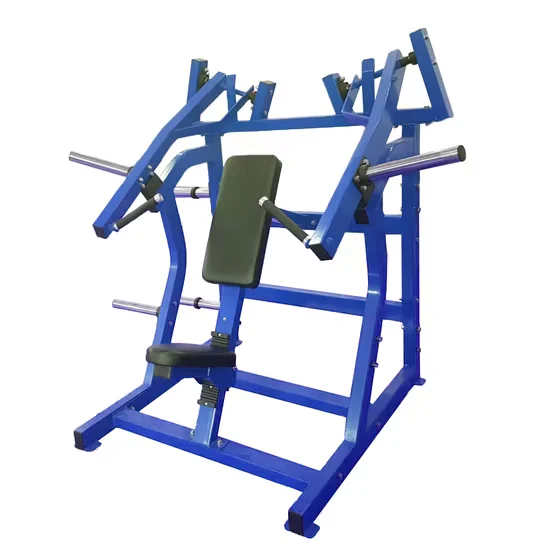
![Commercial ISO-Lateral Decline Press-MTS-8002 Gym Equipment [WARN] draft identifier mismatch](https://bicksport.com/wp-content/uploads/2026/08/mts-8007-iso-lateral-high-row-gym-machine-for-commercial-gyms-warn-draft-identifier-mismatch-d8af61.webp)
Dual Independent Stacks — ISO-lateral decline press with two 90 kg weight stacks delivering separate bilateral resistance paths for balanced chest development.
Technical Specifications
| Parameter | Value |
|---|---|
| Designation | ISO-Lateral Decline Press-MTS-8002 |
| Product Type | ISO-Lateral Strength Machine |
| Exercise Part | Chest |
| Resistance Type | Dual Weight Stacks |
| Weight Stack | 90 kg × 2 Stacks |
| Dimensions (L × W × H) | 99 cm × 163 cm × 168 cm |
| Machine Weight | 342 kg |
| Machine Grade | Commercial Use |
| Folded | Unfolded |
| Customization | Customized |
| Certification | CE, ISO, RoHS, SGS |
Application Suitability
| Deployment Scenario | Typical Use |
|---|---|
| hotel fitness center on guest room floors | Heavy-duty chest press available for 24-hour guest access without noise transfer through floor slabs |
| chain gym cardio zone | High-frequency bilateral chest training between cardio sessions for time-efficient member circuits |
| corporate wellness room | Accessible decline press accommodating varied fitness levels with incremental 90 kg dual stacks |
| high-end residential home gym | Space-consolidated ISO-lateral unit replacing two separate machines in private training spaces |
| sports performance training center | Independent-arm resistance for athletes requiring unilateral load correction and strength balancing |
Why Weight Stack Bindings Cost Gyms More Than They Realize
Guided rail friction and pulley misalignment silently destroy member retention long before the cable snaps.
Facility managers rarely notice the gradual increase in pull resistance until members start skipping the chest station entirely. A decline press that jerks mid-repetition or sticks at the transition point forces users into compensatory shoulder patterns, generating complaints that get misfiled as equipment discomfort rather than mechanical degradation [NEED_CITE: commercial strength equipment cable and pulley wear rates under continuous loading]. The commercial ISO-lateral decline press chest machine addresses this through sealed bearing pulleys and precision-machined guide rods that maintain consistent resistance delivery across thousands of daily cycles.
Bilateral Independence in a Decline Plane
This ISO-lateral strength machine positions the user in a fixed decline angle while allowing each arm to press independently along converging motion paths. The dual 90 kg stacks mean a member recovering from a shoulder imbalance can load asymmetrically without affecting the opposite side’s resistance curve. In a commercial gymnasium layout, it pairs with flat and incline ISO-lateral units to create a complete chest training zone that serves beginners through advanced lifters. The 342 kg machine weight anchors the frame during aggressive loading, and the 99 cm × 163 cm footprint fits standard commercial spacing grids. The commercial ISO-lateral decline press chest machine accommodates adult male users across a wide anthropometric range without requiring seat or pad adjustments between sets.
Continuous Throughput in High-Traffic Strength Zones
A chest station in a chain gym or hotel fitness center sees repeated loading cycles with minimal rest intervals between users. The dual weight stack design distributes wear across two independent cable and pulley systems rather than concentrating stress on a single path [NEED_CITE: weight stack pulley system maintenance intervals in commercial gym environments]. Heat buildup is negligible compared to motorized equipment, but ventilation clearance around the stack shrouds prevents dust accumulation that accelerates guide rod abrasion. The 342 kg frame mass eliminates the need for floor bolting on level concrete surfaces, though anti-vibration pads are recommended when deployed on suspended floors above occupied spaces. Ground leveling within tolerance ensures the guide rods remain plumb, preventing uneven wear patterns that shorten service intervals.
Inside the Guide Rod and Pulley Architecture
The ISO-lateral independent arm mechanism relies on sealed linear bearings traveling along hardened steel guide rods rather than open bushings that require frequent lubrication. Dual 90 kg stacks provide incremental loading suitable for rehabilitation protocols through advanced hypertrophy work without needing auxiliary plate additions. The converging press path mimics the natural arc of a decline barbell press while eliminating the stabilization demand that limits loading for less experienced users. Cable routing through multiple pulley points maintains a consistent resistance feel throughout the full range of motion, avoiding the dead spots that appear when single-pulley systems reach end-of-travel angles. The commercial ISO-lateral decline press chest machine uses a reinforced steel frame welded at primary stress junctions to handle repeated eccentric loading without deflection [NEED_CITE: EN 957 structural testing requirements for selectorized strength equipment].
The Hidden Cost of Cutting Corners on Selectorized Systems
Light-duty guide rods develop play within months of continuous commercial use, creating lateral wobble that members feel as grinding or sticking during the concentric phase. Cables rated below the stack’s maximum load fatigue at crimp points, eventually snapping mid-set and creating liability exposure the facility cannot afford. Weight plates manufactured without precision tolerances bind against guide channels when humidity fluctuates, turning a premium chest station into an out-of-order sign. Selector pins that fail to engage fully create partial-load scenarios where members believe they are training at one resistance while actually moving significantly less [NEED_CITE: selectorized weight stack engagement failure modes in commercial fitness facilities].
Why This Product Line Holds Up Under Daily Abuse
The MTS-8002 ships from a vertically integrated facility where frame welding, powder coating, and assembly happen under one roof, eliminating the fitment gaps that plague multi-vendor builds. Each commercial ISO-lateral decline press chest machine undergoes load-cycle testing on the guide rod and cable system before leaving the production floor. Customization extends to frame color, pad stitching, and brand logo placement so the unit integrates with existing facility visual systems. The ISO 9001 certified production line ensures batch consistency across orders, meaning a second unit purchased a year later matches the first in fitment and finish. Free 3D strength-zone layout planning accounts for the unit’s 99 cm × 163 cm footprint, user approach paths, and adjacent equipment clearance. Technical support responds around the clock when cable tensioning or pulley replacement guidance is needed.
Documentation & Test Records
- CE declaration of conformity covering structural and safety requirements
- EN 957 test report validating load ratings and entrapment clearances
- ISO 9001 certificate for manufacturing quality management
- RoHS compliance statement for material restrictions
- Durability test record documenting repeated cycle performance
- Installation guide with floor anchoring and leveling procedures
Installation, Commissioning & Maintenance
- Position the 99 cm × 163 cm frame with minimum clearance on all sides for user approach and plate access
- Level the 342 kg unit on flat concrete before loading stacks to prevent guide rod binding
- Inspect cable crimps and pulley bearings monthly under commercial use frequency
- Wipe guide rods and apply manufacturer-specified lubricant at defined service intervals
- Verify selector pin engagement across both 90 kg stacks after initial break-in period
- Check frame bolt torque at stress junctions after the first month of operation
Equipment Selection and Deployment Inquiry
Provide your strength zone dimensions and planned equipment list to receive a 3D layout accounting for the ISO-lateral decline press footprint, member flow, and adjacent station spacing. Specify whether the deployment floor is slab-on-grade or suspended to determine if vibration isolation pads are necessary. Indicate target market and any facility branding requirements so customization options for frame color and pad finish can be scoped. Confirm whether multiple units are needed simultaneously to align production scheduling and delivery consolidation.
Frequently Asked Questions
Q: How does ISO-lateral independent arm movement differ from fixed-path chest machines?
A: ISO-lateral arms move independently along converging paths, allowing each side to press without being mechanically linked to the other. This means a user with a strength imbalance between left and right sides can load asymmetrically and train without the stronger side compensating. Fixed-path machines force both arms through a single rigid linkage, which masks imbalances and can reinforce asymmetrical movement patterns over time.
Q: What maintenance intervals apply to the dual weight stack and cable system?
A: Cable tension and crimp integrity should be inspected monthly in high-traffic commercial environments. Guide rods require cleaning and re-lubrication at intervals determined by ambient dust levels and daily cycle counts. Pulley bearings are sealed and typically do not require service unless audible grinding develops. Weight stack plates should be checked for binding against guide channels, particularly in facilities with significant humidity fluctuation.
Q: How does bilateral independent loading affect training outcomes for commercial gym members?
A: Independent bilateral loading allows each arm to handle its own resistance without mechanical assistance from the opposite side. Members with unilateral weakness from prior injury or dominant-side overuse can correct imbalances progressively. This approach also provides trainers with clearer feedback on asymmetries during supervised sessions, enabling targeted programming adjustments that fixed-linkage machines cannot reveal.
Q: What floor and spatial requirements apply when placing this unit in a strength zone?
A: The 342 kg machine weight and 99 cm × 163 cm footprint require a level concrete surface capable of supporting concentrated static load. Adequate clearance on all sides is necessary for user approach, weight stack access, and safe egress. When deployed on suspended floors, vibration isolation pads prevent noise transmission to occupied spaces below. Layout planning should account for adjacent equipment sightlines and member traffic flow.

![Hammer Strength Hip and Glute Plate Machine for Commercial Gyms [WARN] draft identifier mismatch](https://bicksport.com/wp-content/uploads/2026/08/hammer-strength-hip-and-glute-plate-machine-for-commercial-gyms-warn-draft-identifier-mismatch-5cf4a4.webp)