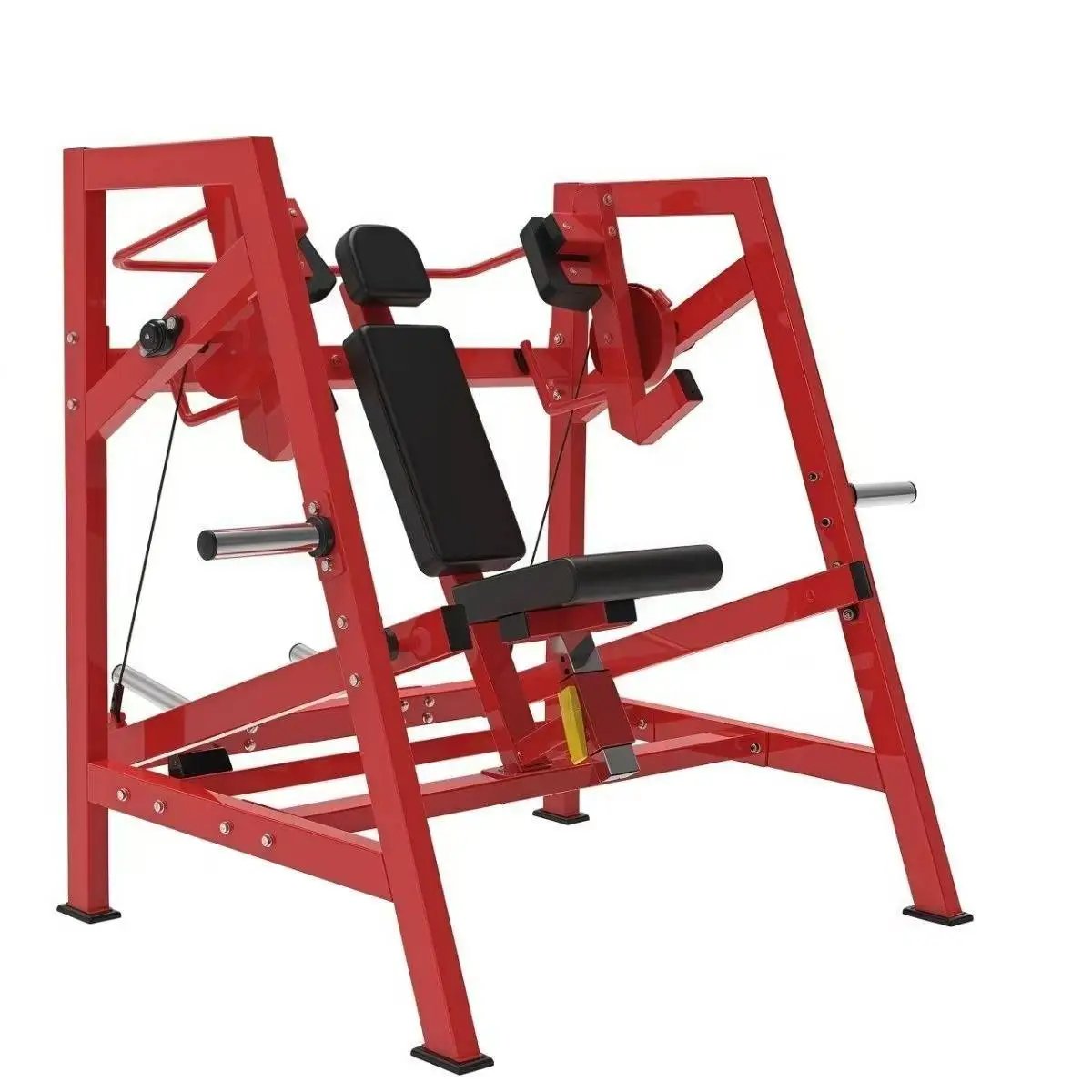
10,000-Hour Endurance — Reinforced steel frames and sealed bearings tested for continuous high-frequency operation in demanding commercial facilities.
Technical Specifications
| Parameter | Value |
|---|---|
| Designation | 2019 Hammer Strength ISO-Lateral Bench Press 01 |
| Product Type | ISO-Lateral Bench Press |
| Model NO. | OS — H5001 |
| Frame Material | Steel |
| Exercise Part | Chest |
| Main Frame Color | According Customers Requirements |
| Cushion Color | According Customers Requirements |
| Product Dimensions | 1323 x 1599 x 1746 mm |
| Net Weight | 140 kg |
| Age Group | Adult |
| Gender | Unisex |
| Fit Area | Professional Gym and Club |
| OEM/ODM | Acceptable |
| Certification | ISO 9001, CE |
Application Suitability
| Deployment Scenario | Typical Use |
|---|---|
| chain gym cardio zone | High-frequency chest training within a full strength circuit |
| hotel fitness center on guest room floors | Durable pressing station for 24-hour guest access |
| corporate wellness room | Low-maintenance upper-body station for employee workouts |
| high-end residential home gym | Biomechanically accurate chest press for dedicated training spaces |
| sports performance training center | Controlled resistance paths for athlete conditioning programs |
Why Frame Integrity Dictates Long-Term Deployment Viability
Reinforced steel construction prevents the micro-fractures that plague light-commercial equipment under continuous public use.
Facility operators often discover that machines rated for light-commercial duty cycles develop frame fatigue within months of 24/7 operation. Weld seams crack, pivot points loosen, and the entire unit requires decommissioning during peak member hours [NEED_CITE: EN 957 requirements for commercial cardio equipment]. The commercial ISO-lateral bench press chest station addresses this by utilizing structural steel gauges that withstand repeated loading cycles without deflection. When a hotel gym or chain facility specifies equipment, the frame must absorb forces generated by users across the full weight spectrum, session after session.
Positioning Within a Commercial Strength Training Layout
This ISO-lateral bench press occupies the dedicated chest-training station within a comprehensive strength circuit, complementing shoulder, back, and leg stations to deliver full-body coverage. The converging press path targets the pectoral musculature through a natural biomechanical arc, accommodating users who train at moderate to high intensity levels. Its footprint integrates into zones configured for plate-loaded or selectorized equipment clusters, positioned where ceiling height and adjacent machine clearance permit full range of motion. The unit serves the broadest adult user demographic across professional gym chains and institutional fitness environments, and the commercial ISO-lateral bench press chest configuration anchors the upper-body segment of any facility layout.
Continuous Uptime and Environmental Deployment Parameters
Facilities running strength equipment for sixteen or more hours daily require frames and pivot bearings rated for sustained loading without thermal degradation or lubrication breakdown. The 140 kg unit mass provides inherent stability, reducing migration on rubber-matted floors common in hotel fitness centers and chain gym cardio zones. Deployment on upper floors demands verification that structural load ratings accommodate concentrated point weights during peak usage periods [NEED_CITE: motor duty cycle classification for continuous commercial operation]. Adequate lateral clearance ensures users can load and unload safely without interfering with adjacent stations, while ambient ventilation prevents sweat accumulation from accelerating corrosion on exposed steel surfaces. Voltage considerations apply only where electronic counters or integrated lighting supplement the mechanical platform.
Decoding the Structural and Mechanical Specifications
The reinforced steel frame forms the load-bearing backbone, engineered to resist torsional stress during unilateral pressing movements where force distribution becomes asymmetrical. ISO-lateral design allows each arm to operate independently along a converging path, matching the natural adduction pattern of the pectoral muscles more accurately than fixed-bar machines. This independent movement prevents the dominant side from compensating during fatigue, delivering balanced stimulus across training sessions. Sealed pivot bearings at the fulcrum points reduce friction and eliminate the need for frequent lubrication schedules that strain maintenance teams in high-throughput facilities. Customizable frame and cushion colors allow branding alignment without altering the underlying structural specifications, maintaining performance consistency across multi-site deployments. The 1323 x 1599 x 1746 mm envelope defines the operational footprint, dictating spacing requirements that facility planners must honor during 3D layout phases.
The Hidden Costs of Underspecified Structural Components
Light-commercial frames deployed in 24/7 chain gyms frequently exhibit weld fatigue within the first year, generating emergency maintenance calls that pull technicians from preventive schedules. Noise from loosening pivot hardware transmits through floor structures, triggering guest complaints in hotel environments where fitness centers sit directly above occupied rooms [NEED_CITE: structural vibration transmission in multi-story commercial buildings]. Insufficient frame mass allows the unit to shift during heavy presses, creating safety concerns and member attrition. Procurement teams that prioritize initial cost over structural verification often face complete fleet replacement cycles far earlier than projected depreciation schedules anticipated. Data from field deployments consistently shows that structural failure cascades begin at connection points, not primary members, making bearing and fastener specifications equally critical.
Why This Product Line Addresses Procurement Blind Spots
The reinforced steel construction undergoes continuous load testing protocols that simulate years of high-frequency use within compressed timeframes. Sealed bearing assemblies at every pivot point eliminate lubrication intervals that disrupt maintenance schedules in 24/7 facilities. The full six-series cardio and strength family allows a single-source procurement strategy where every discipline ships from one production line with consistent lead times. OEM customization extends to frame finishes and cushion upholstery, enabling brand consistency across franchise rollouts without compromising structural integrity. Free 3D layout planning accounts for this unit’s specific footprint and user clearance requirements, preventing the congestion that leaves machines underutilized. Technical support availability around the clock ensures that commissioning questions or parts inquiries receive responses regardless of facility operating hours or time zone differences.
Documentation & Test Records
- CE declaration of conformity verifying European market safety compliance
- EN 957 test report covering structural integrity and user safety requirements
- ISO 9001 certificate demonstrating quality management system adherence
- Durability test record documenting continuous load cycle performance
- Material specification sheets detailing steel grades and bearing ratings
- Installation and commissioning guide with site preparation requirements
Installation, Commissioning & Maintenance
- Verify 1323 x 1599 mm footprint accommodates required lateral and overhead clearances
- Level the 140 kg frame on cured concrete using adjustable feet before anchoring
- Inspect all pivot bearings and fasteners after the initial break-in period
- Wipe down steel surfaces and cushion upholstery daily to prevent sweat corrosion
- Re-torque connection hardware quarterly per the maintenance schedule
Inquiry Guidance for Facility Equipment Selection
Provide your strength zone square footage and target user volume to receive a 3D layout incorporating this unit’s clearance envelope and member flow patterns. Specify daily operating hours so duty-cycle matching confirms the frame and bearing specifications suit your throughput requirements. Indicate deployment floor level and adjacent occupied spaces to verify that vibration transmission remains within acceptable thresholds. State your target market so customization options for frame and cushion colors align with regional branding standards. Confirm whether electronic usage counters or data interfaces are required for integration with your facility management platform.
Frequently Asked Questions
Q: What materials are used in the frame construction?
A: The frame utilizes reinforced steel sections engineered for continuous commercial loading. Structural members are sized to resist torsional stress during unilateral pressing movements, while sealed pivot bearings at connection points reduce friction and maintenance requirements. Material specification sheets detailing steel grades and load ratings are available upon request for procurement verification.
Q: Can the frame and cushion colors be customized?
A: Both frame finish and cushion upholstery colors are configurable to match facility branding requirements. This OEM capability allows franchise networks and hotel groups to maintain visual consistency across multiple deployments without altering the underlying structural or mechanical specifications that define performance.
Q: Is this machine suitable for 24/7 commercial gym use?
A: The unit is engineered for high-frequency commercial environments where equipment operates continuously. Reinforced steel construction, sealed bearings, and commercial-grade components undergo durability testing protocols that simulate years of sustained loading, ensuring reliability in chain gyms, hotel fitness centers, and institutional facilities.
Q: What is the warranty coverage for commercial deployments?
A: Warranty terms cover structural frame integrity and component performance under commercial use conditions. Specific coverage periods and exclusions are detailed in the purchase agreement, and spare parts availability is maintained to support field service throughout the equipment lifecycle.
Q: How does ISO-lateral movement benefit users compared to traditional machines?
A: ISO-lateral design allows each arm to move independently along a converging path, matching natural pectoral adduction patterns. This independent operation prevents dominant-side compensation during fatigue, delivering balanced muscular stimulus and reducing the injury risk associated with fixed-bar pressing movements.

![Commercial ISO-Lateral Front Lat Pulldown Machine for Gym Use [result]Commercial ISO-Lateral Front Lat Pulldown Machine for Gym Use[/result]](https://bicksport.com/wp-content/uploads/2026/08/commercial-iso-lateral-front-lat-pulldown-machine-for-gym-use-resultcommercial-iso-lateral-front-lat-pulldown-machine-for-gym-use-result-81571f.webp)