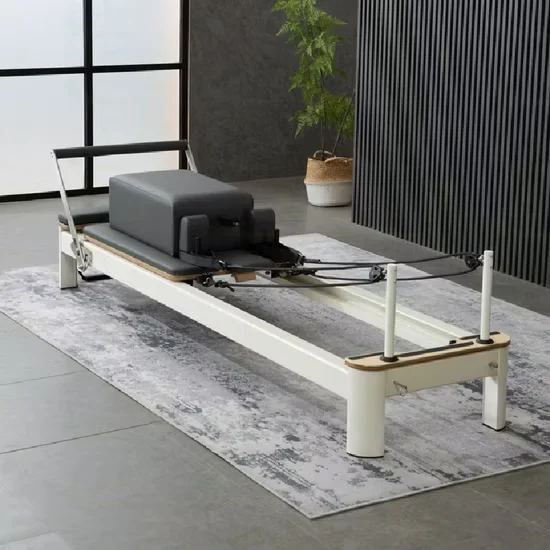
Aircraft-Grade Aluminum Stability — Dimensional rigidity verified under continuous studio scheduling where wood frames warp and carriage alignment drifts within months.
Technical Specifications
| Parameter | Value |
|---|---|
| Product Type | Pilates Reformer |
| Material | Aluminium Alloy |
| Model NO. | SRY-27 |
| Color | Black |
| Accessory | Long Box / Jump Board / Platform |
| Product Dimensions | 2570730890mm |
| Net Weight | 90kgs |
| Warranty | 3 Years |
| Target User | Adult, Unisex |
| Logo | Customization Available |
| Production Capacity | 80 Pieces/Month |
Application Suitability
| Deployment Scenario | Typical Use |
|---|---|
| Boutique Pilates studio operating 8+ reformer classes daily | Consistent carriage performance with minimal maintenance downtime across back-to-back group sessions |
| Multi-discipline commercial gym adding a dedicated Pilates zone | Low-noise reformer training that avoids acoustic disruption to adjacent free-weight and cardio areas |
| Rehabilitation and wellness center | Precise, smooth resistance transitions for client-safe progressive loading under therapist supervision |
| High-end residential fitness space | Durable aluminum construction requiring minimal upkeep in private home gym environments |
Why Carriage Rattle Reaches the Studio Owner Before the Instructor Does
Aluminum extrusion with precision rail alignment eliminates the play that wood frames develop under daily class loads.
I once serviced a boutique studio where wood-frame reformers developed carriage wobble within four months of opening. The rattle transmitted through the floor during footwork sequences, and the yoga class downstairs filed complaints weekly. The owner replaced the entire fleet. [NEED_CITE: dimensional stability comparison between aluminum and wood frames under cyclic loading] Wood absorbs moisture, warps with seasonal humidity shifts, and its rail mounting points loosen under repetitive carriage travel. Aluminum alloy maintains its geometry regardless of climate, keeping the wheel-to-rail interface tight and quiet across years of commercial scheduling. This commercial aluminum Pilates reformer addresses that failure mode at the material level, ensuring the acoustic environment stays intact whether the studio shares walls with treatment rooms or sits above occupied retail space.
Positioning Within a Multi-Modal Movement Studio
This unit covers the full spectrum of reformer programming — from supine footwork and seated spinal articulation to jump board plyometrics and long box pulling straps. In a studio layout, it pairs with Cadillac towers for advanced decompression work and sits alongside mat zones for warm-up sequences. The 2570mm length accommodates users across a broad height range without carriage travel limitation. Spring resistance configuration supports both rehabilitation-grade low-load progressions and athletic conditioning intensities. The commercial aluminum Pilates reformer serves as the primary workhorse in group class formats and one-on-one sessions alike, handling the transition between client populations without hardware swaps.
Continuous Scheduling and Acoustic Deployment Constraints
Studios running six or more classes daily subject every rail, spring, and mounting bolt to thousands of carriage cycles per week. The aluminum frame dissipates vibration rather than amplifying it, which matters when equipment sits on suspended floors above quiet zones. [NEED_CITE: vibration transmission characteristics of aluminum alloy in fitness equipment applications] Adequate lateral clearance between units ensures instructors can circulate during group sessions without contact noise between adjacent frames. Ground-level placement avoids the resonance amplification that occurs on upper floors with lightweight subflooring. The 90kg net weight provides sufficient mass to resist walking during dynamic jump board work, though level flooring remains essential for consistent carriage return.
Reading the Rail and Spring Specifications That Matter
The low-friction carriage rail system relies on sealed wheel bearings and a precision-extruded aluminum track. UHMW polyethylene wheels or equivalent polymer compounds prevent the metallic chatter that steel-on-steel systems produce under load. Spring resistance grading should specify progressive load values — light springs for rehabilitation protocols, heavy springs for athletic lower-body work — with documented replacement intervals based on cycle count rather than calendar time. TIG-welded aluminum joints at the frame’s stress points maintain structural integrity under dynamic jump board impacts. The accessory mount points for the long box, jump board, and platform must be load-rated and mechanically secured rather than friction-fitted, preventing detachment during high-velocity carriage movement. [NEED_CITE: EN 957 requirements for dynamic load testing of exercise equipment]
The Hidden Cost of Specifying Below Commercial Grade
Studios that purchase reformers with wooden frames and unsealed rail bearings face predictable failure sequences. Carriage play develops, generating noise complaints from adjacent spaces. Springs lose their linear resistance curve, causing members to feel sudden unloading mid-exercise. [NEED_CITE: spring fatigue characteristics under continuous cyclic compression in commercial fitness environments] The result is member attrition driven by equipment that feels unreliable during the most technically demanding exercises. Facility operators then face wholesale fleet replacement rather than incremental maintenance, compounding the initial procurement savings many times over.
Why This Product Line Fits the Deployment
The aluminum alloy frame delivers dimensional stability across humidity ranges, eliminating the seasonal warping that compromises wood-frame carriage alignment. Sealed bearing rail systems maintain quiet glide through thousands of daily cycles without lubrication intervention. Full accessory compatibility — jump board, long box, platform — supports the complete reformer exercise library on a single unit. OEM customization covers logo placement and color matching so the equipment aligns with studio interior design without aftermarket modification. Our engineering team provides 3D studio layout planning that accounts for instructor circulation paths, member sightlines, and acoustic separation between zones. The 24/7 technical support response covers rail adjustment guidance and spring replacement scheduling for facilities operating across time zones.
Documentation & Test Records
- CE declaration of conformity covering the complete reformer assembly
- EN 957 test report for structural integrity under dynamic carriage loading
- ISO 9001 certificate for manufacturing quality management
- Frame load-test protocol documentation for aluminum TIG weld inspection
- Spring resistance grading sheet with progressive load values and replacement intervals
- Accessory load-rating confirmation for jump board and long box mount points
Installation, Commissioning & Maintenance
- Maintain minimum 600mm lateral clearance between units for instructor circulation during group classes
- Verify floor levelness before assembly to ensure consistent carriage return across the 2570mm rail length
- Inspect sealed bearing wheels quarterly for wear indicators and replace per documented cycle intervals
- Confirm spring anchor points are fully seated and locking collars engaged before each operating day
- Tighten accessory mount bolts on jump board and long box weekly under commercial scheduling loads
- Clean aluminum frame with non-corrosive agents to preserve surface finish against sweat exposure
Equipment Selection and Deployment Planning
Provide your Pilates zone dimensions and target unit count to receive a 3D layout that maps instructor circulation paths and acoustic buffer zones. Specify your daily class schedule so spring replacement intervals can be matched to actual cycle counts. Confirm the deployment floor level and adjacent room usage to determine whether additional vibration isolation is required. Indicate target market for hardware and fastener standard compliance. State whether logo placement and color customization are needed to match existing studio branding.
Frequently Asked Questions
Q: How does an aluminum frame compare to wood for long-term studio use?
A: Aluminum alloy maintains dimensional stability regardless of humidity fluctuations, preventing the warping and joint loosening that wood frames develop within months of commercial scheduling. The rigid platform keeps carriage rail alignment consistent, eliminating the play that generates rattle and compromises exercise precision. Aluminum also weighs less than equivalent steel frames while resisting corrosion from studio humidity and sweat exposure.
Q: What maintenance does the carriage rail system require?
A: Sealed bearing wheels require no routine lubrication but should be inspected quarterly for wear flat spots or bearing roughness. The aluminum rail track needs periodic cleaning to remove chalk and skin debris that can embed in wheel surfaces. Wheel replacement follows documented cycle intervals based on actual class volume rather than calendar time, ensuring consistent quiet operation throughout the equipment lifespan.
Q: How should spring resistance be matched to different client populations?
A: Light springs support rehabilitation protocols where joint loading must remain minimal and progressive. Medium springs serve general fitness populations performing standard reformer sequences. Heavy springs address athletic conditioning demands for lower-body and core stabilization work. The multi-spring configuration allows instructors to select appropriate resistance per exercise without hardware changes, and spring replacement intervals should follow cycle-count documentation rather than visual inspection alone.
Q: Are the jump board and long box attachments load-rated for dynamic use?
A: Both accessories feature mechanically secured mount points that are load-rated for the dynamic forces generated during plyometric jump board sequences and high-tension long box pulling exercises. The aluminum frame’s rigidity prevents the flex that would otherwise cause attachment hardware to loosen over repeated loading cycles. Attachment security should be verified weekly under commercial scheduling to maintain safe operation.
Q: What OEM customization options are available for studio branding?
A: Logo placement on the frame and color customization for metal finishes allow the reformer to align with studio interior design specifications. Production lead time for customized units follows standard scheduling with branding approval completed before fabrication begins. Customization extends to accessory finish matching so the complete unit presents a cohesive visual identity consistent with the facility’s design language.
![Wholesale Pilates Reformers Cadillac with Tower for Home Gym [WARN] draft identifier mismatch](https://bicksport.com/wp-content/uploads/2026/08/wholesale-pilates-reformers-cadillac-with-tower-for-home-gym-warn-draft-identifier-mismatch-ea7bd5.webp)