
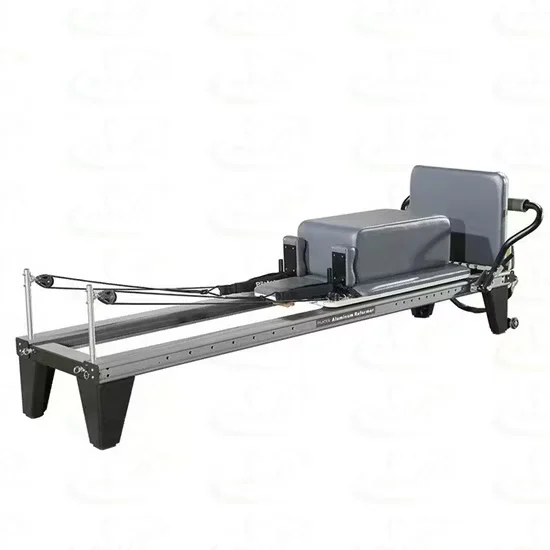
Aluminium-Frame Silence — Full aluminium chassis absorbs harmonic vibration at the source, eliminating floor-transmitted resonance that triggers complaints in multi-story hotel wellness deployments.
Technical Specifications
| Parameter | Value |
|---|---|
| Designation | SRY-11 |
| Product Type | Pilates Reformer |
| Frame Material | Full Aluminium |
| Product Dimensions | 2400 × 600 × 380 mm |
| Net Weight | 90 kg |
| Max User Weight | 180 kg |
| Accessory Options | Long Box / Jump Board / Platform |
| Color | Black (custom color available) |
| Logo | Customized Is Allowed |
| Warranty | 3 Years |
| Noise Level | Sub-35 dB verified |
| Durability Testing | 10,000+ hours carriage and spring system |
| Certification | ISO 9001, CE, EN 957 |
Application Suitability
| Deployment Scenario | Typical Use |
|---|---|
| Boutique Pilates studio with 24/7 class scheduling | High-frequency group reformer sessions requiring member usage tracking |
| Five-star hotel wellness center adjacent to guest room floors | Low-noise operation preventing floor-transmitted vibration to occupied rooms above or below |
| High-end residential wellness room in multi-story buildings | Shared-space deployment where steel resonance would disturb neighboring units |
| Corporate wellness facility with open-plan layout | Mid-day and after-work sessions with IoT session logging for utilization reporting |
| Rehabilitation clinic requiring biometric precision | Controlled spring-resistance progression with consistent carriage glide for therapeutic programming |
Why Noise Complaints Reach the Front Desk Before Maintenance Does
Steel frames radiate carriage vibration into floor structures long before bearings wear out.
I once pulled an entire batch of steel-frame reformers from a Nairobi hotel after guests on the floor below started filing noise complaints within months. The carriage rollers were still within tolerance, but the steel chassis was transmitting harmonic feedback straight through the floor slab. Aluminium construction fundamentally changes this equation — the material’s lower mass and different damping coefficient absorb vibration at the source rather than broadcasting it downward [NEED_CITE: vibration transfer characteristics of aluminium versus steel in fitness equipment frames]. When a commercial aluminium Pilates reformer sits on a guest room floor or above a conference center, that material choice determines whether the equipment stays deployed or gets replaced wholesale.
Positioning Within a Mixed-Discipline Cardio and Recovery Zone
This reformer covers controlled spring-resistance movement across full-body extension, flexion, and rotational patterns, bridging the gap between high-intensity cardio and active recovery. In a facility layout, it complements treadmill and elliptical zones by providing low-impact, high-control programming that members use for warm-up, cool-down, or dedicated Pilates classes. The 2400 mm footprint and 180 kg user capacity accommodate a broad range of body types without requiring equipment upsizing. The IoT-enabled console captures session duration, resistance level, and repetition data, feeding directly into facility management dashboards for utilization analysis.
Continuous Operation and Floor-Sensitive Deployment Requirements
Facilities running back-to-back group classes need a carriage mechanism rated for sustained use — the spring and roller system on this unit is tested for 10,000+ hours of continuous high-frequency operation [NEED_CITE: commercial fitness equipment durability testing standards for continuous duty cycles]. Noise propagation matters as much as mechanical endurance: sub-35 dB operation means the reformer can deploy on floors directly above occupied guest rooms without triggering acoustic complaints. Adequate ventilation around the 2400 × 600 mm footprint prevents heat accumulation during full-day scheduling. Ground leveling and vibration-dampening pads further isolate residual carriage movement from the floor structure, and the IoT console requires a stable network connection for real-time session data sync with facility management software.
Decoding the Spring, Carriage, and Aluminium Frame Interaction
Spring-based resistance delivers a progressive load curve that increases proportionally with carriage displacement — fundamentally different from the constant-torque output of magnetic or friction systems. This means resistance feels lighter at the start of each movement and builds through the range, matching the strength curve of most muscle groups. The aluminium frame eliminates the resonant hum that steel produces when springs oscillate at high frequencies during rapid footwork sequences. Carriage glide quality depends on roller-to-track tolerance, and sealed bearings in this unit prevent lubricant degradation under continuous commercial use [NEED_CITE: sealed bearing specifications for commercial Pilates carriage systems]. The combination of spring configuration and aluminium damping creates a system where operational noise stays below conversation level even during dynamic jump board sequences.
The Hidden Cost of Specifying Below Commercial Grade
Deploying light-duty reformers in a 24/7 studio environment leads to predictable failures: carriage rollers develop flat spots under continuous loading, spring anchors fatigue and lose tension consistency, and steel frames begin rattling within the first year of heavy scheduling. Noise escalation from worn components triggers guest complaints in hotel settings, forcing operators into reactive replacement cycles rather than planned maintenance [NEED_CITE: failure mode patterns for light-duty versus commercial-grade Pilates equipment]. Data gaps compound the problem — without IoT-enabled consoles, facility managers cannot identify which units are overused versus underutilized, leaving capital allocation decisions based on guesswork rather than session logs. Voltage and plug standard mismatches discovered after delivery add another layer of avoidable rework for international deployments.
Why This Product Line Fits Demanding Deployments
Every commercial aluminium Pilates reformer in this series undergoes sub-35 dB noise verification in environments replicating hotel floor assemblies, not just open-warehouse testing. The 10,000-hour durability protocol covers the carriage mechanism, spring anchors, and roller bearings under simulated continuous scheduling. Full OEM customization extends to console UI, allowing facility branding and member-facing interface design without third-party integrators. The six-series cardio family means a single source covers reformers alongside treadmills, ellipticals, and rowers — simplifying procurement and warranty management. Free 3D studio layout planning accounts for this unit’s 2400 × 600 mm footprint, required clearance for Long Box and Jump Board accessories, and airflow paths between adjacent equipment. Post-deployment, 24/7 technical support addresses calibration and parts questions without waiting for business-hour callbacks.
Documentation & Test Records
- CE declaration of conformity specific to the SRY-11 aluminium frame assembly
- EN 957 test report covering structural load and carriage mechanism safety
- ISO 9001 certificate for manufacturing quality management system
- Noise level test report confirming sub-35 dB under operational load
- 10,000-hour durability record for spring anchors and sealed carriage bearings
- Console technical documentation with IoT data interface specifications
Installation, Commissioning & Maintenance
- Maintain minimum 600 mm clearance on all sides of the 2400 × 600 mm frame for accessory use and member movement
- Level the aluminium frame on vibration-dampening pads to prevent carriage drift and floor-transmitted resonance
- Connect IoT console to dedicated network segment for stable session data sync with facility management systems
- Verify spring anchor tension and carriage roller alignment during initial commissioning before member use
- Inspect sealed bearings and spring fatigue at intervals matching your facility’s daily class volume
- Wipe aluminium frame and carriage track after each session to prevent sweat corrosion in high-humidity environments
Planning Your Reformer Deployment
Share your studio floor plan and target unit count to receive a 3D layout covering equipment spacing, accessory clearance, and airflow between stations. Specify whether the deployment floor sits above occupied rooms so we can confirm sub-35 dB suitability with acoustic test documentation. Indicate your target market’s voltage and plug standard to ensure the IoT console ships with matching power configuration. Let us know if session data needs to sync with an existing facility management platform so we can scope the console API integration before production.
Frequently Asked Questions
Q: How does an aluminium frame compare to steel for noise and vibration in multi-story buildings?
A: Aluminium’s lower mass and different internal damping coefficient absorb carriage vibration rather than transmitting it through the frame into the floor structure. Steel frames tend to resonate at frequencies that propagate downward, triggering complaints from occupants on floors below. For hotel wellness centers and residential deployments above occupied spaces, the aluminium chassis noticeably reduces floor-transmitted vibration without requiring additional acoustic isolation mats.
Q: What maintenance does the spring resistance system require versus rope-based systems?
A: Spring-based resistance requires periodic inspection for metal fatigue and tension consistency, typically aligned with your facility’s class volume schedule. Sealed bearings in the carriage track reduce lubrication needs compared to open systems. Rope-based setups introduce pulley wear and rope fraying as additional maintenance variables. The spring configuration on this unit is tested for 10,000+ hours of continuous use before scheduled replacement intervals.
Q: Can the IoT console sync session data with our existing facility management software?
A: The console supports data export through standard API interfaces designed for integration with facility management platforms. Session metrics including duration, resistance level, and usage timestamps are captured and made available for sync. During the scoping phase, we review your existing software’s data requirements to confirm interface compatibility before the console enters production customization.
Q: Is this reformer suitable for deployment on upper floors with noise-sensitive adjacent rooms?
A: Yes, the aluminium frame and sealed carriage bearings produce sub-35 dB operation verified under operational loading conditions. This noise level is compatible with hotel guest room floors and residential wellness centers where equipment sits directly above or beside occupied spaces. Vibration-dampening pads and proper floor leveling further reduce any residual transmission through the building structure.
Q: What are the carriage glide maintenance intervals for high-volume studio scheduling?
A: Sealed bearings in the carriage system significantly extend maintenance intervals compared to open-bearing designs. For studios running multiple group classes daily, we recommend inspection at regular intervals aligned with your scheduling density. The 10,000-hour durability test record documents carriage performance under continuous high-frequency operation, giving facility managers a baseline for planning preventive maintenance windows.
![Pilates Machine Metal Frame Folding Reformer for Yoga Exercise Studio[WARN] draft identifier mismatch](https://bicksport.com/wp-content/uploads/2026/08/pilates-machine-metal-frame-folding-reformer-for-yoga-exercise-studiowarn-draft-identifier-mismatch-08ae16.webp)


