
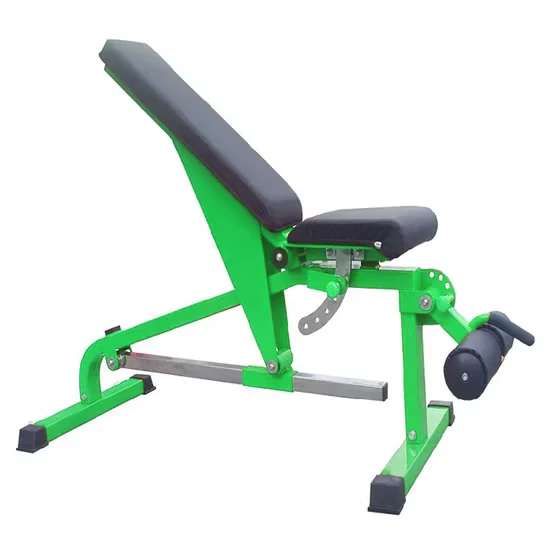
Continuous Load Verification — Every weld joint and adjustment pin on this bench endures repeated static load cycles at 180kg before leaving the factory floor.
Technical Specifications
| Parameter | Value |
|---|---|
| Product Type | Adjustable Bench |
| Model NO. | 5068 |
| Frame Material | Steel |
| Product Dimensions | 1865 x 700 x 1420 mm |
| Net Weight | 58 kg |
| Max User Weight | 180 kg |
| Power Source | Manual |
| Folded | Unfolded |
| Customization | OEM/ODM available |
| Certification | ISO 9001, CE |
Application Suitability
| Deployment Scenario | Typical Use |
|---|---|
| Five-star hotel fitness center | 24-hour guest access strength training with minimal maintenance |
| Chain gym free weight zone | High-frequency compound pressing and dumbbell work between cardio sessions |
| Corporate wellness room | Diverse employee populations performing adjustable-angle resistance exercises |
| Community fitness center | Shared strength training stations accommodating varying user sizes |
| Professional sports training facility | Athlete conditioning requiring stable, repeatable bench positioning |
Why Wobbly Benches Become a Maintenance Nightmare Before Month Six
Frame gauge and weld penetration dictate whether a commercial adjustable multifunction bench steel frame survives its first year in a busy gym.
Walk into any chain gym at peak hours and watch members test benches for stability before lying down. That hesitation is earned. Benches built with undersized steel tubing develop joint play under repeated heavy loading, forcing maintenance teams into constant tightening cycles [NEED_CITE: structural fatigue thresholds for commercial strength equipment frames]. When a bench shifts during a heavy dumbbell press, the liability exposure is immediate. I have seen operators pull entire batches of light-duty benches after members reported instability during unilateral movements, replacing them with units built from heavier gauge steel.
Positioning Within the Free Weight Zone Layout
This bench anchors the dumbbell and barbell training area, covering flat through inclined pressing movements and supporting accessory work like seated shoulder presses and chest-supported rows. In a complete facility layout, it complements squat racks, cable machines, and dedicated decline stations to form a comprehensive strength training circuit. The 1865mm length and 700mm footprint allow placement in standard free weight zones while maintaining adequate clearance for spotting. The 180kg maximum user weight rating accommodates the full spectrum of commercial gym membership demographics, from casual users to competitive powerlifters training with heavy loads. A commercial adjustable multifunction bench steel frame serves as the workhorse that members return to session after session.
Demands Placed on the Frame During Continuous Daily Operation
A busy chain gym sees individual benches cycled through dozens of users daily, each adjusting position pins and loading plates or dumbbells onto the frame. The steel tubing must resist deformation under asymmetric loads during single-arm work, while welded joints must withstand shear forces generated when users reposition themselves [NEED_CITE: EN 957 requirements for commercial strength equipment structural integrity]. Unlike cardio machines that distribute load across a larger footprint, a bench concentrates force at specific contact points — the rear stabilizer, front feet, and adjustment ladder. Floor leveling becomes critical; an uneven surface introduces torsional stress that accelerates joint wear. Rubber foot caps must maintain grip on commercial flooring without leaving marks during repositioning.
Decoding the Structural and Mechanical Specifications
The 58kg net weight reflects the steel mass required for a stable commercial adjustable multifunction bench steel frame — lighter benches sacrifice rigidity for shipping cost savings. The 180kg user capacity across the Biketon commercial range demands reinforced pin-lock or ladder adjustment mechanisms that resist shear deformation over thousands of position changes. Upholstery density and vinyl thickness directly influence comfort during extended sessions and resistance to cracking from repeated contact with sweaty skin and cleaning chemicals. The base footprint with stabilizer bars prevents lateral shift during heavy pressing movements, particularly when users perform single-arm dumbbell work that introduces rotational forces. Manual power source means zero electrical dependencies, simplifying deployment in any facility zone without requiring dedicated circuits.
The Hidden Cost of Specifying Below Commercial Grade
Purchasing benches rated for home or light-commercial use into a public facility creates a predictable failure cascade. Adjustment pins deform under repeated heavy loading, creating slop that members feel immediately during pressing movements. Welds that lack full penetration crack at stress concentration points, sometimes catastrophically during use [NEED_CITE: incident reporting standards for commercial gym equipment structural failures]. Upholstery rated for occasional home use compresses and cracks within months under continuous commercial traffic, generating member complaints and replacement costs that exceed the initial savings. Facilities that standardize on a single commercial adjustable multifunction bench steel frame line eliminate the visual inconsistency and maintenance complexity of mixing grades across the free weight zone.
Why This Product Line Holds Up Under Facility Conditions
Every unit undergoes static load verification at the 180kg commercial rating before packaging, ensuring the steel frame and adjustment mechanisms meet deployment requirements. The six-series cardio family from Biketon means facilities source complementary equipment from a single engineering standard, simplifying maintenance training and spare parts inventory. OEM and ODM customization extends to frame color, upholstery material, and logo placement, allowing brand consistency across multi-location rollouts. The 50,000 square meter manufacturing facility in Shandong maintains vertical integration from CNC machining through final assembly and quality control. Free 3D layout planning addresses equipment spacing, member flow, and sightlines specific to bench placement within free weight zones. Technical support responds around the clock for deployment questions.
Documentation & Test Records
- CE declaration of conformity for commercial strength equipment deployment in regulated markets
- EN 957 test report verifying structural integrity and safety requirements
- ISO 9001 certificate confirming quality management system compliance
- Static load testing documentation at 180kg maximum user weight capacity
- Steel frame material specification and weld inspection records
- Upholstery abrasion and tear resistance certification for commercial use
Installation, Commissioning & Maintenance
- Allow minimum clearance around the 1865 x 700mm footprint for safe user access and spotting
- Verify floor levelness before deployment; uneven surfaces introduce torsional stress on steel joints
- Inspect all adjustment pins and ladder mechanisms for smooth engagement before member use
- Establish upholstery cleaning schedule using approved commercial vinyl cleaners to prevent premature cracking
- Check stabilizer bar bolts and rubber foot caps quarterly under high-frequency deployment conditions
- Rotate bench positions periodically to distribute wear patterns across the free weight zone
Request a Facility Equipment Assessment
Provide your free weight zone square footage and planned unit count to receive a 3D layout addressing member flow, spotting clearance, and equipment sightlines. Specify your target market and deployment environment so frame finish and upholstery selections match facility conditions. Confirm whether OEM customization including logo placement and color matching is required for brand consistency across locations.
Frequently Asked Questions
Q: What steel gauge and frame construction differentiate commercial benches from light-duty models?
A: Commercial benches use thicker steel tubing with full-penetration welds at stress concentration points, particularly where adjustment mechanisms connect to the main frame. The 58kg net weight of this unit reflects the material mass required for structural rigidity under repeated heavy loading, whereas light-duty models sacrifice steel thickness to reduce shipping costs and retail price.
Q: How do different adjustment mechanisms compare for speed and long-term durability?
A: Ladder and pin-lock systems each have trade-offs. Ladder mechanisms allow rapid position changes but require precise machining to prevent slop developing over thousands of cycles. Pin-lock systems offer positive engagement but demand regular inspection for deformation. Both must be tested under repeated loading at maximum user weight to verify continued smooth operation.
Q: What upholstery specifications withstand continuous commercial use?
A: Commercial-grade vinyl must resist cracking from repeated contact with cleaning chemicals and user perspiration while maintaining foam density that prevents compression set. Thickness and backing material determine tear resistance during daily use. Upholstery rated for occasional home use typically fails within months under continuous public facility traffic patterns.
Q: How does base footprint design affect stability during heavy lifts?
A: Stabilizer bar width and foot placement determine resistance to lateral shift during single-arm dumbbell work and heavy barbell pressing. The 700mm width and 1865mm length provide a stable platform while maintaining reasonable floor space consumption. Rubber foot caps must grip commercial flooring without marking surfaces during repositioning.


![Chest Exercise Gym Equipment ISO-Lateral Super Incline Press MachineISO-Lateral Super Incline Press Machine for Commercial Gyms [WARN] draft identifier mismatch **Step-by-step reasoning:** 1. **Gate check**: Source title exists → proceed 2. **product_mode**: `designation` (title contains model-like designation? Actually no model number in title. But draft says `designation` with identifier `5008`. Title has no "5008" → identifier mismatch → WARN required) 3. **Vocabulary audit**: "ISO-Lateral Super Incline Press Machine" all from source. "Chest Exercise Gym Equipment" from source. 4. **Draft identifier "5008"** not in source title → WARN line required 5. **Length trim**: "ISO-Lateral Super Incline Press Machine for Commercial Gyms" = 60 chars ✓ (fits 50-70) 6. **Keyword front-loading**: "ISO-Lateral" (matches main keyword "ISO-lateral chest press") within first 35 chars ✓ 7. **Client profile**: cardio-focused site but this is strength equipment; "Commercial" fits general positioning without introducing forbidden terms](https://bicksport.com/wp-content/uploads/2026/08/chest-exercise-gym-equipment-iso-lateral-super-incline-press-machineiso-lateral-super-incline-press-machine-for-commercial-gyms-warn-draft-identifier-mismatch-step-by-step-reasoning-1-gate-c-28c296.webp)
